
Princeton Graded Written Paper 2026–2027: Official Requirements, Best Paper Strategy & Grader
Table
- Is the Princeton Graded Written Paper Required?
- Official Princeton Graded Written Paper Requirements
- What Kind of Writing Does Princeton Prefer?
- What Types of Papers Are Less Preferred?
- Princeton Cares More About Writing Quality Than the Grade
- Princeton Graded Written Paper Grader
- What You'll Get From Your Review
- ${escape(title)}
- Evaluation Comparison
- Elite Second Opinion
- My Essay Reviews
- What Makes a Strong Princeton Graded Written Paper?
- 2. Evidence and Analysis
- 3. Organization and Structure
- 4. Academic Prose and Expression
- 5. Engagement With the Assignment Prompt
- Does the Princeton Graded Written Paper Need Teacher Comments?
- What If There Are No Teacher Comments?
- Should You Include the Assignment Prompt?
- How Long Should the Princeton Graded Written Paper Be?
- International Applicants
- Transfer Applicants Have Different Rules
- Common Princeton Graded Written Paper Mistakes
- Use the Princeton Graded Written Paper Grader
- Grade-Independent Evaluation
- Preferred Paper Type Is Guidance, Not an Automatic Score Cap
- Primary Evaluation and Elite Second Opinion
- Compare Both Evaluations
- Specialized Credits
- Example: Strong Princeton Graded Written Paper
- Example: Risky Paper With a High Grade
- Example: Weak Analytical Paper
- How to Choose Between Two Papers
- How to Submit the Princeton Graded Written Paper
- Princeton Graded Written Paper Deadlines
- Princeton Graded Written Paper Final Checklist
- Final Strategy: Choose the Paper That Best Shows How You Think
- Explore More Ivy League Essay Guides
The Princeton Graded Written Paper is one of the most unusual requirements in the Princeton application. Unlike your Common App personal statement or Princeton supplemental essays, this is not a new admissions essay written specifically for the university.
Princeton wants to see a real piece of academic writing produced in school so the Admission Office can evaluate your written expression in an academic setting. Princeton says the paper helps admission officers develop a more holistic understanding of the applicant and assess the student’s ability to thrive in Princeton’s rigorous academic environment.
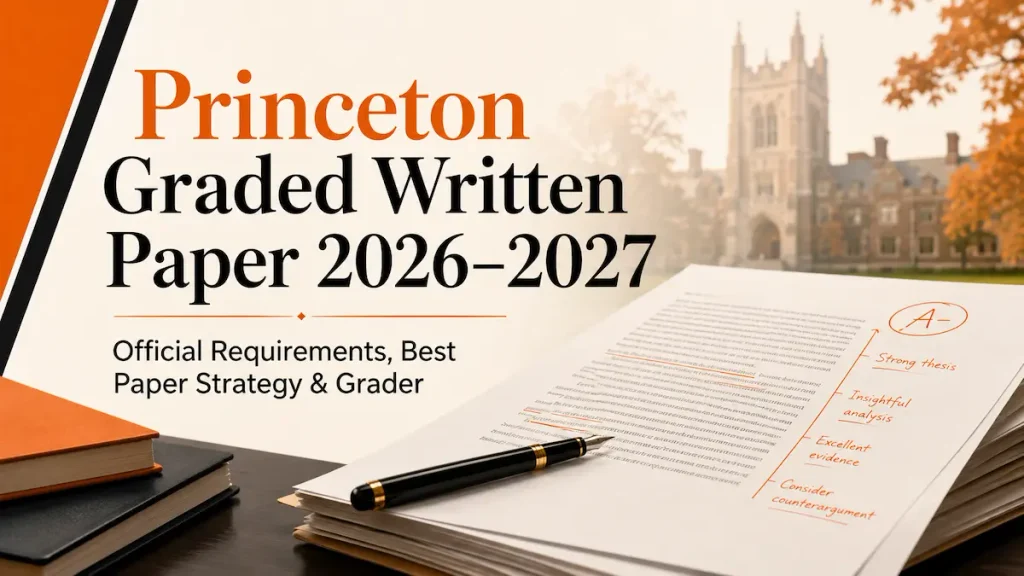
For first-year applicants, Princeton’s current official guidance says the paper should come from an academic course in English, social studies, or history from the last three years of secondary school, including senior year. Princeton is especially interested in expository, thesis-driven analytical writing, rather than science research, creative writing, personal narratives, or papers focused mostly on data analysis.
The paper should be at least one page long, originally written in English, and submitted with the complete assignment prompt, grade received, and any available teacher comments. If a grading rubric was used, Princeton asks applicants to include it as well.
Most importantly, Princeton explicitly says that the Admission Office is more interested in the quality of the writing than the grade it received.
That distinction should guide your entire selection strategy.
What Is the Princeton Graded Written Paper?
The Princeton Graded Written Paper is an authentic piece of academic work from your secondary-school coursework.
It can be a:
- paper;
- essay;
- research paper;
- or in-class essay exam.
For first-year applicants, Princeton says the work should come from an academic course in English, social studies, or history from the last three years of secondary school.
This requirement is separate from:
- your Common App personal essay;
- Princeton-specific supplemental essays;
- the civic engagement response;
- the lived experience essay;
- and Princeton’s short takes.
The Graded Written Paper serves a different purpose.
Your application essays show personal voice, perspective, motivation, and reflection.
The Princeton Graded Written Paper shows how you construct and sustain academic reasoning.
Is the Princeton Graded Written Paper Required?
Yes.
Princeton’s first-year application checklist explicitly lists the Graded Written Paper as required.
The university’s Graded Written Paper page says that Princeton asks all students to submit one for consideration as part of their application.
For the current application timeline, Princeton lists the Graded Written Paper as due with the application materials:
- November 1 for Single-Choice Early Action;
- January 1 for Regular Decision.
That means this is not something applicants should leave until after submitting the rest of the application.
Princeton Graded Written Paper Resources
•
Already have a paper selected? Use our Princeton Graded Written Paper Grader below to check whether your paper fits Princeton’s requirement, academic subject expectations, thesis quality, evidence use, teacher feedback context, and major submission risks.
•
If you are also working on Princeton’s essays, read our full Princeton Supplemental Essays Guide to understand how your academic paper fits into the rest of your Princeton writing profile.
•
Before choosing your paper, verify the latest requirement directly on the official Princeton Graded Written Paper page.
Official Princeton Graded Written Paper Requirements
For first-year applicants, the current official requirements are straightforward.
Your Princeton Graded Written Paper should:
- come from English, social studies, or history;
- come from the last three years of secondary school, including senior year;
- be at least one page long;
- include the entire paper;
- include the assignment prompt;
- include the grade received;
- include any available teacher comments;
- include the grading rubric if one was used;
- and have been originally written in English, not translated.
Princeton does not publish an official maximum word count.
It also does not say that the paper must be a specific number of pages beyond the one-page minimum.
The correct strategy is therefore not to chase an artificial word count. Choose the paper that best demonstrates sustained academic reasoning.
What Kind of Writing Does Princeton Prefer?
This is one of the most important parts of the requirement.
Princeton says it is most interested in seeing:
expository, thesis-driven analytical writing.
That generally favors papers where the student:
- makes an arguable claim;
- uses evidence;
- interprets that evidence;
- develops reasoning across multiple paragraphs;
- responds directly to an academic assignment;
- and reaches a conclusion supported by the analysis.
Examples might include:
- literary analysis;
- historical argument;
- source-based history essays;
- government or political analysis;
- social studies essays;
- argumentative English papers;
- humanities research papers.
The subject itself is less important than whether the writing gives Princeton enough evidence of how you reason academically.
What Types of Papers Are Less Preferred?
Princeton specifically contrasts its preferred analytical writing with:
- science research;
- creative writing;
- personal narratives;
- papers focused mostly on data analysis.
That does not mean these forms of writing are inherently poor.
It means they may not show the specific type of academic writing Princeton is trying to evaluate through this requirement.
For example, an excellent creative short story may demonstrate imagination and prose control, but it may reveal very little about your ability to formulate a thesis and analyze evidence.
Likewise, a strong laboratory report may show technical competence while still providing less evidence of sustained written argument.
If you have a good analytical paper from English, history, or social studies, that will usually be the cleaner choice.
Princeton Cares More About Writing Quality Than the Grade
Students often make the mistake of choosing whichever paper received the highest numerical grade.
Princeton explicitly warns against thinking that way.
The Admission Office says it is more interested in the quality of the writing than the grade it received and encourages applicants to submit work showing their best efforts regardless of the grade.
That means:
Paper A
- A+
- mostly summary
- weak thesis
- limited analysis
may be a worse choice than:
Paper B
- B+ or A-
- clear thesis
- strong use of evidence
- thoughtful analysis
- coherent structure.
The grade is context.
It should not become the main selection criterion.
Princeton Graded Written Paper Grader
Get feedback on your Princeton Graded Written Paper submission — the separate academic writing sample Princeton asks first-year applicants to submit alongside the Common Application.
Official requirement (First-Year only): a paper, essay, research paper, or in-class essay exam from an academic course in English, social studies, or history, from the last three years of secondary school including senior year. Princeton says it is "most interested in seeing expository, thesis-driven analytical writing" rather than science research, creative writing, personal narratives, or data-analysis-focused papers — include the entire paper, the assignment prompt, and (if available) the grade and teacher comments. This tool covers the First-Year Graded Written Paper only, not the Transfer variant, and not the separate Princeton Supplemental Essays.
What You'll Get From Your Review
Feedback is based only on the quality of your paper's argument and writing.
Academic Writing RubricThesis, evidence, organization, prose, and how directly you answer the assignment prompt.
Evidence-Based FeedbackCriterion feedback uses verified literal excerpts from your paper.
Grade-Independent ScoringYour original teacher grade is context only — it never raises or lowers this score.
Princeton says the paper should be at least one page long. Princeton does not publish an official minimum or maximum word count.
Words: 0
Complete your Primary Review first to unlock an independent second evaluation and side-by-side comparison.
Need more audits now?
This tool uses Specialized Credits, a shared pool separate from the Universal Credits used by essay-supplement graders — the same Specialized Credits balance used across all specialized audit tools. Your account includes 2 free Graded Written Paper audits for the lifetime of the account.
What Makes a Strong Princeton Graded Written Paper?
A strong Princeton Graded Written Paper usually performs well in five areas.
1. Thesis or Interpretive Argument
The paper should make a clear claim rather than merely summarize information.
A strong thesis does more than announce a topic.
Weak:
The New Deal created many important programs during the Great Depression.
Stronger:
The New Deal fundamentally expanded Americans’ expectations of federal responsibility, even though racial exclusions and constitutional resistance limited the reach of that transformation.
The second statement establishes an interpretation that the rest of the paper can test and support.
2. Evidence and Analysis
Evidence alone is not enough.
A strong paper explains why the evidence matters.
A student may cite:
- textual passages;
- historical events;
- legislation;
- court decisions;
- primary sources;
- scholarly sources;
- documentary evidence.
But the important part is the reasoning connecting that evidence to the argument.
A paper that simply lists facts can still be analytically weak.
3. Organization and Structure
Strong academic writing should progress logically.
Each paragraph should have a purpose.
The body should build the argument rather than feel like separate examples placed next to one another.
Look for:
- purposeful topic sentences;
- logical sequencing;
- transitions;
- cumulative reasoning;
- a conclusion that synthesizes rather than merely repeats.
4. Academic Prose and Expression
The Princeton Graded Written Paper does not need to sound artificially sophisticated.
Clear writing is better than inflated vocabulary.
Strong academic prose is:
- precise;
- controlled;
- readable;
- appropriately formal;
- grammatically sound;
- and free from unnecessary ornament.
5. Engagement With the Assignment Prompt
Princeton asks applicants to include the original assignment prompt.
That context matters because it allows the reader to understand what the teacher actually asked you to do.
A polished essay that does not answer the assignment well is less useful than one that clearly fulfills the academic task.
Does the Princeton Graded Written Paper Need Teacher Comments?
Princeton says to include any available comments, and states that the grade and teacher comments should appear on the paper. If a grading rubric was used, Princeton asks applicants to include it.
If your school does not provide grades, Princeton says you should submit teacher comments and a rubric instead.
The important distinction is that teacher feedback gives Princeton useful context, but it should not be confused with the actual quality of the writing.
A paper can still be analytically strong even when the teacher identifies areas for improvement.
What If There Are No Teacher Comments?
Princeton asks for any available comments.
That means you should not invent or recreate teacher feedback that does not exist.
If your paper has:
- a grade but no comments;
- a rubric but no margin notes;
- or limited teacher annotation;
submit the authentic materials you actually received.
Focus your selection on the quality of the paper itself.
Should You Include the Assignment Prompt?
Yes.
Princeton specifically asks applicants to submit the entire paper as well as the prompt.
The prompt helps admission officers understand whether your paper actually accomplished the assignment.
Ideally, your final submission should make it easy to identify:
- assignment prompt;
- complete paper;
- original grade;
- teacher comments;
- grading rubric, when applicable.
How Long Should the Princeton Graded Written Paper Be?
Princeton publishes only one formal length rule:
the paper should be at least one page in length.
There is no official maximum word count published.
That means claims such as “Princeton requires 2–5 pages” or “the paper must be at least 300 words” should not be treated as official requirements.
A longer paper is not automatically better.
What matters is whether the paper gives Princeton enough material to evaluate:
- thesis;
- evidence;
- analysis;
- organization;
- academic expression.
Choose depth over raw length.
International Applicants
For international students, Princeton states that the graded written paper must have been written in English and cannot be translated from another language into English. Teacher comments and any grading rubric submitted should also be in English.
Princeton notes that the paper may come from O-level or A-level coursework as long as the submission satisfies the other requirements.
Applicants should therefore choose authentic academic work originally produced in English rather than translating a stronger paper written in another language.
Transfer Applicants Have Different Rules
Transfer applicants should not automatically follow the first-year rules described above.
Princeton states that a transfer applicant’s graded paper may come from coursework taken within the last two to three years of schooling. The university prefers English or history but will also consider work from humanities and social sciences courses if the other requirements are satisfied.
The current Princeton Graded Written Paper Grader on College Essay Grader is designed specifically for the first-year version of the requirement.
Transfer applicants should follow Princeton’s transfer guidance directly.
Common Princeton Graded Written Paper Mistakes
1. Choosing the Highest Grade Instead of the Strongest Writing
An A+ does not automatically make a paper the strongest choice.
Evaluate the writing.
2. Submitting Creative Writing
A short story may be excellent but may not demonstrate the thesis-driven analytical writing Princeton says it most wants to see.
3. Submitting a Personal Narrative
Your admissions essays already provide personal narrative.
The Graded Written Paper serves a different function.
4. Choosing a Science or Data-Heavy Paper When a Strong Analytical Paper Is Available
Princeton explicitly says it is more interested in thesis-driven analytical writing than science research or papers focused primarily on data analysis.
5. Forgetting the Assignment Prompt
The prompt is part of Princeton’s requested submission materials.
6. Overreacting to Teacher Criticism
Minor teacher comments do not automatically make a paper weak.
Read the paper itself.
7. Inventing an Official Word Count
Princeton says at least one page.
It does not publish a minimum or maximum number of words.
8. Translating a Paper Into English
The work must have been originally written in English.
Use the Princeton Graded Written Paper Grader
The Princeton Graded Written Paper Grader is designed to evaluate the academic quality of the paper without treating the original teacher grade as the score.
The grader reviews five areas:
- Thesis / Interpretive Argument
- Evidence and Analysis
- Organization and Structure
- Academic Prose and Expression
- Engagement With Assignment Prompt
The teacher grade, teacher comments, course subject, declared writing type, and grading rubric are treated as context, not direct scoring inputs.
That mirrors Princeton’s own statement that it cares more about writing quality than the original grade.
Grade-Independent Evaluation
The Princeton Graded Written Paper Grader intentionally avoids anchoring the evaluation to the teacher’s original grade.
A strong paper with a C should not automatically receive a weak grader score.
Likewise, an A+ should not rescue a paper with:
- a weak thesis;
- shallow analysis;
- poor organization;
- or weak engagement with the assignment.
This allows the tool to focus on the writing itself.
Preferred Paper Type Is Guidance, Not an Automatic Score Cap
The grader also distinguishes between paper quality and Princeton’s stated format preference.
For example, a creative narrative may be beautifully written.
A science research paper may contain sophisticated reasoning.
Those qualities can still be evaluated honestly.
However, the grader can separately flag that Princeton says it is most interested in expository, thesis-driven analytical writing rather than those formats.
This distinction matters.
The grader does not need to artificially force a low score simply because a paper is creative or scientific.
Instead, it can tell you:
This paper may be strong writing, but another paper may better match the type of academic writing Princeton says it most wants to see.
Primary Evaluation and Elite Second Opinion
The current Princeton Graded Written Paper tool supports two independent reviews of the same paper.
The Primary Evaluation reviews your paper using the five academic-writing criteria.
Applicants who want another perspective can request an Elite Second Opinion.
The second evaluator:
- receives the exact same paper;
- receives the same assignment prompt;
- uses the same rubric;
- uses the same maximum points;
- does not see the Primary Evaluation.
When both reviews exist, you can compare them directly.
Compare Both Evaluations
The comparison shows:
- Primary score;
- Independent score;
- Combined Evaluation Score;
- criterion-level agreement;
- criterion-level differences;
- shared revision priorities;
- Primary-only concerns;
- Second-Opinion-only concerns.
The Combined Evaluation Score is simply the arithmetic average.
It is not a third admissions score.
Specialized Credits
The Princeton Graded Written Paper is treated as a Specialized review product.
The account includes up to 2 free Graded Written Paper audits for the lifetime of the account.
After that, Specialized Credits can be used for additional Primary reviews.
The Elite Second Opinion costs 2 paid Specialized Credits and does not use the free allowance.
Specialized Credits are shared across the specialized tools that use this credit pool.
Example: Strong Princeton Graded Written Paper
Course: AP U.S. History
Type: Analytical history essay
Grade: B+
Prompt: Evaluate the extent to which the New Deal transformed the relationship between the federal government and American citizens.
A strong response might include:
- a qualified thesis;
- specific evidence such as the WPA, Social Security, SEC, or FDIC;
- analysis connecting programs to changing expectations of federal responsibility;
- acknowledgment of limitations;
- clear organization.
Notice that the B+ itself is not what makes this a strong choice.
The argument does.
Example: Risky Paper With a High Grade
Course: Creative Writing
Type: Personal narrative
Grade: A+
The paper may demonstrate excellent imagery, pacing, and voice.
But Princeton says it is more interested in expository analytical writing.
If you have a strong academic essay available, that will generally give Princeton more of the evidence it is requesting through this requirement.
Example: Weak Analytical Paper
Course: U.S. History
Type: Analytical essay
Grade: A
Weaknesses:
- broad thesis;
- mostly factual summary;
- little interpretation;
- disconnected evidence;
- repetitive conclusion.
Even though it fits the correct subject area and received an A, it may still be a weak Princeton Graded Written Paper.
How to Choose Between Two Papers
If you are deciding between multiple options, I would use this order:
- Confirm both satisfy Princeton’s official first-year requirements.
- Prefer thesis-driven analytical writing.
- Compare the strength of the thesis.
- Compare evidence and analysis.
- Compare organization.
- Compare clarity of academic prose.
- Compare how fully each paper answers its assignment.
- Review teacher comments.
- Treat the original grade as context rather than the deciding factor.
The strongest paper is the one that best demonstrates academic reasoning.
How to Submit the Princeton Graded Written Paper
Princeton currently gives applicants multiple submission options:
- upload it with the Common Application;
- upload it through the applicant portal;
- email it;
- or mail it through USPS.
Whatever method you use, make sure the submission is complete and readable.
Include:
- assignment prompt;
- entire paper;
- grade;
- available teacher comments;
- grading rubric if one was used.
Princeton Graded Written Paper Deadlines
For first-year applicants, Princeton currently lists:
Single-Choice Early Action
- Graded Written Paper due November 1
Regular Decision
- Graded Written Paper due January 1.
Do not assume you can submit it much later simply because the paper may also be uploaded through the applicant portal.
Prepare it before your application deadline.
Princeton Graded Written Paper Final Checklist
Before submitting your Princeton Graded Written Paper, verify:
- Is it from English, social studies, or history?
- Is it from the last three years of secondary school?
- Was it originally written in English?
- Is it at least one page long?
- Does it contain the entire paper?
- Did you include the assignment prompt?
- Did you include the original grade?
- Did you include any available teacher comments?
- Did you include the rubric if one was used?
- Does the paper contain a clear thesis?
- Does it analyze evidence rather than merely summarize?
- Is the structure logical?
- Does it directly answer the assignment?
- If it is creative, personal, scientific, or data-heavy, do you have a stronger thesis-driven analytical alternative?
- Have you checked Princeton’s official guidance immediately before submission?
Final Strategy: Choose the Paper That Best Shows How You Think
The Princeton Graded Written Paper should not be treated as a contest for the highest grade or the most impressive course title.
Princeton is using it to see your academic writing in context.
The strongest submission is usually the paper that most clearly demonstrates:
- an arguable thesis;
- evidence;
- sustained analysis;
- logical organization;
- precise academic expression;
- and direct engagement with the assignment.
Princeton’s own guidance makes the central priority unusually clear: the quality of the writing matters more than the original grade.
Use the Princeton Graded Written Paper Grader to compare your strongest options, identify weaknesses in the argument, and decide whether the paper you are considering genuinely represents your best academic writing.
Explore More Ivy League Essay Guides
Princeton’s application is only one part of the broader Ivy League admissions landscape. Each university uses its supplemental essays differently, with its own prompts, priorities, word limits, and expectations for academic curiosity, community contribution, personal voice, and institutional fit.
If you are applying to multiple Ivy League schools, use the university-specific guides and graders below to compare requirements and avoid recycling the same generic essay across every application. Each resource is built around that university’s current prompts and admissions context, so you can adapt your strategy without losing your own voice.