Princeton Supplemental Essays 2026–2027: New Official Prompts, Word Limits & Strategy Guide
Table
- What Changed in the Princeton Supplemental Essays for 2026–2027?
- Why the Princeton Supplemental Essays Matter
- Princeton Supplemental Essay Prompt 1: A.B. or Undecided Academic Interest
- Princeton Supplemental Essay Prompt 1B: B.S.E. Engineering
- Princeton Program Connection: Specificity Without Name-Dropping
- Princeton Supplemental Essay Prompt 2: Community and Lived Experience
- Do Not Turn Lived Experience Into an Identity Label
- What Will Your Princeton Classmates Learn From You?
- Princeton Supplemental Essay Prompt 3: Civic Engagement
- Avoid the Savior-Complex Princeton Essay
- Civic Engagement Does Not Require Leadership
- Princeton Short Takes: More About You
- Princeton Short Take 1: New Skill
- Princeton Short Take 2: What Brings You Joy?
- Princeton Short Take 3: Soundtrack of Your Life
- Princeton Supplemental Essay Grader
- What You'll Get From Your Review
- ${escape(title)}
- Evaluation Comparison
- Elite Second Opinion
- My Essay Reviews
- Use the Princeton Supplemental Essay Grader
- How the Princeton Supplemental Essay Grader Evaluates Academic Interest
- How the Princeton Supplemental Essay Grader Evaluates Lived Experience
- How the Princeton Supplemental Essay Grader Evaluates Civic Engagement
- How the Princeton Supplemental Essay Grader Evaluates Short Answers
- Primary Evaluation and Elite Second Opinion
- Compare Both Evaluations
- A High Princeton Essay Score Is Not an Admission Prediction
- Common Mistakes in Princeton Supplemental Essays
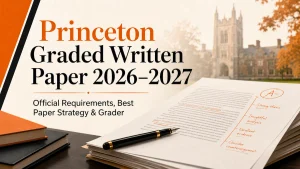
- Princeton Graded Written Paper Is a Separate Requirement
- Princeton Graded Written Paper Deadlines
- Final Princeton Supplemental Essays Checklist
- Use the Princeton Supplemental Essay Grader Before You Submit
The Princeton supplemental essays for the 2026–2027 application cycle are now officially published. Princeton has confirmed the full first-year writing structure for Fall 2027 applicants, including the separate academic prompts for A.B./Undecided and B.S.E. candidates, the 400–500 word lived experience essay, the civic engagement response, and three 50-word short answers.
This is no longer a provisional prompt set. Princeton’s admissions website explicitly identifies these as the questions for the 2026–27 application cycle, so applicants can now prepare their final responses using the official wording and limits.
The Princeton supplemental essays are designed to reveal several different parts of an applicant at once: academic curiosity, intellectual direction, lived perspective, civic responsibility, personal voice, and the way the applicant might participate in Princeton’s community.

Before finalizing your application, verify the latest Princeton-specific questions directly on the official Princeton Admission Princeton-specific Questions page.
For the academic response, Princeton now makes the distinction especially clear:
- A.B. applicants and students who are undecided answer one academic-interest prompt.
- B.S.E. applicants answer a separate engineering-focused prompt.
- Both have a maximum of 250 words.
All first-year applicants then complete two Your Voice essays and three More About You short responses.
Princeton also continues to ask applicants to submit a separate Graded Written Paper, which is not part of the Princeton supplement and should be treated as a distinct application component.
Before submitting, always verify the current questions on the official Princeton Admission page.
What Changed in the Princeton Supplemental Essays for 2026–2027?
The most important update is that the questions are now officially confirmed for 2026–27.
Applicants no longer need to rely on last year’s prompt structure or third-party predictions.
The current first-year Princeton supplemental essays consist of:
- one academic essay based on degree choice;
- one lived experience essay;
- one civic engagement essay;
- three short answers.
The official structure is:
A.B./Undecided Academic Interest
250 words or fewer
B.S.E. Academic Interest
250 words or fewer
Community and Lived Experience
400–500 words
Civic Engagement
250 words or fewer
New Skill
50 words or fewer
What Brings You Joy?
50 words or fewer
Soundtrack of Your Life
50 words or fewer
The 400-word minimum on the lived experience response is particularly important. It is not simply “up to 500 words.” Princeton explicitly publishes a 400–500 word range.
Why the Princeton Supplemental Essays Matter
The Princeton supplemental essays give the admissions office information that cannot be communicated through grades, testing, activities, or a résumé alone.
Princeton’s application review is holistic. The university states that no particular factor receives a fixed weight and that the entire application is evaluated through an individualized assessment.
That means applicants should resist the temptation to treat the supplement as a checklist of “Princeton things.”
A strong set of responses usually demonstrates:
- genuine academic curiosity;
- applicant-owned intellectual questions;
- clear reasoning about why Princeton’s programs fit those interests;
- a developed lived perspective;
- thoughtful engagement with community;
- humility around service;
- and short answers that sound human rather than engineered.
A weak Princeton supplement often sounds interchangeable with Harvard, Yale, Brown, Columbia, or another Ivy League university.
Prestige is not a substitute for specificity.
Princeton Supplemental Essay Prompt 1: A.B. or Undecided Academic Interest
For applicants pursuing an A.B. degree or who are currently undecided, Princeton asks what academic areas most spark their curiosity and how Princeton’s programs suit those interests.
Word limit: 250 words or fewer.
This is one of the most important Princeton supplemental essays because it combines two tasks:
- Explain what intellectually interests you.
- Explain why Princeton is a useful environment for pursuing those questions.
Strategy
Do not begin with Princeton.
Begin with the question, contradiction, idea, system, or problem that genuinely interests you.
For example, instead of:
I have always been passionate about economics.
A stronger direction might be:
I became interested in economics after noticing that two households facing the same price increase could respond completely differently.
That creates an intellectual problem.
Then connect that curiosity to Princeton.
A strong Princeton connection is not simply naming:
- the Economics Department;
- public policy;
- psychology;
- neuroscience;
- a professor;
- a research center;
- or the senior thesis.
The connection should explain how a Princeton opportunity would help you investigate your question.
The Princeton Supplemental Essay Grader therefore does not reward name-dropping by itself. A program name only matters when the applicant explains its relevance.
Princeton Supplemental Essay Prompt 1B: B.S.E. Engineering
B.S.E. applicants answer a different academic question.
Princeton asks applicants to explain:
- why they are interested in engineering;
- their experiences or exposure to engineering;
- and how Princeton’s programs fit their particular interests.
The response is limited to 250 words or fewer.
Strategy
This is not merely a “Why Engineering?” response.
A strong B.S.E. essay normally has three components:
- a genuine origin or development of engineering interest;
- concrete engineering exposure;
- a meaningful Princeton-specific connection.
One common mistake is writing:
I have always enjoyed solving problems and building things.
That may be true, but it tells the reader almost nothing.
A stronger essay identifies a real engineering experience:
- repairing something;
- building a circuit;
- debugging code;
- designing a mechanism;
- working with sensors;
- prototyping;
- testing a system;
- encountering an engineering failure.
The strongest responses then explain what that experience made the student curious about.
Princeton Program Connection: Specificity Without Name-Dropping
Both academic versions of the Princeton supplemental essays require applicants to explain how Princeton’s programs suit their interests.
That does not mean you need to cram the essay with proper nouns.
A weak Princeton connection sounds like:
Princeton’s world-class professors, research opportunities, and interdisciplinary curriculum make it the perfect place for me.
That could describe dozens of selective universities.
A stronger connection explains:
- what you want to investigate;
- which Princeton structure helps you do it;
- and why that structure matters to your particular intellectual direction.
Princeton’s undergraduate model includes significant independent academic work, so applicants may find opportunities to connect their interests to Princeton’s research-oriented environment. But independent work or senior thesis references should only appear when they genuinely advance the explanation.
The Princeton Supplemental Essay Grader looks for reasoning, not institutional vocabulary.
Princeton Supplemental Essay Prompt 2: Community and Lived Experience
Princeton’s first Your Voice essay asks applicants to reflect on how their lived experiences will shape conversations in classrooms, dining halls, and other campus spaces.
It asks:
- what lessons you have learned;
- what classmates would learn from you;
- and how your lived experience has shaped you.
The official required range is 400–500 words.
This is the longest of the Princeton supplemental essays, and that length matters.
Princeton is giving you enough room to develop an experience rather than simply identify one.
What counts as lived experience?
Almost anything that genuinely shaped the way you interpret people, ideas, or situations can work:
- family responsibilities;
- work;
- language;
- neighborhood;
- migration;
- caregiving;
- school environment;
- cultural traditions;
- socioeconomic circumstances;
- conflict;
- family business;
- faith or non-faith;
- community roles;
- interpersonal habits;
- ordinary routines.
The experience does not need to be dramatic.
Do Not Turn Lived Experience Into an Identity Label
A common mistake is assuming this essay requires a dramatic identity narrative.
It does not.
Statements like:
As a diverse student, I will bring diversity to Princeton.
are too broad.
The admissions reader needs to understand how an experience actually changed your perspective.
A stronger essay might show how:
- translating for customers changed the way you think about language and access;
- caring for siblings changed how you understand time and responsibility;
- working in a family store changed how you interpret economic decisions;
- avoiding conflict taught you that silence is not always agreement.
Specific experience creates credibility.
What Will Your Princeton Classmates Learn From You?
This part is easy to underdevelop.
It is not enough to write:
My classmates will learn the value of resilience.
Ask instead:
What perspective, question, habit, or way of interpreting situations would you actually bring into a Princeton conversation?
For example:
I tend to ask who experiences a policy differently because of time, transportation, language, or money.
That gives the reader something concrete.
The Princeton Supplemental Essay Grader evaluates whether the contribution follows causally from the lived experience rather than being attached as a generic conclusion.
Princeton Supplemental Essay Prompt 3: Civic Engagement
Princeton’s second Your Voice response focuses on service and civic responsibility.
The university asks applicants how their own story intersects with Princeton’s commitment to service and civic engagement.
Word limit: 250 words or fewer.
This essay does not require:
- founding a nonprofit;
- national advocacy;
- political leadership;
- large-scale impact;
- thousands of volunteer hours.
Ordinary service can produce an excellent essay.
What matters is what the applicant understands about responsibility through the experience.
Avoid the Savior-Complex Princeton Essay
One of the easiest ways to weaken the civic engagement essay is to center yourself as the person who “saved” another community.
Avoid language such as:
I gave disadvantaged students hope.
or:
I changed their lives.
A stronger response demonstrates humility.
For example:
I originally believed service meant taking initiative. Working regularly at a food pantry taught me that consistency, listening, and following systems created by people with more experience can matter just as much.
That kind of reflection communicates maturity without inflating impact.
Civic Engagement Does Not Require Leadership
The Princeton supplemental essays should not become another résumé.
An applicant who:
- packs groceries;
- cleans neighborhood spaces;
- translates for relatives;
- tutors one student;
- helps at a community center;
- cares for family members;
can write an excellent civic engagement essay.
The important questions are:
- Why did you continue?
- What did you notice?
- What changed in your understanding?
- What do you still not understand?
- How has the experience affected your sense of responsibility?
The Princeton Supplemental Essay Grader does not reward leadership, prestige, or scale automatically.
Princeton Short Takes: More About You
Princeton includes three short answers under More About You.
Each response is limited to 50 words or fewer, and Princeton explicitly tells applicants that there are no right or wrong answers and encourages them to be themselves.
That instruction matters.
These answers should not sound like miniature personal statements.
They should sound like a person.
Princeton Short Take 1: New Skill
Princeton asks:
What is a new skill you would like to learn in college?
Maximum: 50 words.
A good answer is usually concrete:
- woodworking;
- ceramics;
- sailing;
- jazz improvisation;
- cooking;
- bike repair;
- glassblowing;
- auto repair;
- printmaking;
- conversational Arabic.
Avoid abstract qualities like:
- leadership;
- communication;
- resilience;
- success.
Those are traits, not clearly defined skills.
Princeton Short Take 2: What Brings You Joy?
Princeton asks:
What brings you joy?
Maximum: 50 words.
The best answers usually contain a small amount of texture.
Weak:
My family brings me joy.
Stronger:
Sunday breakfast with my family brings me joy. We make eggs, argue about which music to play, and stay at the table longer than we need to.
The second answer reveals a lived experience instead of a category.
Princeton Short Take 3: Soundtrack of Your Life
Princeton asks:
What song represents the soundtrack of your life at this moment?
Maximum: 50 words.
Name an actual song.
Then explain why it fits this moment.
The answer should not simply summarize the song’s lyrics or reputation. What matters is the personal connection.
For example:
“Vienna” by Billy Joel reminds me that being ambitious does not require rushing through every stage of my life.
That is a useful starting point, but it becomes stronger when the applicant adds one individualized detail about what they currently feel pressured to rush.
Princeton Supplemental Essay Grader
Review your Princeton-specific questions with prompt-specific scoring, verified evidence, and actionable revision feedback for the 2026–2027 admission cycle.
Official 2026–2027 requirement: one Academic Interest response (A.B./Undecided or B.S.E., 250 words), Your Voice — Community and Lived Experience (400–500 words), Your Voice — Civic Engagement (250 words), and three More About You short answers (50 words each). This is the Princeton-specific supplement only — it does not include the separate Princeton Graded Written Paper.
What You'll Get From Your Review
Feedback is tied to each exact Princeton-specific question.
Prompt-Specific ScoringCriteria written for each exact question, not a generic essay rubric.
Evidence-Based FeedbackCriterion feedback uses verified literal excerpts from your responses.
Independent EvaluationAdd an optional Elite Second Opinion and compare both reviews locally.
Words: 0 / 250
Princeton values community and encourages students, faculty, staff and leadership to engage in respectful conversations that can expand their perspectives and challenge their ideas and beliefs. As a prospective member of this community, reflect on how your lived experiences will impact the conversations you will have in the classroom, the dining hall or other campus spaces. What lessons have you learned in life thus far? What will your classmates learn from you? In short, how has your lived experience shaped you?
Your Voice — Community and Lived Experience — 400–500 words
Words: 0 / 400-500
Princeton has a longstanding commitment to understanding our responsibility to society through service and civic engagement. How does your own story intersect with these ideals?
Your Voice — Civic Engagement — up to 250 words
Words: 0 / 250
What is a new skill you would like to learn in college?
More About You — New Skill — up to 50 words
Words: 0 / 50
What brings you joy?
More About You — Joy — up to 50 words
Words: 0 / 50
What song represents the soundtrack of your life at this moment?
More About You — Soundtrack — up to 50 words
Words: 0 / 50
Complete your Primary Review first to unlock an independent second evaluation and side-by-side comparison.
Need more reviews now?
Your account includes 2 free essay reviews for life. Paid Universal Credits are always used first and work across all graders.
Need more credits?
View all pricing plans →
Instant activation after payment. 1 Universal Credit = 1 comprehensive essay review.
Use the Princeton Supplemental Essay Grader
The Princeton Supplemental Essay Grader has been updated for the official 2026–2027 Princeton-specific questions.
The grader now treats the application as six scored responses:
- one A.B./Undecided or B.S.E. Academic Interest essay;
- Community and Lived Experience;
- Civic Engagement;
- New Skill;
- Joy;
- Soundtrack.
The A.B. and B.S.E. pathways are evaluated separately because they are different prompts with different expectations.
The grader evaluates each response using criteria appropriate to the question rather than applying one generic “Princeton fit” score to the entire application.
How the Princeton Supplemental Essay Grader Evaluates Academic Interest
For A.B./Undecided applicants, the grader examines areas such as:
- prompt fulfillment;
- specific academic curiosity;
- Princeton program connection;
- intellectual motivation;
- clarity and compression.
For B.S.E. applicants, it instead examines:
- prompt fulfillment;
- concrete engineering experience;
- Princeton program connection;
- intellectual motivation;
- clarity and compression.
This matters because the B.S.E. prompt explicitly asks about engineering experience or exposure, while the A.B./Undecided prompt does not.
How the Princeton Supplemental Essay Grader Evaluates Lived Experience
The lived experience response is evaluated for:
- prompt fulfillment;
- specific lived detail;
- what classmates could learn from the applicant;
- reflection on impact;
- clarity and compression.
Maximum scores require developed evidence.
Simply saying:
My experiences taught me resilience.
is not enough.
Likewise, a vague statement that you would “bring a different perspective” does not fully establish what classmates would actually learn from you.
How the Princeton Supplemental Essay Grader Evaluates Civic Engagement
The civic engagement response is evaluated around:
- prompt fulfillment;
- personal connection to service;
- reflection and humility;
- authentic voice;
- clarity.
Importantly, scale is not a scoring proxy.
A student doing ordinary community work can perform just as strongly as someone with a visible leadership title if the response demonstrates deeper personal connection and reflection.
How the Princeton Supplemental Essay Grader Evaluates Short Answers
The three More About You responses emphasize:
- direct responsiveness;
- authenticity and specificity;
- personal insight;
- clarity within the 50-word limit.
They do not reward unnecessarily literary prose.
An ordinary answer can earn maximum marks if it is specific, revealing, natural, and complete.
That aligns well with Princeton’s own instruction to applicants: be yourself.
Primary Evaluation and Elite Second Opinion
The current Princeton Supplemental Essay Grader can provide two independent evaluations of the same Princeton responses.
The Primary Evaluation evaluates all six responses against the current 2026–2027 prompts and rubrics.
Applicants who want a second perspective can request an Elite Second Opinion.
The second evaluator:
- receives the same exact responses;
- uses the same prompts;
- uses the same rubrics;
- uses the same maximum points;
- does not see the Primary Evaluation.
When both evaluations exist, the grader can generate a direct comparison.
Compare Both Evaluations
The comparison shows:
- Primary score;
- Independent score;
- Combined Evaluation Score;
- criterion-level agreement;
- criterion-level disagreement;
- shared revision priorities;
- Primary-only concerns;
- Second-Opinion-only concerns.
The Combined Evaluation Score is simply the arithmetic mean of the two evaluations.
It is not a third admissions evaluation.
The purpose is to identify where two independent reviews agree and where reasonable interpretation differs.
A High Princeton Essay Score Is Not an Admission Prediction
A score from the Princeton Supplemental Essay Grader does not represent an admissions probability.
Princeton uses holistic review and does not assign a fixed weight to any single component of the application.
A high grader score means the response strongly satisfies the prompt-specific evaluation criteria.
It does not mean:
- guaranteed admission;
- likely admission;
- an admissions officer would assign the same number;
- an essay compensates automatically for weaknesses elsewhere.
The most useful part of the grader is the feedback: what is established, what is missing, and what revision would make the response stronger.
Common Mistakes in Princeton Supplemental Essays
1. Generic Ivy League Praise
Do not spend precious words explaining that Princeton is prestigious.
Admissions officers already know that.
2. Princeton Name-Dropping Without Reasoning
Listing:
- departments;
- professors;
- research centers;
- certificates;
- laboratories;
does not demonstrate fit by itself.
Explain what you would actually investigate there.
3. Weak Academic Questions
“I love economics.”
“I love engineering.”
“I am passionate about science.”
These statements need evidence.
Show the question or experience beneath the interest.
4. Résumé Dumping
The activities section already tells Princeton what you did.
The essays should show:
- what you noticed;
- how you reasoned;
- what changed;
- what you value.
5. Savior Framing in Civic Engagement
Avoid making other people props for your personal growth.
Service essays are often stronger when they demonstrate uncertainty, accountability, consistency, or listening.
6. Vague Lived Experience Contribution
Do not stop at:
I will bring my unique perspective to Princeton.
Explain the perspective.
7. Over-Polished Short Takes
The short responses should sound natural.
Trying to turn a 50-word joy answer into a philosophical manifesto usually makes it weaker.
8. Reusing Your Common App Essay
The lived experience essay should expand your application rather than simply retell the same story.
Princeton Graded Written Paper Is a Separate Requirement
Princeton also asks students to submit a Graded Written Paper as part of the application.
For first-year applicants, Princeton says the paper should generally come from an academic course in:
- English;
- social studies;
- or history;
from the last three years of secondary school, including senior year. Princeton says it is most interested in expository, thesis-driven analytical writing rather than science research, creative writing, personal narratives, or papers focused mostly on data analysis.
The paper should be at least one page long.
The Graded Written Paper is not one of the Princeton supplemental essays and should not be evaluated using the same rubric.
Read the separate guide here:
Princeton Graded Written Paper Deadlines
For current first-year applicants, Princeton lists the Graded Written Paper alongside the application materials due:
- November 1 for Single-Choice Early Action;
- January 1 for Regular Decision.
Applicants can submit the paper with their application materials or through the applicant portal; Princeton also provides additional submission options in its guidance.
Final Princeton Supplemental Essays Checklist
Before submitting your Princeton supplemental essays, ask:
- Did I select the correct A.B./Undecided or B.S.E. academic prompt?
- Is my academic essay 250 words or fewer?
- Does the academic response explain a real intellectual interest?
- Does my Princeton connection include reasoning rather than name-dropping?
- Is my Community and Lived Experience essay between 400 and 500 words?
- Does that essay explain what classmates could genuinely learn from me?
- Is my Civic Engagement essay 250 words or fewer?
- Does my civic response show reflection rather than self-congratulation?
- Are all three More About You responses 50 words or fewer?
- Does the soundtrack answer name an actual song?
- Do my short answers sound like a person rather than an admissions consultant?
- Have I avoided résumé dumping?
- Have I avoided generic Ivy League praise?
- Have I separately prepared my Princeton Graded Written Paper?
- Have I checked the official Princeton admissions page before submitting?
Use the Princeton Supplemental Essay Grader Before You Submit
The Princeton supplemental essays for 2026–2027 are now official, which means applicants can finally prepare their final responses without relying on provisional prompts.
The updated Princeton Supplemental Essay Grader reviews the current A.B./Undecided and B.S.E. pathways separately, evaluates the 400–500 word lived experience response, reviews civic engagement, and analyzes all three Princeton short takes.
Use the grader to identify:
- generic academic reasoning;
- weak Princeton-specific connections;
- underdeveloped engineering exposure;
- vague lived experience contributions;
- shallow civic reflection;
- résumé dumping;
- prestige-driven language;
- generic short answers;
- and missing evidence.
Then revise the writing yourself.
The objective is not to manufacture a “perfect Princeton applicant.”
It is to make sure the Princeton supplemental essays clearly communicate the applicant’s actual intellectual questions, lived perspective, civic understanding, and personality.Our Princeton Supplemental Essay Grader is custom-calibrated to review your full Princeton writing profile, including the academic essay, lived experience response, civic engagement response, and short takes.