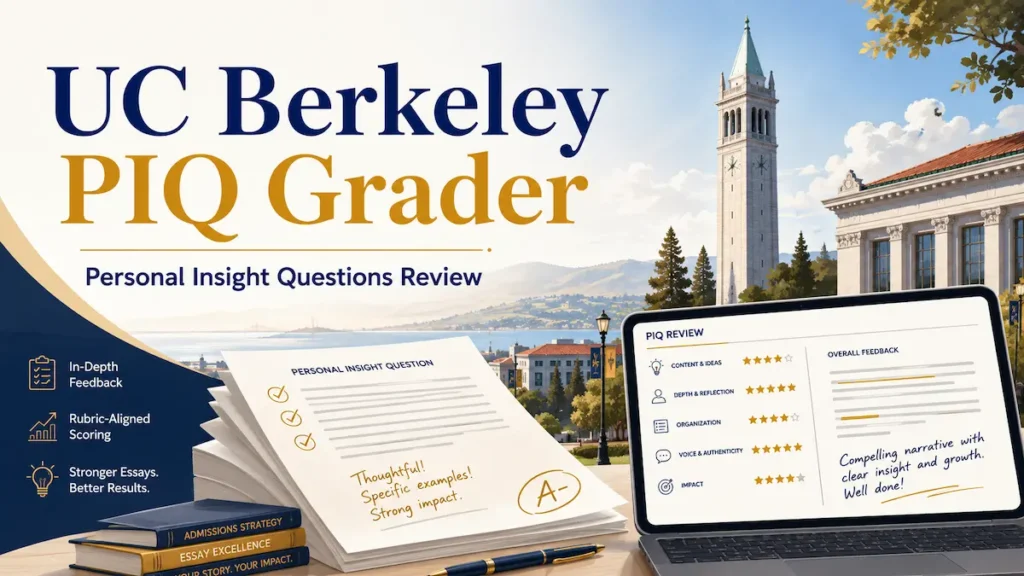
UC Berkeley PIQ Grader 2026–2027: Review Your Personal Insight Questions for Fall 2027
- UC Berkeley Personal Insight Questions 2026–2022027: What Is Current for Fall 2027?
- Important UC Berkeley Application Policies for 2026–2027
- Some Berkeley Applicants May Be Invited to Submit Recommendation Letters
- What Berkeley Says It Looks for in the Personal Insight Questions
- Berkeley's Most Useful PIQ Test: What Do We Know About You?
- Review Your Four Berkeley PIQs
- UC Berkeley PIQ Grader
- What You’ll Get From Your UC Berkeley PIQ Review
- UC Berkeley Evaluation Comparison
- Elite Second Opinion
- My Essay Reviews
- Caltech Evaluation Comparison
- UC PIQ Evaluation Comparison
- There Is No Required Berkeley PIQ Combination
- Berkeley Wants Choices and Gains, Not Just Activities
- UC Berkeley PIQ Strategy: Prompt by Prompt
- Stop Writing Résumé Paragraphs
- Evidence Beats Adjectives
- Do Not Invent Impact
- Berkeley Reads Achievement in Context
- Your Four Berkeley PIQs Should Not Tell the Same Story
- What Should Your Four PIQs Reveal Together?
- Additional Comments Is Not PIQ #9
- Berkeley Does Not Conduct a Standard Admissions Interview
- Common UC Berkeley PIQ Mistakes for 2026–2027
- Before You Submit, Read All Four as a Berkeley Reader
- Use the UC Berkeley PIQ Grader to Review All Four Responses
- Elite Second Opinion
- Compare Both Evaluations
- How to Use Your Berkeley PIQ Feedback
- Final UC Berkeley PIQ Checklist for Fall 2027
- Review Your UC Berkeley PIQs Before You Submit
- Explore More UC Admissions Resources
Applying to UC Berkeley for Fall 2027 means competing in a highly selective admissions process where your academic record is only one part of the application.
For students applying during the 2026–2027 admissions cycle, the Personal Insight Questions give Berkeley something grades, courses, activities, and awards cannot fully provide: context about your experiences, decisions, motivations, challenges, intellectual interests, and development.
Berkeley explains that it uses the PIQs to help distinguish among applicants whose academic records may be similar, gain insight into academic, personal, and extracurricular achievement, and uncover information that may not appear elsewhere in the application.

That makes the central question much bigger than:
“Is my essay well written?”
A better question is:
“After reading my four PIQs, what does Berkeley actually understand about me?”
The UC Berkeley PIQ Grader on this page reviews all four responses as a portfolio. It can help identify which PIQs are strongest, which need more development, what evidence is working, where important context may be missing, whether the four responses become repetitive, and what you should revise before submitting.
You can verify the current requirements on the official University of California Personal Insight Questions page.
UC Berkeley Personal Insight Questions 2026–2022027: What Is Current for Fall 2027?
The University of California continues to use the established first-year PIQ structure:
- 8 Personal Insight Questions are available.
- First-year applicants answer 4 of the 8.
- Each response has a maximum of 350 words.
- Applicants choose the four questions most relevant to their own experiences and circumstances.
- All eight questions receive equal consideration.
UC explicitly states that there is no advantage or disadvantage to choosing particular PIQs.
That means there is no secret “best Berkeley PIQ combination.”
PIQ #1 is not automatically stronger because it involves leadership.
PIQ #6 is not automatically superior because it is academic.
PIQ #5 does not become more valuable simply because it describes hardship.
The best four are the questions that allow you to provide the strongest and most useful non-redundant evidence about yourself.
A useful question is:
If I removed this PIQ, what important thing would Berkeley no longer know about me?
If the answer is “almost nothing,” the response may be repeating information already visible elsewhere.
That principle is especially important when reviewing all four responses together. Your existing strategy section already captures this well: different prompt numbers do not guarantee different information; what matters is whether each response contributes distinct evidence.
Important UC Berkeley Application Policies for 2026–2027
Berkeley's current first-year policy page was last updated in June 2026 and confirms several important policies for applicants.
UC Berkeley Remains Test-Free
UC Berkeley states that it is test-free.
SAT and ACT scores are not used in any part of Berkeley's application evaluation. Scores that students submit may still later be used for placement or subject credit if the student enrolls.
This does not make the PIQs a substitute for academic achievement.
Instead, the PIQs perform a different function: they give readers context and information that grades alone cannot communicate.
Berkeley Uses Holistic Review
Berkeley considers academic and non-academic accomplishments in the context of the opportunities available to each applicant.
Its current first-year criteria include personal qualities such as leadership, motivation, insight, tenacity, initiative, originality, intellectual independence, responsibility, maturity, and concern for others and the community. Berkeley also considers likely contribution to the intellectual and cultural vitality of campus.
This matters strategically.
A student who worked twenty hours each week, helped care for siblings, attended a school with limited advanced coursework, or lacked access to expensive enrichment programs should not assume those experiences are inherently weaker than prestigious activities.
Context matters.
What matters is what you did with the opportunities and constraints you actually had.
Some Berkeley Applicants May Be Invited to Submit Recommendation Letters
Selected first-year applicants may be invited by Berkeley to submit two letters of recommendation.
This is not a standard requirement for every applicant. Berkeley states that only invited students may submit the letters, that submission is voluntary, and that unsolicited recommendation letters are not accepted.
Berkeley asks recommenders to consider qualities including:
- academic performance and potential;
- love of learning;
- leadership;
- persistence in the face of challenges;
- cross-cultural engagement;
- originality and creativity;
- concern for others.
These themes are useful because they reinforce a broader point about Berkeley's admissions philosophy.
But they are not a checklist that every PIQ must satisfy.
Trying to demonstrate leadership, creativity, service, resilience, intellectual curiosity, persistence, and impact in all four responses will usually make the essays generic.
Different PIQs can reveal different dimensions of the same applicant.
What Berkeley Says It Looks for in the Personal Insight Questions
Berkeley's current PIQ guidance specifically identifies:
- initiative;
- motivation;
- leadership;
- persistence;
- service to others;
- special potential;
- substantial experience with other cultures;
- achievements considered in light of available opportunities;
- unusual circumstances or hardships and how the applicant responded to them.
For applicants discussing hardship, Berkeley explicitly emphasizes how the student confronted or responded to the challenge and what was learned or achieved despite it, rather than simply including hardship for its own sake.
That distinction is important.
Berkeley is not asking:
“Who experienced the most impressive hardship?”
The useful questions are:
“What happened?”
“What did you do?”
“What choices did you make?”
“What changed?”
“What did the experience reveal about you?”
Berkeley's Most Useful PIQ Test: What Do We Know About You?
Berkeley gives applicants an unusually useful way to judge whether their PIQs are working.
After reading the responses, Berkeley says the reader ultimately asks:
“What do we know about this individual?”
That may be one of the best editing questions you can use.
After reading all four PIQs, could someone explain:
- what motivates you;
- how you make decisions;
- how you learn;
- what you do when something fails;
- what responsibilities you carry;
- what questions interest you;
- how you contribute;
- how you have used the opportunities available to you;
- what has changed in your thinking or behavior?
If four polished responses reveal almost none of that, better prose will not solve the underlying problem.
Review Your Four Berkeley PIQs
UC Berkeley PIQ Grader
Review four UC Personal Insight Questions with the official UC guidance and the approved rubric for each selected prompt.
What You’ll Get From Your UC Berkeley PIQ Review
Go beyond a single score with prompt-specific feedback, evidence-backed revision guidance, portfolio analysis, and an optional independent second evaluation.
Scores are guidance tools, not predictions of admission. The most valuable part of your review is the evidence, reasoning, and revision priorities behind each score.
PIQ 1
PIQ 2
PIQ 3
PIQ 4
Complete your Primary Review first to unlock an independent second evaluation and side-by-side comparison.
Need more reviews now?
Your account includes 2 free essay reviews for life. Paid Universal Credits are always used first and work across all graders.
Instant activation after payment. 1 Universal Credit = 1 full Berkeley PIQ portfolio review.
There Is No Required Berkeley PIQ Combination
Students often search for:
- “best PIQs for Berkeley Engineering”
- “best four PIQs for Berkeley”
- “which Berkeley PIQs should I answer?”
There is no universal answer.
Because UC gives all eight questions equal consideration, your strategic goal is not to select the four prompts that appear most prestigious.
Choose the four that provide the strongest non-redundant evidence about you.
For one applicant, that might be:
1 + 2 + 6 + 7
For another:
3 + 4 + 5 + 8
Neither combination is inherently better.
Berkeley Wants Choices and Gains, Not Just Activities
Berkeley tells applicants to describe not only what they have done but also the choices they made and what they gained from those experiences.
That gives you a useful editing structure:
Context → Choice → Action → Result → Insight
Context
What was happening?
Choice
What decision was yours?
Action
What did you actually do?
Result
What happened afterward?
Insight
What changed in your understanding, approach, priorities, or behavior?
A response missing several of those components may read more like an activity description than personal insight.
UC Berkeley PIQ Strategy: Prompt by Prompt
PIQ #1: Leadership Experience
Leadership does not require being president, captain, founder, or CEO.
The useful question is what happened because you accepted responsibility.
A weak version might say:
“I became president of the club and learned that leadership is important.”
A stronger Berkeley PIQ shows:
- what problem existed;
- who was involved;
- what responsibility you assumed;
- what decision you made;
- what you actually did;
- how other people responded;
- what changed;
- what leadership came to mean to you.
The title supplies context.
Your decisions and influence supply the evidence.
PIQ #2: Creative Side
Creativity is much broader than painting, music, or creative writing.
It can appear through:
- coding;
- engineering;
- research;
- design;
- problem-solving;
- experimentation;
- building;
- repairing;
- organizing information;
- adapting an existing process.
Often the most revealing part is iteration.
Instead of simply writing:
“I am creative because I built an app.”
show:
problem → first attempt → unexpected problem → adjustment → result
That lets the reader see creativity happening.
PIQ #3: Greatest Talent or Skill
The danger with PIQ #3 is turning it into proof that you are good at something.
Awards may support the response, but they should not substitute for development.
Explain:
- what the skill actually is;
- how you developed it;
- what practice or difficulty changed;
- where you demonstrated it;
- how you use it now.
“Communication” is broad.
“Realizing that I needed to identify exactly where another person's understanding broke down before explaining the solution” is specific.
Specific behavior makes a claimed skill credible.
PIQ #4: Educational Opportunity or Barrier
This PIQ gives you two possible routes:
- explain how you took advantage of an educational opportunity; or
- explain how you worked to overcome an educational barrier.
An opportunity could involve:
- advanced coursework;
- community college;
- independent study;
- research;
- mentorship;
- internships;
- specialized academic programs;
- another meaningful learning opportunity.
A barrier might involve:
- limited course availability;
- financial constraints;
- family responsibilities;
- access limitations;
- school circumstances;
- another genuine educational obstacle.
The circumstance is only the beginning.
The response becomes personal when you show what you did about it.
Berkeley explicitly considers achievement in the context of the opportunities available to the applicant.
You therefore do not need to make your circumstances sound more prestigious than they were.
PIQ #5: Significant Challenge
PIQ #5 is not a competition for the most dramatic hardship.
The UC prompt asks about the challenge, the steps you took to overcome it, and the effect on your academic achievement.
Berkeley's own guidance reinforces that emphasis on response rather than hardship itself.
A strong response should eventually explain:
- why the challenge mattered;
- what it affected;
- what you did;
- what strategies changed;
- what happened academically;
- what you learned;
- what may still remain difficult.
If your grades remained stable, do not invent an academic collapse.
Truthful context is more useful than manufactured drama.
PIQ #6: Academic Subject
A strong academic-interest response needs more than:
“I have always loved computer science.”
Give the reader an intellectual hook.
For example:
“I became interested in why two programs can produce the same answer while requiring radically different amounts of time as the input grows.”
Now there is something to investigate.
Then show pursuit:
- classes;
- independent reading;
- experiments;
- projects;
- research;
- discussions;
- competitions;
- tutoring;
- self-directed investigation.
A Special Note for Berkeley Professional Colleges
Berkeley's PIQ guidance states that applicants to professional colleges such as Engineering or Chemistry should discuss their intended field of study, interest in the specific major, and relevant school or work experience.
This does not mean every Berkeley PIQ should become a “Why Berkeley?” essay.
Academic credibility should come primarily from an existing pattern:
question → pursuit → action → learning → next question
not repeated university name-dropping.
PIQ #7: Making Your Community Better
Community can mean:
- school;
- neighborhood;
- family;
- workplace;
- team;
- cultural community;
- religious community;
- online community;
- another group that genuinely matters to you.
The critical issue is making your contribution visible.
If every important sentence begins with:
“We organized…”
“We decided…”
“We created…”
the reader may struggle to understand what you personally did.
You do not need to erase collaborators.
You do need to identify your role.
And the impact does not have to be enormous.
Credible small-scale improvement may reveal much more than an inflated claim about changing thousands of lives.
PIQ #8: What Makes You a Strong Candidate?
PIQ #8 is often misunderstood.
Avoid:
“I am hardworking, passionate, resilient, motivated, and therefore a strong candidate for Berkeley.”
Those are claims.
Instead ask:
What important thing about me would the admissions reader fail to understand if this PIQ were removed?
Then provide evidence.
That might involve:
- a responsibility;
- a perspective;
- an important habit;
- an experience;
- a skill;
- a family circumstance;
- a way of thinking;
- something else not adequately visible elsewhere.
Stop Writing Résumé Paragraphs
Berkeley already has your activities section.
A PIQ should not merely repeat:
President of Robotics Club. Organized 12 meetings. Competed at three tournaments. Won two awards. Mentored younger students.
Ask instead:
- What did I notice?
- What decision was mine?
- What did I initially misunderstand?
- Where did something fail?
- What did I change?
- What did another person help me notice?
- What happened because I acted?
- What does this reveal about me?
The accomplishment establishes what happened.
The PIQ should reveal the person making the decisions.
Evidence Beats Adjectives
Compare:
“I am persistent.”
with:
“After my first prototype repeatedly overheated, I changed the enclosure, logged temperatures across three configurations, and discovered that the problem was airflow rather than the processor.”
The second example does not need to announce persistence.
The behavior demonstrates it.
Apply the same rule to:
- leadership;
- responsibility;
- creativity;
- curiosity;
- service;
- maturity;
- resilience.
Show the quality through behavior.
Do Not Invent Impact
You do not need fabricated percentages, participant counts, or dramatic statistics to make an experience meaningful.
Do not turn:
“Students began coming back for tutoring.”
into:
“Student retention increased by 43%.”
unless you genuinely collected and know that number.
A truthful observation such as:
“Several students began requesting the same tutor during later sessions.”
can provide better evidence.
Specificity does not require fake precision.
Your existing draft makes this evidence-first distinction especially well.
Berkeley Reads Achievement in Context
This deserves its own section because students often misunderstand selective admissions.
Berkeley evaluates academic and non-academic accomplishments relative to the opportunities available to the applicant. It also considers contextual circumstances affecting achievement and the maturity, determination, and insight demonstrated when responding to hardship.
So if your school did not offer:
- research laboratories;
- extensive AP/IB options;
- advanced mathematics;
- robotics;
- expensive summer programs;
- specialized enrichment;
you do not need to pretend it did.
A student can demonstrate substantial initiative through paid work, caregiving, independent learning, family responsibilities, or opportunities that appear ordinary on a résumé.
The important question is:
What did you do within the circumstances you actually had?
Your Four Berkeley PIQs Should Not Tell the Same Story
Consider this portfolio:
- PIQ #1 — leadership through robotics;
- PIQ #2 — creativity through robotics;
- PIQ #6 — engineering through robotics;
- PIQ #7 — mentoring younger members through robotics.
All four responses might be individually excellent.
Together, however, they may reveal a narrow picture.
That does not mean two PIQs can never involve the same subject.
Two responses may both involve technology but reveal entirely different things:
- one demonstrates intellectual curiosity;
- another demonstrates creative iteration.
Look at the function of the evidence, not merely the topic.
Ask after each response:
If I removed this PIQ, what would Berkeley no longer know about me?
What Should Your Four PIQs Reveal Together?
One portfolio might demonstrate:
- how you lead;
- how you think;
- how you respond when something fails;
- how you contribute.
Another might reveal:
- intellectual curiosity;
- family responsibility;
- creativity;
- community involvement.
There is no required combination.
The goal is range without artificiality.
Additional Comments Is Not PIQ #9
UC provides an Additional Comments field for context or information that did not fit elsewhere.
It should not become another essay.
Use it when the reader genuinely needs clarification about circumstances, school context, activities, responsibilities, academic information, or another relevant issue.
Do not use it to squeeze another personal statement into the application.
Berkeley Does Not Conduct a Standard Admissions Interview
Berkeley states that it does not conduct interviews as part of its standard admissions process and emphasizes that the application itself provides the information used to evaluate applicants.
That makes your own explanations in the PIQs particularly valuable.
Do not waste the space simply repeating facts already obvious from another section of the application.
Common UC Berkeley PIQ Mistakes for 2026–2027
Watch especially for:
- choosing prompts because they appear prestigious;
- beginning every response with broad background;
- turning PIQ #1 into a leadership-title essay;
- assuming PIQ #2 creativity requires traditional art;
- treating PIQ #5 as a hardship competition;
- writing PIQ #6 as “why I love my major” without showing pursuit;
- using “we” so extensively in PIQ #7 that your role disappears;
- using PIQ #8 for generic self-praise;
- repeating your activities list;
- inventing measurable impact;
- ending every PIQ with the same generic reflection;
- forcing Berkeley's name into responses unnecessarily;
- writing four PIQs that essentially demonstrate the same thing;
- treating Additional Comments as a fifth PIQ.
Before You Submit, Read All Four as a Berkeley Reader
Read the four PIQs consecutively.
Then ask:
What motivates this student?
If you cannot tell, motivation may be too implicit.
What has this student actually done?
If you mainly see titles and adjectives, add actions.
What happens when something does not work?
Failure, iteration, adaptation, persistence, and changed strategy often reveal more than a perfect outcome.
What intellectual interests are visible?
If you name an academic subject but never show pursuit, the interest may feel unsupported.
What does this student contribute?
Contribution can be academic, interpersonal, familial, creative, cultural, or community-based.
Do the four PIQs sound like the same person?
They should.
Do they reveal exactly the same thing?
They should not.
Use the UC Berkeley PIQ Grader to Review All Four Responses
Once you have drafted the complete four-response set, the UC Berkeley PIQ Grader can help you move from writing to revision.
This is where I would introduce the tool heavily—not earlier.
The grader reviews all four selected PIQs and helps answer practical questions such as:
- Which PIQ is strongest?
- Which PIQ has the most revision opportunity?
- What evidence is already working?
- What remains missing or underdeveloped?
- Where are my responses repeating themselves?
- What qualities are actually demonstrated by the evidence?
- What should I revise first?
Your existing copy already captures this product positioning well.
Prompt-Specific Evaluation
Each PIQ is evaluated according to the question actually selected.
A leadership response is not judged using exactly the same criteria as an academic subject, educational barrier, or community response.
That matters because strong PIQs answer different questions in different ways.
Evidence-Based Feedback
For important criteria, the grader can identify evidence directly from the student's response.
That allows the student to understand not simply that a criterion received a particular score, but what in the response supported that evaluation.
Missing or Underdeveloped
The review identifies where the response has not yet fully demonstrated something important.
That is more useful than generic feedback such as:
“Be more personal.”
The goal is to identify the actual gap.
Clear Revision Priorities
The grader highlights the highest-value revisions rather than encouraging the student to rewrite everything.
A student may discover that the biggest issue is not grammar but:
- missing context;
- unclear personal responsibility;
- generalized evidence;
- weak reflection;
- insufficient academic pursuit;
- redundancy with another PIQ.
Portfolio-Level Review
The four PIQs are also considered together.
The portfolio analysis can identify:
- complementary strengths;
- repeated experiences;
- genuine redundancy;
- strongest response;
- response with the most revision opportunity;
- patterns across the complete set.
Importantly, related themes are not automatically redundant.
Two PIQs can both involve technology, family, responsibility, or community while revealing completely different evidence and perspectives.
Elite Second Opinion
Students who want another perspective can unlock an Elite Second Opinion.
The same four PIQs are evaluated independently a second time using the same prompts, rubrics, criteria, and maximum points.
The second evaluation does not replace the Primary Evaluation.
It provides an independent reading.
Compare Both Evaluations
After the second evaluation, students can compare both reviews side by side.
The comparison can show:
- Primary Evaluation;
- Independent Second Evaluation;
- Combined Evaluation Score;
- criterion-level differences;
- evidence selected by each evaluation;
- areas where both award the same points;
- Shared Revision Priorities;
- concerns identified by only one evaluator.
The Combined Evaluation Score is useful as a reference.
But the more important question is:
Where do two independent evaluations agree that my portfolio needs work?
If both evaluations identify the same weakness, give it serious attention.
If they disagree, compare the reasoning rather than blindly trusting whichever score is higher.
Your current article already positions the second opinion correctly as a way to prioritize feedback rather than merely obtain another number.
How to Use Your Berkeley PIQ Feedback
Do not change everything at once.
Start with the response identified as having the greatest revision opportunity.
Then:
- Read its lowest-scoring substantive criteria.
- Check What is missing or underdeveloped.
- Read the recommendation.
- Ask whether you genuinely possess the missing information.
- Add only evidence that is true.
- Re-read the four-response portfolio for redundancy.
- Confirm that the revised response still sounds like you.
If both Primary and Elite Second Opinion identify the same issue, prioritize it.
If they disagree, read both explanations.
And never invent information because a recommendation asks for greater specificity.
The tool should help you discover which true details would strengthen the response, not manufacture a stronger applicant.
Final UC Berkeley PIQ Checklist for Fall 2027
Before submitting, confirm:
- I selected four of the eight PIQs.
- Every response is 350 words or fewer.
- Every response directly answers its selected question.
- My actions are clearer than my adjectives.
- My personal role is visible in collaborative experiences.
- Important claims have credible evidence.
- I have not invented statistics or impact.
- My reflection explains what actually changed.
- Academic interests include evidence of pursuit where relevant.
- My four PIQs reveal meaningfully different dimensions of me.
- I provide context when it is necessary to understand my opportunities or circumstances.
- I have not treated Additional Comments as another essay.
- My responses do not depend on prestige or Berkeley name-dropping.
- After reading all four PIQs, someone could describe who I am beyond grades, titles, and activities.
Review Your UC Berkeley PIQs Before You Submit
For Fall 2027 applicants, the PIQs remain one of the clearest opportunities to give Berkeley information that the academic record alone cannot communicate.
Berkeley's current guidance emphasizes initiative, motivation, leadership, persistence, service, context, response to difficulties, choices, achievement, and what applicants gained from their experiences.
You do not need to demonstrate every quality in every PIQ.
And you do not need the largest awards, most dramatic hardship, highest-impact organization, or most sophisticated vocabulary.
What you need is evidence that allows the reader to understand your:
choices → actions → thinking → development → contribution
Draft all four responses.
Read them together.
Remove unnecessary repetition.
Strengthen the evidence that is already true.
Then use the UC Berkeley PIQ Grader to identify what already works, what remains underdeveloped, and which revision is most likely to strengthen the complete portfolio.