Harvard Supplemental Essays 2026–2027: Fall 2027 Prompts, Examples & Strategy Guide
Table
- Harvard Supplemental Essays 2026–2027 at a Glance
- Did the Harvard Supplemental Essays Change for 2026–2027?
- Why the 150-Word Harvard Essay Limit Matters
- Harvard Supplemental Essay Prompt 1: Life Experiences and Contribution
- Harvard Supplemental Essay Prompt 2: Disagreement and Learning
- Harvard Supplemental Essay Prompt 3: Activities, Employment, Travel or Family Responsibilities
- Harvard Supplemental Essay Prompt 4: Future Use of a Harvard Education
- Harvard Supplemental Essay Prompt 5: Top 3 Things Your Roommates Might Like to Know
- Harvard Supplemental Essay Grader
- My Essay Reviews
- How the Five Harvard Supplemental Essays Should Work Together
- Specificity Matters More Than Grandness
- Reflection Should Grow From Evidence
- Common Harvard Supplemental Essay Mistakes
- How to Revise a 150-Word Harvard Supplemental Essay
- Can You Use AI on the Harvard Supplemental Essays?
- How the Harvard Supplemental Essay Grader Reviews Your Five Responses
- Prompt-by-Prompt Feedback, Portfolio-Level Review
- Independent Second Opinion
- Use Feedback Without Replacing Your Voice
- Harvard Testing Requirements for 2026–2027 Applicants
- Harvard Supplemental Essays FAQ
- Harvard Supplemental Essays Final Checklist
- Final Strategy for the Harvard Supplemental Essays 2026–2027
- Explore More University Essay Graders
Last updated: October 2026 for the 2026–2027 application cycle and Fall 2027 entry. Verified against Harvard College’s current Application Requirements and Application Tips, most recently updated by Harvard College Admissions on September 23, 2026.
The Harvard Supplemental Essays for 2026–2027 consist of five required short-answer responses, each with a maximum of 150 words for first-year applicants using the Common Application.
Harvard currently asks every Common App first-year applicant to respond to the same five topics:
- 1 Life Experiences and Contribution
- 2 Disagreement and Learning
- 3 Activities, Employment, Travel, or Family Responsibilities
- 4 Future Use of a Harvard Education
- 5 Top 3 Things Your Roommates Might Like to Know
There is no separate optional long Harvard essay in the current standard Common App supplement. The current Harvard Supplemental Essays are built around these five required short answers. Harvard says the purpose is to understand how applicants have been shaped by their experiences, how they engage with other people, and what they hope to do in the future.
The format changes the strategy.
You do not have 650 words to build a long narrative. With only 150 words per response, each Harvard Supplemental Essay needs to establish enough context, provide concrete evidence, answer the actual question, and reveal something meaningful without wasting space.
Harvard also emphasizes that there is no single ideal Harvard applicant. Admissions considers academic achievement alongside extracurricular activity, life experience, potential contribution, differing perspectives, and the way applicants interact with the world.
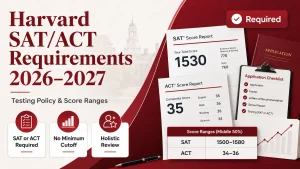
Harvard 2026 Testing Policy
Do You Know Harvard’s Current SAT/ACT Requirements?
Before finalizing your Harvard essays, make sure your testing strategy is aligned with Harvard’s updated 2026 admissions policy, competitive SAT/ACT ranges, and score-review rules.
Read the Harvard SAT/ACT Guide →Harvard Supplemental Essays 2026–2027 at a Glance
| Harvard Prompt | Maximum | Main Job |
|---|---|---|
| Life Experiences and Contribution | 150 words | Experience → perspective → contribution |
| Disagreement and Learning | 150 words | Engagement → learning |
| Activities / Employment / Travel / Family | 150 words | Experience → shaping effect |
| Future Use of Harvard Education | 150 words | Direction → future use |
| Roommates: Top 3 Things | 150 words | Everyday personality |
All five Harvard Supplemental Essays are required for first-year Common App applicants.
Did the Harvard Supplemental Essays Change for 2026–2027?
No material prompt change appears in Harvard’s latest published guidance.
Harvard’s official Application Tips page was updated on September 23, 2026 and still lists the same five required short-answer questions with the same 150-word maximum for each.
That makes older advice about a long optional Harvard supplement outdated for the current standard first-year Common Application.
For Fall 2027 applicants, the relevant structure is:
five questions × 150 words maximum
One important caveat: QuestBridge applicants do not use exactly this same five-question structure. Harvard’s current QuestBridge route includes different supplemental-writing requirements, including a 150-word future-use question and a separate 400-word perspective question.
So this guide is specifically about the Harvard Supplemental Essays for Common Application first-year applicants.
Why the 150-Word Harvard Essay Limit Matters
A 150-word maximum changes how you should write the Harvard Supplemental Essays.
There is little room for:
long introductions;
extensive background;
generic admissions language;
résumé repetition;
multiple unrelated examples;
elaborate transitions;
conclusions that merely restate the opening.
But short does not mean superficial.
A strong response can still contain:
context → evidence → action or observation → reflection
The goal is not to squeeze a 500-word personal essay into 150 words.
The goal is to decide what Harvard actually needs to understand.
The goal is to decide what Harvard actually needs to understand.
Harvard Supplemental Essay Prompt 1: Life Experiences and Contribution
Official prompt
“Harvard values enrolling students with diverse perspectives and background experiences. How will the personal experiences that formed who you are today allow you to contribute to the Harvard community?”
Maximum: 150 words.
This initial Harvard Supplemental Essay fulfills two core objectives:
- 1 Highlight a background experience that meaningfully defined your identity.
- 2 Demonstrate how insights gained from that experience will drive your prospective contributions.
A recommended structure is:
experience → perspective or habit → current behavior → contribution
What Can You Write About?
The experience might involve:
family;
language;
culture;
geography;
work;
responsibility;
migration;
community;
caregiving;
school environment;
financial circumstances;
another sustained experience.
You do not need a dramatic story.
You also do not need to write an abstract essay about “diversity.”
You also do not need to write an abstract essay about “diversity.”
The strongest Harvard Supplemental Essays show the connection through evidence.
Weak vs. Strong Harvard Prompt 1 Approach
Weak:
“My diverse background has given me a unique perspective that I hope to bring to Harvard.”
The claim may be sincere, but it reveals little.
Stronger direction:
“Translating school documents for my parents taught me that information can be technically available and still difficult to use. I now notice when instructions assume knowledge that not everyone has.”
Now there is evidence.
The potential contribution can emerge naturally from the habit the experience created.
You Do Not Need to Manufacture “Harvard Fit”
Prompt 1 asks how your experiences may enable you to contribute.
It does not require a list of Harvard programs.
Do not force:
a professor;
course;
lab;
student organization;
famous Harvard resource
into the response unless it genuinely strengthens the answer.
The person and the experience should come first.
Harvard Supplemental Essay Prompt 2: Disagreement and Learning
Official prompt
Describe a time when you strongly disagreed with someone about an idea or issue. How did you communicate or engage with this person? What did you learn from this experience?
Maximum: 150 words.
This Harvard Supplemental Essay has three separate tasks:
disagreement → engagement → learning
A common mistake is spending nearly the entire response explaining the controversy and leaving ten words for reflection.
Do the opposite.
Give enough context to understand the disagreement, then focus on what you actually did.
Show the Engagement
Possible actions include:
asking a question;
listening;
testing evidence;
explaining your reasoning;
identifying an assumption;
changing part of your position;
acknowledging uncertainty;
reaching a compromise;
remaining in disagreement but understanding the issue differently.
Harvard’s broader first-year admissions guidance explicitly identifies willingness to respectfully engage with differing ideas and opinions as one of the factors it considers.
You Do Not Have to Win the Argument
Weak:
“I explained my evidence and eventually convinced him that my position was correct.”
That mainly demonstrates persuasion.
A stronger Harvard disagreement essay may end without agreement.
For example:
Stronger direction:
“I entered the conversation trying to defend our proposal. When she explained the problem from the perspective of the people expected to implement it, I realized we had been debating the solution without agreeing on what problem we were trying to solve.”
Now there is learning.
Avoid Generic Reflection
Weak:
“I learned that everyone has different opinions.”
Better:
“I learned to ask what evidence would change my own position before asking someone else to defend theirs.”
The second sentence describes behavioral change.
That is much stronger evidence.
Harvard Supplemental Essay Prompt 3: Activities, Employment, Travel or Family Responsibilities
Official prompt
Briefly describe any of your extracurricular activities, employment experience, travel, or family responsibilities that have shaped who you are.
Maximum: 150 words.
This Harvard Supplemental Essay should not become a second Activities List.
Harvard already receives your activities elsewhere in the Common Application.
The useful question is:
What does this response reveal that the activity title cannot?
Strong Prompt 3 Topics
You might discuss:
a part-time job;
caring for a sibling;
cooking for your family;
research;
a sports team;
an extracurricular activity;
travel;
employment;
a recurring family responsibility;
a responsibility that changed how you think or behave.
Harvard’s actual wording is useful because it places employment and family responsibilities alongside extracurricular activities.
That tells applicants that the experience does not need prestige.
Ordinary Responsibilities Can Be Strong Material
You do not need:
a national award;
a nonprofit;
an internship at a famous organization;
a leadership title;
extraordinary travel;
hundreds of volunteer hours.
Imagine a student who prepares dinner twice a week because both parents work late.
The essay could reveal:
planning;
adapting when ingredients are missing;
negotiating preferences;
caring for younger siblings;
learning when to ask for help.
That may tell Harvard considerably more than another résumé bullet.
A Useful Structure
For this Harvard Supplemental Essay:
responsibility → complication → response → shaping effect
Weak:
“Working at my family restaurant taught me responsibility and teamwork.”
Stronger:
“I learned that forgetting to label one takeout order did not create a problem for me; it created extra work for someone in the kitchen ten minutes later.”
Now the reader can see what responsibility means to this applicant.
Harvard Supplemental Essay Prompt 4: Future Use of a Harvard Education
Official prompt
“How do you hope to use your Harvard education in the future?”
Maximum: 150 words.
This Harvard Supplemental Essay asks for direction.
It does not require a binding career contract.
Harvard’s own application guidance acknowledges that students may change their academic interests after arriving at college.
You therefore do not need to pretend that you already know:
your eventual concentration;
exact career title;
employer;
graduate degree;
sector;
lifelong professional plan.
A Strong Prompt 4 Structure
Try:
problem or direction → what you want to understand → possible future use
For example:
“I want to understand why public systems that appear efficient from an institutional perspective can remain confusing to the people who actually use them.”
That gives the response a question.
The applicant can then explain what they hope to learn and how they may eventually apply that knowledge.
Do Not Turn Prompt 4 Into “Why Harvard?”
A frequent mistake in Harvard Supplemental Essays is using Prompt 4 to dump Harvard names.
You do not need to mention:
three courses;
two professors;
a research center;
a lab;
four organizations.
A genuinely relevant Harvard opportunity can help.
But the prompt asks:
How do you hope to use your Harvard education?
It does not ask:
How many Harvard webpages did you research?
Avoid Prestige as the Future Plan
Weak:
“Harvard's world-class faculty and network will prepare me to become a leader in my field.”
This could be written by almost anyone.
Better responses identify:
a problem;
system;
population;
research question;
professional direction;
type of impact.
Specific future reasoning is more useful than prestige language.
Harvard Supplemental Essay Prompt 5: Top 3 Things Your Roommates Might Like to Know
Official prompt
“Top 3 things your roommates might like to know about you.”
Maximum: 150 words.
This is the most explicitly everyday-personal of the Harvard Supplemental Essays.
Use that freedom.
The response might reveal:
routines;
sleep habits;
food;
hobbies;
humor;
music;
social preferences;
communication style;
small rituals;
what happens when you are stressed;
what sharing a room with you might actually be like.
Exactly Three Means Exactly Three
A simple structure can work perfectly:
- 1 One habit
- 2 One interest or quirk
- 3 One roommate-relevant preference
You do not need an elaborate narrative.
The three items should reveal different things.
Do Not Turn the Roommate Essay Into a Résumé
Weak:
- 1 I love intellectual conversations.
- 2 I am committed to excellence.
- 3 I hope to inspire the people around me.
After reading that, we still have little idea what sharing a room with the applicant would be like.
Stronger possibilities:
you wake up early but never turn on the overhead light;
stress makes you cook too much pasta;
you collect strange maps;
you need ten minutes of silence after waking;
you prefer solving small roommate problems immediately rather than letting them grow.
Ordinary details can create a much more memorable response.
Harvard even published a student piece explaining that first-year roommates are assigned based in part on a housing questionnaire about real living habits—another reminder that roommate life at Harvard is quite literal, not merely a metaphor for intellectual community.
Review Your Harvard Essays Before Submitting
Harvard Supplemental Essay Grader
Review your five Harvard first-year short-answer responses for a direct answer to each prompt, specific evidence, and genuine reflection across the whole portfolio you submit.
Harvard 2026–2027 first-year writing focus: All five short-answer prompts are required (150 words or fewer each). Harvard asks every applicant to answer the same five prompts, so the grader reads the five responses as one portfolio and still reports criterion-level feedback for every prompt.
What You’ll Get From Your Harvard Review
See whether each response answers its own prompt directly with specific evidence and genuine reflection — feedback first, score second.
Direct Response to the Prompt
Specificity and Evidence
Reflection and Meaning
Independent Second Opinion
Paste your five Harvard responses below to get criterion-level feedback for every prompt, portfolio-level revision priorities, and a saved review.
Your account includes 1 free essay review for life. Paid Universal Credits are always used first.
Required Response 1 — Life Experiences and Contribution
Harvard has long recognized the importance of enrolling a student body with a diversity of perspectives and experiences. How will the life experiences that shaped who you are today enable you to contribute to Harvard? 150 words or fewer.
Words: 0 / 150
Describe a time when you strongly disagreed with someone about an idea or issue. How did you communicate or engage with this person? What did you learn from this experience? 150 words or fewer.
Words: 0 / 150
Briefly describe any of your extracurricular activities, employment experience, travel, or family responsibilities that have shaped who you are. 150 words or fewer.
Words: 0 / 150
How do you hope to use your Harvard education in the future? 150 words or fewer.
Words: 0 / 150
Top 3 things your roommates might like to know about you. 150 words or fewer.
Words: 0 / 150
Elite Second Opinion
Get an independent second review of the same Harvard responses and compare where both evaluations agree or differ.
Complete and save a Harvard review to unlock this option.
Buy More CreditsNeed more reviews now?
Need more credits?
View all pricing plans →
Instant activation after payment. 1 Universal Credit = 1 comprehensive Harvard supplement review.
How the Five Harvard Supplemental Essays Should Work Together
You should not make all five Harvard Supplemental Essays prove the same quality.
The prompts already create different opportunities:
| Prompt | Useful Dimension |
|---|---|
| Prompt 1 | Experience + contribution |
| Prompt 2 | Disagreement + learning |
| Prompt 3 | Responsibility + shaping experience |
| Prompt 4 | Future direction |
| Prompt 5 | Everyday personality |
Read all five consecutively.
Ask:
Am I repeating the same story?
Am I using the same activity multiple times?
Does each response reveal something new?
Does every answer still sound like the same person?
Is one part of my life dominating the entire supplement?
Is an important dimension missing?
The goal is not mathematical balance.
It is efficient use of limited application space.
Specificity Matters More Than Grandness
A recurring weakness in Harvard Supplemental Essays is abstraction.
A recurring weakness in Harvard Supplemental Essays is abstraction.
Compare:
Abstract:“Working at my family business taught me responsibility.”
with:
Concrete evidence:
“I learned that forgetting to label one order created extra work for somebody in the kitchen ten minutes later.”
The second provides evidence.
Specificity can come from:
an object;
action;
short interaction;
decision;
exact responsibility;
mistake;
observation;
behavioral change.
The event does not need to be extraordinary.
It needs to be concrete enough that the reflection feels earned.
Reflection Should Grow From Evidence
A strong Harvard Supplemental Essay usually answers more than:
What happened?Ask:
What did I originally assume?
What did I notice?
What surprised me?
What changed?
Why did the change matter?
What do I do differently now?
Reflection does not have to sound philosophical.
For example:
“I learned that reliability does not always mean following the original plan; sometimes it means adapting without turning the disruption into someone else's problem.”
The reflection works because it describes an actual change in understanding.
Common Harvard Supplemental Essay Mistakes
1. Treating Prompt 1 as an Abstract Diversity Essay
Do not spend 100 words defining diversity.
Show an experience and what developed from it.
2. Winning Prompt 2
Harvard asks how you engaged and what you learned.
Being right is not the same as learning.
3. Rewriting the Activities List
Prompt 3 should reveal what the activity or responsibility did to you—not simply what you did.
4. Pretending Your Future Is Completely Fixed
Prompt 4 needs direction, not artificial certainty.
5. Stuffing Prompt 4 With Harvard Names
One accurate, meaningful connection can help.
A catalog usually cannot.
6. Turning Prompt 5 Into Another Achievement Essay
Use the roommate prompt to show something different.
7. Writing Five Versions of the Same Applicant
Repeated stories waste scarce space.
8. Generic “Harvard Fit”
Harvard explicitly states there is no typical Harvard student or ideal Harvard applicant.
Do not imitate an imaginary Harvard personality.
9. Over-Polishing the Voice
A short answer that sounds like a professional admissions consultant may lose the applicant.
Harvard says an applicant's essays should reflect their own content, writing style and English proficiency.
How to Revise a 150-Word Harvard Supplemental Essay
Do not assume you need to write 400 words and cut them down.
That can produce a compressed essay designed for the wrong format.
Instead:
- 1 Write one sentence that directly answers the question.
- 2 Identify the strongest evidence.
- 3 Add only the context needed to understand it.
- 4 Explain why it matters.
- 5 Delete everything that does not serve those jobs.
Look especially for:
generic openings;
résumé language;
unnecessary adjectives;
repeated ideas;
broad claims without evidence;
long scene-setting;
conclusions that repeat the introduction.
In Harvard Supplemental Essays, every sentence needs a job.
Can You Use AI on the Harvard Supplemental Essays?
Harvard has explicit guidance on application-writing authenticity.
Harvard says the student's essay should reflect the applicant's own content, writing style, and English proficiency. It also points to the Common Application certification that submitted materials must be the applicant's own work and honestly presented. Harvard specifically warns that presenting the substantive output of an AI system as one's own original work can violate application standards.
For the Harvard Supplemental Essays, that means AI can be much safer as a revision tool than as a ghostwriter.
Reasonable uses include:
identifying repetition;
testing whether the prompt was actually answered;
spotting unclear passages;
checking grammar;
identifying generic reflection;
suggesting questions the applicant should answer themselves.
Do not use AI to invent:
experiences;
dialogue;
accomplishments;
emotional reactions;
family circumstances;
future goals;
Harvard-specific facts.
The underlying content and voice need to remain yours.
How the Harvard Supplemental Essay Grader Reviews Your Five Responses
The current Harvard Supplemental Essay Grader follows the Fall 2027 five-response structure.
It evaluates all five required answers and looks for areas such as:
Direct Response to the Prompt
Specificity and Evidence
Reflection and Meaning
Cross-response strengths
Portfolio-level revision priorities
Each response is still evaluated against its own prompt.
The grader does not assume that the roommate essay and disagreement essay should demonstrate the same qualities.
Prompt-by-Prompt Feedback, Portfolio-Level Review
A useful review of the Harvard Supplemental Essays needs two levels.
First:
Does each response answer its own question?
Second:
What do all five responses reveal together?
That can uncover problems such as:
the same experience appearing repeatedly;
several responses making the same point;
all five answers being achievement-focused;
a missing personal dimension;
generic reflection across multiple prompts.
The goal is feedback first, score second.
Independent Second Opinion
The current Harvard grader also supports an Independent Second Opinion.
That gives you another evaluation of the same submitted responses so you can compare where two independent reviews:
agree;
disagree;
identify the same strengths;
identify different concerns;
converge on revision priorities.
The score remains diagnostic.
It is not an admission probability and should not be interpreted as a prediction of what Harvard's admissions committee will decide.
Use Feedback Without Replacing Your Voice
If feedback says a Harvard Supplemental Essay needs more specificity, return to what actually happened.
Do not invent a better story.
If the grader asks for clearer reflection, explain what you genuinely thought, noticed, changed, or learned.
Do not fabricate:
conversations;
outcomes;
Harvard programs;
responsibilities;
emotional responses;
accomplishments.
If a suggested revision cannot be supported truthfully, use a different revision.
Harvard Testing Requirements for 2026–2027 Applicants
Harvard currently requires first-year applicants to submit the SAT or ACT.
In exceptional circumstances where those tests are genuinely inaccessible, Harvard allows certain alternatives:
AP exam results;
IB actual or predicted scores;
GCSE/A-Level actual or predicted results;
national leaving examination results or predictions.
Harvard says these alternatives are intended for exceptional situations involving genuine problems with access, cost, available seats, or similar circumstances—not as a standard alternative for applicants who could reasonably take the SAT or ACT.
Testing remains only one part of the broader application.
Harvard Supplemental Essays FAQ
How many Harvard Supplemental Essays are required for 2026–2027?
Harvard currently requires five short-answer responses for first-year Common Application applicants.
What is the Harvard supplemental essay word limit?
Each of the five Harvard Supplemental Essays has a maximum of 150 words.
Did the Harvard essay prompts change for Fall 2027?
Harvard's latest official Application Tips page, updated September 23, 2026, continues to list the same five prompts and 150-word limits.
Are the Harvard Supplemental Essays optional?
No. The five short-answer questions are required for the standard first-year Common Application route. Harvard states that the application is not complete until the supplement is submitted
Does Harvard still have an optional long supplemental essay?
The current standard Common App supplement is built around the five required short answers. Applicants should follow the current application rather than older essay structures.
Are Harvard QuestBridge essays the same?
No. Harvard's QuestBridge route has a different supplemental-writing structure, so QuestBridge applicants should follow Harvard's QuestBridge requirements rather than using this five-question checklist.
Should Prompt 1 be about diversity?
It can involve background or perspective, but the prompt is broader. The core task is to connect a life experience with the contribution that may grow from it.
Do I have to resolve the disagreement in Prompt 2?
No. The important questions are how you engaged and what you learned.
Should Prompt 3 show leadership?
No. Harvard explicitly allows extracurricular activity, employment, travel and family responsibilities.
Do I need to know exactly what career I want for Prompt 4?
No. Harvard recognizes that students may change their academic interests. A coherent direction is enough.
Should Prompt 5 be academic?
No. It is an opportunity to show everyday personality and what sharing living space with you might actually be like.
Should I mention Harvard programs in every essay?
No. Use Harvard-specific details only when they genuinely strengthen the response.
Can I use AI to write my Harvard Supplemental Essays?
Harvard says submitted essays should reflect the applicant's own content, writing style, and English proficiency, and warns against presenting substantive AI-generated material as one's own original work.
Does Harvard require the SAT or ACT?
Yes. Harvard currently requires the SAT or ACT, with specified alternatives allowed in exceptional circumstances when those exams are not accessible
Harvard Supplemental Essays Final Checklist
Before submitting your Harvard Supplemental Essays, check:
✓
I answered all five required questions.
✓
Every response is 150 words or fewer.
✓
Each response directly answers its own prompt.
✓
Prompt 1 connects experience with contribution.
✓
Prompt 2 shows engagement and learning rather than victory.
✓
Prompt 3 adds information beyond my Activities List.
✓
Prompt 4 communicates direction without artificial certainty.
✓
Prompt 5 contains exactly three useful roommate-relevant details.
✓
I used specific, truthful evidence where appropriate.
✓
I avoided repeating the same activity across multiple responses.
✓
I did not force Harvard names where they add nothing.
✓
I avoided prestige language.
✓
The five responses reveal different dimensions of me.
✓
The writing still sounds like me.
✓
Every factual claim is accurate.
✓
I checked Harvard's current requirements before submitting.
Final Strategy for the Harvard Supplemental Essays 2026–2027
The Harvard Supplemental Essays 2026–2027 do not require five dramatic stories.
They require five concise answers to five different questions.
Use Prompt 1 to connect experience with contribution.
Use Prompt 2 to show engagement with disagreement and genuine learning.
Use Prompt 3 to explain how a real activity, job, trip or responsibility shaped you.
Use Prompt 4 to describe a meaningful but appropriately flexible future direction.
Use Prompt 5 to reveal everyday personality that the rest of the application may never show.
Across all five Harvard Supplemental Essays, prioritize:
evidence over slogans → reflection over résumé repetition → specificity over grandness → authentic voice over imagined Harvard polish
Harvard says its admissions process considers the whole applicant and that there is no ideal Harvard profile.
Your job is therefore not to manufacture one.
Your job is to give Harvard five short, credible pieces of information that help the admissions reader understand the person behind the rest of the application.
Explore More University Essay Graders
Compare your Harvard Supplemental Essays with other university-specific graders built around each school's current prompts, limits, and evaluation context.
These tools review prompt fulfillment, specific evidence, applicant-owned reasoning, reflection, personal voice, and portfolio-level strategy—not simply grammar or writing style.
If you are also revising your Common App Personal Statement, review it separately so the main essay adds something different from your Harvard short answers instead of repeating the same story.