
MIT Supplemental Essay Grader 2026–2027: New Fall 2027 Prompts, Short Answers & Essay Changes
Table
- MIT Supplemental Essay Grader 2026–2027: What Changed for Fall 2027?
- MIT Added Four 40–50 Word Short Responses
- The Biggest MIT Essay Change: Eight Responses Need to Work Together
- A Major Fall 2027 Prompt Change: Problems and Community Impact
- MIT Still Says This Is Not a Writing Test
- MIT Supplemental Essay Grader
- My Essay Reviews
- How to Approach the Four Main MIT Essays for 2026–2027
- How to Approach the Four MIT Short Takes
- What MIT Applicants Should Avoid in 2026–2027
- Avoid the Generic STEM Trap
- You Do Not Need MIT Name-Dropping to Write a Strong Essay
- Avoid the Résumé Dump
- Ordinary Experiences Can Make Excellent MIT Essays
- Do Not Manufacture a “Genius Applicant” Voice
- The Optional MIT Additional Information Box
- How the MIT Supplemental Essay Grader Reviews Your Fall 2027 Responses
- Prompt-Specific Feedback Instead of Generic Admissions Indexes
- Feedback First, Score Second
- Portfolio-Level Feedback Matters
- Elite Second Opinion
- Compare Both Evaluations
- Shared Revision Priorities
- Report a Problem With a Review
- Use My Reviews to Track Your MIT Essay Revisions
- Common MIT Supplemental Essay Mistakes
- How to Improve Your MIT Supplemental Essays
- Should You Mention MIT Programs or Resources?
- Do MIT Essays Need to Be Perfect?
- Use the MIT Supplemental Essay Grader Before You Submit
- Explore More Top STEM & Tech University Essay Graders
The MIT Supplemental Essay Grader has been updated for the 2026–2027 application cycle and Fall 2027 admission. MIT has changed the structure of its supplemental writing, and older guides that still describe the previous essay format may now be outdated.
For Fall 2027 applicants, MIT currently asks students to complete four main short-answer essays of approximately 100–200 words each, followed by four much shorter responses of about 40–50 words each. MIT also provides one optional open-ended Additional Information box.
That means applicants now need to prepare eight distinct MIT responses, each serving a different purpose.
Before using the MIT Supplemental Essay Grader, it is important to understand exactly what changed this year, what MIT is now asking, and how the new 2026–2027 structure changes your essay strategy.
MIT Supplemental Essay Grader 2026–2027: What Changed for Fall 2027?
The biggest change is the structure of the MIT writing supplement.
MIT’s current official admissions page lists four primary short-answer essay questions for the 2026–2027 application:
- Field of Study: What field of study appeals to you most right now, and what led you to that interest?
- Unexpected Educational Path: How have you done something different from what was expected in your educational journey?
- Problems and Community Impact: How have your personal and academic experiences influenced the types of problems you would want to tackle with an MIT education and the impact you aim to make on your community?
- Unexpected Challenge: How did you manage a situation or challenge you did not expect, and what did you learn from it?
MIT says these responses should generally be approximately 100–200 words each, depending on the question.
This current structure differs from older MIT essay guides that may describe a different set of prompts or a five-question supplement.
The MIT Supplemental Essay Grader now follows this current Fall 2027 structure instead of relying on outdated MIT prompts.
Before writing or submitting your MIT responses, always confirm the current requirements on MIT’s official admissions page: MIT Admissions — Essays, Activities & Academics .
MIT Added Four 40–50 Word Short Responses
In addition to the four main essays, MIT now asks applicants to answer four very short questions with only 40–50 words available for each response:
- What do you do just for fun?
- Who is someone you admire, whether you know them personally or look up to them from afar, and why?
- What academic or non-academic topic could you talk about for hours?
- Do you consider yourself more of a generalist with varied interests or a specialist who focuses deeply on one or a few passions, and why?
MIT says these questions are designed to help the admissions office get to know applicants better.
These short takes are not filler.
With only 40–50 words available, applicants cannot rely on lengthy context, elaborate storytelling, or several paragraphs of reflection. Each answer needs to communicate one clear idea efficiently.
That creates a very different writing challenge from a traditional 500- or 650-word college essay.
The Biggest MIT Essay Change: Eight Responses Need to Work Together
The new structure gives MIT more opportunities to see different sides of an applicant.
Across the eight responses, MIT can learn about:
- your academic direction;
- how you make educational choices;
- which problems matter to you;
- the community impact you hope to make;
- how you respond when plans fail;
- what you genuinely enjoy;
- which qualities you admire in other people;
- what captures your curiosity;
- whether you naturally explore broadly or specialize deeply.
That means repeating the same robotics competition, research project, leadership role, award, or extracurricular story across several answers can waste valuable space.
A strong MIT supplement should create range across the portfolio.
Your Field of Study response does not need to repeat the same story used in Unexpected Challenge.
Your Just for Fun response does not need to secretly become another STEM achievement.
And your Topic for Hours response does not need to prove that you are academically impressive.
Each answer has a different job.rengths, weaknesses, actionable improvements, an improved direction, and a final admissions-style comment.
A Major Fall 2027 Prompt Change: Problems and Community Impact
This is one section where applicants should be particularly careful with older MIT essay guides.
For 2026–2027, MIT asks how your personal and academic experiences have influenced the problems you would want to tackle with an MIT education and the impact you aim to make on your community.
Older wording or third-party guides may describe this prompt differently.
The current response should answer questions such as:
What experiences led you to care about this particular problem?
What specifically about the problem interests you?
What kind of impact would you realistically hope to make?
This should not become a generic:
“I want to use technology to change the world.”
A specific local problem with a credible connection to your own experiences can be considerably stronger than a huge claim about solving an entire global issue.
MIT Still Says This Is Not a Writing Test
MIT’s own guidance is unusually clear: the short responses are not a writing test.
MIT tells students to be honest, open, and authentic, and specifically warns applicants against spending excessive time trying to strategize about what makes them “look best” rather than giving honest answers.
That matters.
You do not need to write like:
- a professional researcher;
- a startup founder;
- a technical journal;
- an admissions consultant;
- an imaginary teenage genius.
Strong responses often show something much more useful: how you actually think and act.
That can include:
- building;
- testing;
- fixing;
- observing;
- debugging;
- measuring;
- questioning;
- revising;
- experimenting;
- collaborating;
- changing an approach when something fails.
MIT also says it values curiosity, intensity, community responsibility, and balance rather than expecting students to accumulate an enormous number of activities.
MIT Supplemental Essay Grader
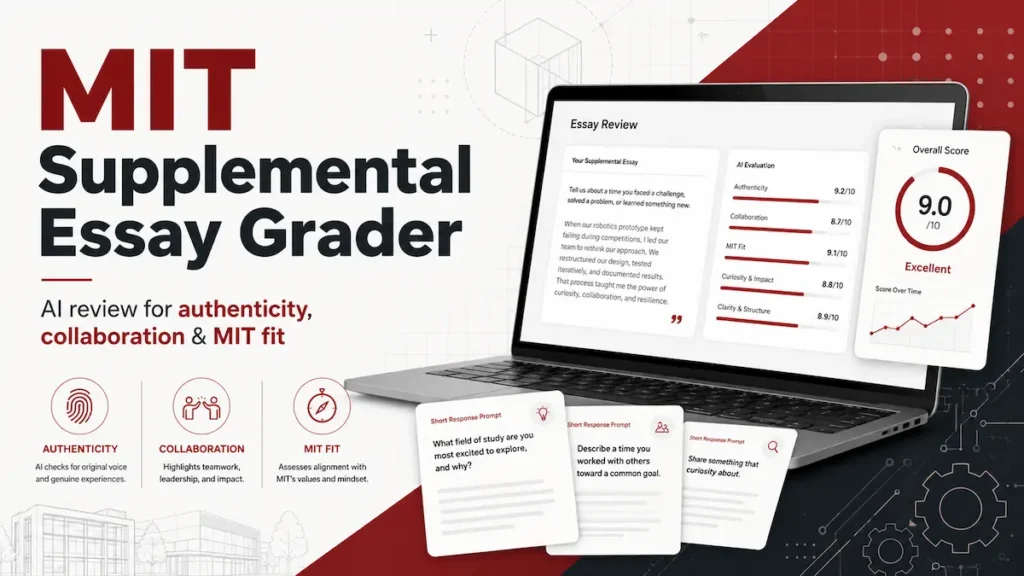
Review your MIT short responses for authenticity, hands-on curiosity, collaboration, humility, and fit with MIT’s intense problem-solving culture.
MIT 2026–2027 essay focus: This grader reviews the complete set of four main short answers, four 40–50 word short takes, and the optional additional-information response when provided. Strong responses are direct, human, curious, collaborative, and specific.
What You’ll Get From Your MIT Review
Prompt-Specific Scoring
Evidence-Based Feedback
Independent Evaluation
Actionable Revision Priorities
Full Portfolio Consistency Check
MIT-Specific Prompt Coverage
Each response uses criteria written for that exact MIT question, with feedback grounded in verified literal excerpts from your writing. Add an optional Elite Second Opinion and compare both reviews locally.
Your account includes 1 free essay review for life. Paid Universal Credits are always used first.
What field of study appeals to you the most right now? (Applicants select from a drop-down list.) Reflect on what has led you to this interest. 200 words or fewer.
Words: 0 / 200
While some reach their goals following well-trodden paths, others blaze their own trails achieving the unexpected. In what ways have you done something different than what was expected in your educational journey? 200 words or fewer.
Words: 0 / 200
How have your personal and academic experiences influenced the types of problems you would want to tackle with an MIT education and the impact you aim to make on your community? 200 words or fewer.
Words: 0 / 200
How did you manage a situation or challenge that you didn’t expect? What did you learn from it? 200 words or fewer.
Words: 0 / 200
40–50 words.
Words: 0 / 50
40–50 words.
Words: 0 / 50
40–50 words.
Words: 0 / 50
40–50 words.
Words: 0 / 50
Anything else essential that the application does not already cover. 200 words or fewer. It is stored with your submission and never scored.
Words: 0 / 200
Elite Second Opinion
Get an independent second review of the same MIT responses and compare where both evaluations agree or differ.
Complete and save a MIT review to unlock this option.
Buy More CreditsNeed more reviews now?
Need more credits?
View all pricing plans →
Instant activation after payment. 1 Universal Credit = 1 comprehensive MIT supplement review.
How to Approach the Four Main MIT Essays for 2026–2027
Each of the four primary MIT essays serves a different purpose.
Your goal is not to make all four answers equally impressive.
Your goal is to make each answer reveal something useful that the others do not.
Field of Study
MIT asks which field of study appeals to you most right now and what led you to that interest.
This is not simply a request to name your intended major.
The important part is:
What led you there?
Weak:
“I have always loved engineering because I enjoy solving problems.”
That tells the reader almost nothing.
A stronger response might show:
- a particular mechanism you tried to understand;
- something you built;
- something that broke;
- a scientific question;
- a class that changed how you viewed a problem;
- an independent project;
- an observation that became an obsession;
- a progression from one interest into another.
The strongest responses usually show development, not simply declaration.
The MIT Supplemental Essay Grader therefore looks for more than whether you named a field. It evaluates whether the response explains how that interest emerged and whether your evidence makes the interest believable.
Unexpected Educational Path
MIT asks how you have done something different from what was expected in your educational journey.
This does not require rebellion.
And it does not require an extraordinary educational background.
A meaningful answer might involve:
- choosing an unexpected course;
- studying something independently;
- changing academic direction;
- attending community college;
- pursuing depth when others expected breadth;
- balancing school with work;
- balancing school with family responsibility;
- learning outside a traditional classroom;
- questioning the educational path others expected you to follow.
A useful structure is:
What was expected → what you did differently → why that decision mattered.
The key is not merely proving that your path was unusual.
The response should reveal something about your agency, curiosity, priorities, or way of learning.
Problems and Community Impact
Start with experience, not ambition.
Weak:
“I want to use engineering to improve transportation.”
Better:
Show the experience that made transportation a problem you actually think about.
Maybe:
- your bus was routinely unreliable;
- a family member had difficulty reaching work;
- you began comparing transit maps;
- a class introduced you to optimization;
- you noticed a recurring scheduling problem;
- a project exposed you to a technical constraint you had never considered.
Then explain what kind of impact would matter.
The strongest response connects:
Experience → problem → intellectual direction → realistic community impact.
The intended impact should be credible and proportional.
You do not need to promise to transform an entire industry.
Unexpected Challenge
MIT asks how you managed an unexpected challenge and what you learned from it.
This is fundamentally an adaptability prompt.
A useful structure is:
Situation → first response → adjustment → learning.
The most informative part is often the adjustment.
What did you do when your initial plan stopped working?
Did you:
- ask someone for help;
- change your method;
- reorganize responsibilities;
- reconsider an assumption;
- test another solution;
- learn something you had previously ignored?
A perfect victory story is unnecessary.
A response where something went wrong but genuinely changed your approach can be much more revealing.
How to Approach the Four MIT Short Takes
These 40–50 word responses should not be treated like miniature 200-word essays.
You have space for one central idea.
Specificity matters more than coverage.
What Do You Do Just for Fun?
Answer the question MIT actually asked.
What do you enjoy doing when you are not trying to impress anyone?
Your response can be about:
- cooking;
- gaming;
- chess;
- running;
- drawing;
- music;
- repairing things;
- collecting something;
- obscure maps;
- watching airplanes;
- hiking;
- reading strange historical topics;
- experimenting with recipes;
- playing with your dog.
MIT explicitly discusses the importance of balancing work and play and says its fun-related question is not a trick.
You do not need to convert fun into another accomplishment.
Weak:
“For fun, I develop machine-learning applications that improve healthcare access.”
Maybe that really is fun for you.
But if it is simply another attempt to prove achievement, the answer may reveal very little personality.
Who Is Someone You Admire?
The most important part of this response is usually not who you choose.
It is why.
A famous scientist is not automatically better than:
- your mother;
- your older cousin;
- a teacher;
- your boss;
- a mechanic;
- your neighbor;
- a teammate;
- a friend.
The quality you choose to notice can reveal your own values.
Instead of listing accomplishments, show the behavior or characteristic you genuinely respect.
What Topic Could You Talk About for Hours?
This is a curiosity prompt.
Weak:
“Artificial intelligence.”
That is a category, not yet a revealing answer.
Go one level deeper.
What about AI?
Or transportation?
Or music theory?
Or history?
Or baseball analytics?
What question, mechanism, contradiction, tradeoff, debate, or obscure detail keeps pulling you back?
A highly specific non-academic interest can be stronger than an impressive-sounding academic topic if the specificity makes your curiosity believable.
Generalist or Specialist?
MIT explicitly says it values both generalists and specialists.
Therefore, there is no correct strategic answer.
Do not choose “specialist” because it sounds intellectually serious.
Do not choose “generalist” because you think MIT wants interdisciplinary students.
Explain how your curiosity actually behaves.
A specialist might explain why one particular type of problem keeps drawing them deeper.
A generalist might show how a question in economics leads to mathematics, then to transportation, then to history.
The explanation matters more than the label.
What MIT Applicants Should Avoid in 2026–2027
The current eight-response structure makes certain mistakes particularly visible.
Common problems include:
- repeating the same activity across several essays;
- using generic STEM language;
- trying to sound artificially brilliant;
- excessive jargon;
- résumé dumping;
- prestige-driven MIT name-dropping;
- describing a field without explaining the origin of the interest;
- claiming enormous impact without showing a credible mechanism;
- telling a challenge story without showing adaptation;
- making every response academic;
- turning the Just for Fun answer into another achievement;
- giving abstract personality claims instead of concrete evidence;
- treating the 40–50 word short takes like miniature personal statements.
Avoid the Generic STEM Trap
One of the easiest ways to weaken an MIT essay is to sound interchangeable with thousands of other academically strong STEM applicants.
Generic statements include:
- “I love solving problems.”
- “Technology can change the world.”
- “I have always been passionate about science.”
- “I want to innovate.”
- “MIT has brilliant students.”
- “I want to make an impact.”
None of those ideas is automatically wrong.
The problem is that they reveal very little about you.
Compare:
“I love mechanical engineering because I enjoy solving problems.”
with:
a response that describes why a particular mechanism repeatedly failed, what you originally assumed, and what changed when you applied a physics concept to diagnose it.
The second answer gives the reader evidence.
Specificity makes curiosity believable.
You Do Not Need MIT Name-Dropping to Write a Strong Essay
Applicants often assume that a strong MIT response must mention:
- UROP;
- a famous professor;
- a laboratory;
- a course;
- a maker space;
- a department;
- a particular research group.
That is not automatically true.
MIT-specific resources can be useful when they naturally explain something important about your academic direction.
But mentioning an MIT program does not make an essay stronger simply because the name belongs to MIT.
Forced name-dropping can actually consume valuable space that could have been used to explain the applicant.
The MIT Supplemental Essay Grader does not award points simply because you inserted more MIT proper nouns.
It evaluates the quality of your response to the actual prompt.
Avoid the Résumé Dump
MIT allows applicants to list up to four activities that matter most to them, and MIT specifically tells students to use its application form rather than submitting a résumé for that section.
Your essays therefore do not need to reproduce your activities list.
Instead of:
Robotics captain. State finalist. Programming lead. Outreach coordinator. Won three awards.
one carefully chosen moment may reveal much more:
- the design failure you could not explain;
- the disagreement that changed the team's approach;
- the student who taught you something;
- the assumption you discovered was wrong;
- the moment a prototype finally behaved differently than expected.
Achievements provide context.
Essays should reveal the person making the decisions.
Ordinary Experiences Can Make Excellent MIT Essays
MIT essays do not require:
- prestigious internships;
- national awards;
- published research;
- nonprofit organizations;
- startup companies;
- formal leadership titles;
- exceptional hardship.
MIT explicitly acknowledges that applicants may spend significant time on family, work, or other obligations and that opportunities differ across communities.
A compelling response can come from:
- working at a family store;
- helping siblings;
- repairing bicycles;
- cooking;
- taking a community-college class;
- commuting by bus;
- helping a parent;
- an ordinary group presentation;
- discovering something during a school assignment.
The experience does not need prestige.
It needs to reveal something useful through specific evidence, reasoning, action, or reflection.
Do Not Manufacture a “Genius Applicant” Voice
Trying to sound intellectually impressive can make a response less effective.
Compare:
“I leveraged advanced computational methodologies to optimize system-level efficiencies.”
with a sentence that simply explains:
- what you measured;
- what did not work;
- what assumption failed;
- what tradeoff you noticed;
- what you changed.
Technical terminology is useful when the technical detail actually matters.
Jargon is not a substitute for intellectual depth.
MIT itself tells applicants not to over-strategize their responses and instead to be honest and authentic.
The Optional MIT Additional Information Box
MIT also includes a final open-ended Additional Information text box where applicants can share something else they believe MIT should know.
This box is optional.
Do not manufacture another essay simply because an empty field feels uncomfortable.
Additional Information can be useful when you need to explain:
- unusual academic circumstances;
- responsibilities;
- disruptions;
- educational context;
- information that does not fit elsewhere;
- something genuinely important to understanding your application.
If there is nothing meaningful to add, leaving it blank can be perfectly reasonable.
In the MIT Supplemental Essay Grader, this field is treated as optional context rather than another scored essay.
How the MIT Supplemental Essay Grader Reviews Your Fall 2027 Responses
Once you understand the new prompts, the MIT Supplemental Essay Grader becomes the additional layer that helps you test the actual drafts.
The tool evaluates the complete 2026–2027 MIT writing supplement rather than applying one generic essay rubric to everything.
That distinction matters.
A 40-word Just for Fun response should not be evaluated like a 200-word academic essay.
An Unexpected Challenge response requires different evidence from a Field of Study response.
Each prompt therefore has its own scoring criteria and maximum points.
The MIT Supplemental Essay Grader reviews:
- all four primary essays;
- all four short takes;
- the full response set as a portfolio;
- the Additional Information response as optional non-scoring context.
Prompt-Specific Feedback Instead of Generic Admissions Indexes
The current MIT Supplemental Essay Grader does not reduce your supplement to vague indexes such as “MIT Fit” or “Admissions Readiness.”
Instead, each response is evaluated against criteria designed for that specific prompt.
For every criterion, the grader can provide:
Criterion Points
You can see how strongly the response fulfilled that particular part of the prompt.
Reason
The evaluation explains why those points were awarded.
Verified Evidence
When the grader cites evidence, it uses text from your actual response.
That means the reasoning can be checked against what you really wrote.
Missing or Underdeveloped
If something important is absent or insufficiently developed, the grader identifies it explicitly.
If no material deficiency exists, it should not invent one simply because every essay “must have something wrong.”
Recommendation
When revision is needed, the recommendation should connect directly to the weakness already identified.
Strengths and Revision Priorities
Each response also includes a clearer summary of what is already working and what deserves attention first.
Next Best Action
Instead of leaving you with twenty disconnected comments, the grader identifies a practical next step.
Feedback First, Score Second
The MIT Supplemental Essay Grader provides a numerical score, but the number is secondary.
The score is not an admission probability.
It does not mean:
“You have an 87% chance of getting into MIT.”
MIT evaluates the complete application, including academics, testing, recommendations, activities, context, and many other factors.
The more useful question is:
Why did this response earn these points, and what evidence would make it stronger?
A response can already be strong and still contain an identifiable improvement opportunity.
Likewise, the grader does not artificially prevent excellent responses from earning maximum points.
A 100 is possible when the response provides affirmative evidence that fully satisfies the criteria.
But simply avoiding obvious mistakes does not automatically justify a perfect score.
Portfolio-Level Feedback Matters
A response can be excellent individually and still create a weaker overall supplement if every answer reveals the same side of you.
For example:
- Field of Study = robotics;
- Unexpected Path = robotics;
- Challenge = robotics;
- Topic for Hours = robotics;
- Just for Fun = robotics.
The individual stories might all be strong.
The portfolio may still feel narrow or repetitive.
The MIT Supplemental Essay Grader therefore looks across the complete response set for recurring strengths and revision priorities.
The goal is not to force artificial variety.
It is to identify situations where several prompts are wasting space by communicating essentially the same information.
Elite Second Opinion
After completing the Primary Evaluation, eligible students with paid Universal Credits can request an Elite Second Opinion.
This is an independent second evaluation of the same MIT responses.
Both evaluations use:
- the same MIT application cycle;
- the same prompts;
- the same rubrics;
- the same criteria;
- the same maximum points.
The independent evaluator does not receive the Primary Evaluation before evaluating the submission.
That means it can independently agree or disagree about how strongly a response satisfies individual criteria.
The purpose is not to manufacture identical scores.
A small difference between two independent evaluations is normal.
What matters is whether both identify similar evidence, strengths, and important weaknesses.
Compare Both Evaluations
After the Elite Second Opinion is complete, the MIT Supplemental Essay Grader can compare both evaluations side by side.
The comparison includes:
- Primary Evaluation;
- Independent Second Evaluation;
- Combined Evaluation Score;
- overall score difference;
- criterion-by-criterion comparisons;
- evidence selected by each evaluator;
- areas of agreement;
- areas where evaluator judgment differs;
- shared revision priorities;
- Primary-only concerns;
- second-opinion-only concerns.
The Combined Evaluation Score is simply the arithmetic average of the two evaluation scores.
It is calculated locally.
It is not a third AI evaluation.
That distinction matters because the comparison is designed to help interpret two independent judgments, not generate yet another opinion.
Eight MIT responses can produce a large amount of feedback.
Not all of it deserves equal attention.
The comparison therefore highlights concerns both evaluations identify as materially similar.
These shared revision priorities are especially useful because they point to weaknesses that survived independent review.
Neutral statements such as:
- “Maintain this quality.”
- “Submit as is.”
- “No material deficiency.”
- “Preserve this structure.”
are not treated as revision problems.
The goal is to separate genuine corrective feedback from positive maintenance advice.
Report a Problem With a Review
If a review appears to contain a genuine problem, users can report it directly from the evaluation.
This is intended for issues such as:
- incorrect feedback;
- technical problems;
- missing content;
- a review that appears inconsistent with the submitted response.
Reporting a problem does not consume another essay-review credit.
Use My Reviews to Track Your MIT Essay Revisions
Completed evaluations can be saved to My Reviews, allowing students to return to earlier feedback rather than losing it when they leave the page.
A useful workflow is:
Draft → Primary Evaluation → Read the evidence → Revise → Review again
If you choose to use the independent second evaluation:
Primary Evaluation → Elite Second Opinion → Compare Both Evaluations → Revise
The goal is not to endlessly chase a higher number.
The goal is to use specific feedback to make the next draft better.
Common MIT Supplemental Essay Mistakes
The MIT Supplemental Essay Grader is particularly useful for identifying issues such as:
- answering only part of the prompt;
- describing an academic field without explaining what created the interest;
- calling something an unconventional path without establishing what was expected;
- describing a large problem with no connection to personal or academic experience;
- claiming huge community impact without a credible mechanism;
- telling a challenge story without showing adaptation;
- treating a short take like a résumé bullet;
- using generic STEM language;
- replacing evidence with technical jargon;
- repeating the same activity across several responses;
- giving abstract personality claims instead of observable details;
- using MIT name-dropping instead of personal reasoning;
- writing short takes that sound manufactured rather than human.
How to Improve Your MIT Supplemental Essays
Before revising, identify the lowest-value sentence in each answer.
That is not necessarily the sentence with the weakest grammar.
It is the sentence consuming words without telling MIT much about you.
Ask:
Could thousands of applicants plausibly write this exact sentence?
If yes, it may need more specificity.
Improve the Field of Study Essay
Replace broad declarations with:
- a concrete question;
- a mechanism;
- a project;
- an observation;
- a discovery;
- a technical problem;
- a moment when your understanding changed.
Do not merely explain that the field is interesting.
Show why you became interested in it.
Improve the Unexpected Educational Path Essay
Make the contrast visible.
What was expected?
What did you actually do?
Why?
What changed afterward?
The strongest answer generally needs both the decision and its significance.
Improve Problems and Community Impact
Ground the problem in something you experienced, observed, studied, or worked on.
Then make the intended impact specific enough that the reader can understand what improvement might actually look like.
Avoid inflated promises.
Improve the Unexpected Challenge Essay
Do not spend the entire response describing what went wrong.
Show the adaptation.
What did you change?
Why did you change it?
What do you now do differently because of that experience?
Improve the MIT Short Takes
With only 40–50 words, one memorable detail is often more valuable than three generic claims.
Instead of trying to cover everything, choose one specific idea and make every sentence earn its space.
Should You Mention MIT Programs or Resources?
Sometimes.
But only when the reference genuinely contributes to the response.
Mentioning UROP or a particular laboratory can be useful when the opportunity directly connects to a clearly established interest.
It is weaker when the essay essentially says:
“MIT has UROP, therefore MIT is perfect for me.”
The current main MIT prompts are primarily asking about you.
Keep the applicant at the center of the response.
Do MIT Essays Need to Be Perfect?
No.
In fact, trying to make every answer sound perfectly polished can remove personality.
MIT says these questions are designed to help the admissions office get to know applicants and explicitly frames the process as something other than a writing test.
Your response still needs to be clear.
But clarity and authenticity are more valuable than unnecessary sophistication.
A 45-word answer that sounds recognizably human can do its job better than an overengineered answer filled with admissions language.
Use the MIT Supplemental Essay Grader Before You Submit
The MIT Supplemental Essay Grader gives applicants a structured way to review the complete Fall 2027 MIT supplement using the actual 2026–2027 response structure.
First, understand what MIT changed this year.
Then make sure each response is doing a different job.
Finally, use the grader to identify:
- what your writing actually demonstrates;
- which evidence supports that judgment;
- what is missing;
- which responses are strongest;
- which revision should come first;
- whether the portfolio becomes repetitive;
- where two independent evaluations agree or differ.
MIT’s new eight-response structure rewards range.
Across the full supplement, admissions readers can learn how you choose an academic direction, make educational decisions, think about real problems, react to uncertainty, enjoy your free time, admire other people, pursue curiosity, and understand your own learning style.
The goal is not to construct an imaginary perfect MIT applicant.
It is to make each answer specific enough, clear enough, and honest enough that the person behind the application becomes easier to understand.
And once your drafts are ready, the MIT Supplemental Essay Grader gives you a second layer of structured feedback before you submit.
Explore More Top STEM & Tech University Essay Graders
Applying to several top STEM and technology universities? Explore our complete collection of AI-powered essay graders designed for highly selective engineering, computer science, and innovation-focused institutions.