UPenn Supplemental Essays 2026–2027: Official Fall 2027 Prompts, School Essays & Strategy Guide
Table
- UPenn Supplemental Essays 2026–2027 at a Glance
- What Changed in the UPenn Supplemental Essays for 2026–2027?
- How Many UPenn Supplemental Essays Are Required?
- UPenn Supplemental Essay Prompt 1: Thank-You Note
- UPenn Supplemental Essay Prompt 2: Exploring Community at Penn
- The Two Directions of the Penn Community Essay
- Penn Community Specificity Without Name-Dropping
- UPenn School-Specific Essays 2026–2027
- College of Arts and Sciences Supplemental Essay
- Wharton Supplemental Essay 2026–2027
- Penn Engineering Supplemental Essay
- Penn Nursing Supplemental Essay
- Specialized Penn Programs Require Additional Essays
- Huntsman Supplemental Essays
- LSM Supplemental Essay
- M&T Supplemental Essays
- NHCM Supplemental Essay
- VIPER Supplemental Essays
- VIC Supplemental Essay
- Penn Supplemental Essay Grader
- What You'll Get From Your Review
- ${escape(title)}
- Evaluation Comparison
- Elite Second Opinion
- My Essay Reviews
- What Does Penn Officially Say Makes Strong Writing?
- Specificity Is Not the Same as Name-Dropping
- Avoid Résumé Dumping in the UPenn Supplemental Essays
- Avoid the Prestige Trap
- Penn’s Current AI Policy for Application Essays
- How the UPenn Supplemental Essay Grader Works
- What the Grader Reviews by School
- Elite Second Opinion for UPenn Supplemental Essays
- Common UPenn Supplemental Essay Mistakes
- How Should Your UPenn Supplemental Essays Work Together?
- UPenn Supplemental Essays FAQ
- UPenn Supplemental Essays Final Checklist
- Final Strategy for the UPenn Supplemental Essays 2026–2027
- Explore More University Essay Graders
Last updated: October 2026 for the 2026–2027 application cycle and Fall 2027 entry. Verified against the University of Pennsylvania’s official 2026–27 Writing page.
The UPenn Supplemental Essays for 2026–2027 include two responses required of every Penn applicant plus one short answer tied to the undergraduate school you select. Applicants to certain coordinated dual-degree or specialized programs must complete additional program-specific writing.
For most Fall 2027 first-year applicants, the current UPenn Supplemental Essays consist of:
Thank-You Note: 50–200 words
Exploring Community at Penn: 50–200 words
School-Specific Response: 50–200 words
Additional specialized-program essays: only when your selected Penn program requires them
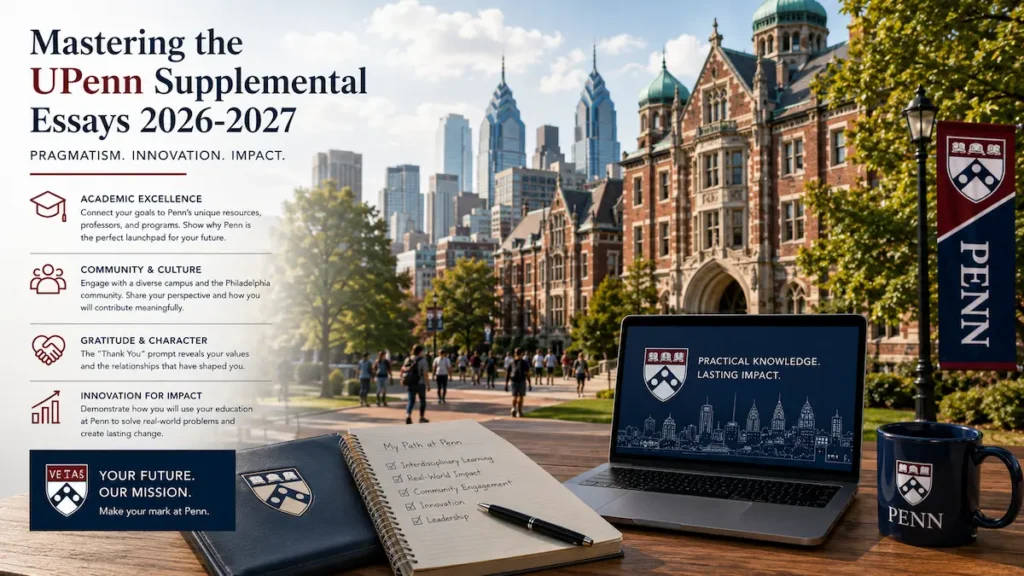
Penn’s official 2026–27 Writing page says there are two prompts for all applicants and then a school-specific response based on the undergraduate school selected. Penn also tells coordinated dual-degree and specialized-program applicants to answer the normal school prompt based on their single-degree school choice, while using the separate specialized essay to explain their interest in the special program.
That distinction matters.
The UPenn Supplemental Essays should not become three versions of “Why Penn?”
Each response has a different job:
gratitude and character → reciprocal community engagement → academic or professional direction
Applicants using older Penn guides should also be careful with word limits. Penn’s cycle-specific 2026–27 Writing page lists the standard first-year responses at 50–200 words, even though another general Penn requirements page still displays the older 150–200 range for some prompts. For Fall 2027, the cycle-specific Writing page is the more directly relevant source for the current prompt set.
UPenn Supplemental Essays 2026–2027 at a Glance
| Penn Response | Current Limit | Main Purpose |
|---|---|---|
| Thank-You Note | 50–200 words | Gratitude, character, reflection |
| Exploring Community at Penn | 50–200 words | Reciprocal community engagement |
| School-Specific Response | 50–200 words | Academic/program direction |
| Specialized Program Essays | Varies | Program-specific integration |
Penn’s current application asks first-year students to apply to one of its four undergraduate schools—or, where applicable, a coordinated dual-degree program. The four undergraduate schools are the College of Arts and Sciences, Wharton School, School of Engineering and Applied Science, and School of Nursing.
The UPenn Supplemental Essay Grader mirrors that structure: you select the appropriate school, and the corresponding current school-specific question loads rather than applying one generic Penn-fit prompt to everyone.
What Changed in the UPenn Supplemental Essays for 2026–2027?
The most important practical update is Penn’s dedicated page labeled “2026-27 Short Answer and Essay Prompts.”
That page lists:
the Thank-You Note at 50–200 words;
Community at Penn at 50–200 words;
each undergraduate school prompt at 50–200 words;
program-specific requirements and limits for coordinated dual-degree and specialized programs.
Some older Penn materials still show 150–200 words for the general prompts. That is why applicants should use the current cycle-specific Writing page before submitting.
There is another important 2026–27 clarification: Penn says some school- and program-specific prompts were updated this year, while the Gratitude and Community questions remain the same.
So copying last year’s Wharton, Engineering, Nursing, LSM, M&T, VIPER or other specialized essay without checking the current prompt is risky.
How Many UPenn Supplemental Essays Are Required?
For a standard single-degree first-year applicant, there are three Penn-specific responses:
1
Thank-You Note
2
Exploring Community at Penn
3
One school-specific response
Applicants to certain coordinated dual-degree or specialized programs receive additional writing requirements.
That means two Penn applicants may have different total essay counts.
A standard College of Arts and Sciences applicant may submit three Penn responses.
An M&T applicant, for example, has the two university-wide prompts plus the normal school-specific response and two additional M&T responses.
The key is to follow the prompts generated by your actual application route rather than a generic internet checklist.
UPenn Supplemental Essay Prompt 1: Thank-You Note
Penn asks applicants to:
“Write a short thank-you note to someone you have not yet thanked and would like to acknowledge.”
Penn also encourages applicants, when possible, to share the note with the person and reflect on the experience.
Current limit: 50–200 words.
The UPenn Thank-You Note is unusual because it should actually feel like a note to a person, not like a conventional admissions essay disguised as one.
What Should the UPenn Thank-You Note Reveal?
A strong response can reveal:
gratitude;
humility;
emotional awareness;
what you notice about other people;
a changed habit or assumption;
the continuing effect of another person’s action.
The recipient does not need to be impressive.
You can thank:
a teacher;
sibling;
coworker;
coach;
neighbor;
grandparent;
friend;
mentor;
classmate;
supervisor.
The strongest UPenn Supplemental Essays do not treat prestige as evidence of meaning.
Avoid Turning the Thank-You Note Into an Achievement Essay
Weak:
“Thank you for believing in me and helping me win first place.”
The emotional center of that sentence is still the applicant's achievement.
A stronger direction is:
“I never thanked you for staying after chemistry class when I was embarrassed to admit I was lost. You made asking a precise question feel like part of learning rather than evidence that I did not belong.”
Now the note shows:
specific act → personal meaning → continuing effect
That is much more revealing.
UPenn Supplemental Essay Prompt 2: Exploring Community at Penn
Penn’s second university-wide prompt asks:
“How will you explore community at Penn? Consider how Penn will help shape your perspective, and how your experiences and perspective will help shape Penn.”
Current limit: 50–200 words.
This is one of the most important UPenn Supplemental Essays because the prompt is explicitly reciprocal.
It asks both:
What will Penn do to you?
and
What will you do at Penn?
The Two Directions of the Penn Community Essay
A strong Penn community essay addresses both directions.
What Will You Bring?
Possible evidence might include:
a collaborative habit;
cultural or linguistic experience;
technical background;
community responsibility;
way of listening;
specific curiosity;
ability to translate across disciplines;
experience working with different groups.
What Will Penn Change in You?
Maybe Penn would push you to:
work across disciplines;
test ideas outside the classroom;
engage more deeply with Philadelphia;
work with people holding unfamiliar perspectives;
move from analysis to implementation;
develop a new collaborative skill;
expose an assumption you currently hold.
Strong UPenn Supplemental Essays make that exchange specific.
Penn Community Specificity Without Name-Dropping
Weak:
“Penn has many diverse student organizations, and I look forward to joining Civic House and interdisciplinary clubs.”
The problem is that proper nouns do not automatically create specificity.
Ask:
Why this community?
What would you actually do?
What past behavior suggests you would contribute?
What do you expect to learn?
How might the interaction change you?
Penn’s own writing advice says specificity helps admissions understand why you are applying: classes, research opportunities, groups, and clubs can all help when they are connected to your actual motivation.
Reasoning comes first.
The Penn name comes second.
The Penn name comes second.
UPenn School-Specific Essays 2026–2027
Penn’s third required response depends on the undergraduate school selected.
The current schools are:
College of Arts and Sciences
The Wharton School
School of Engineering and Applied Science
School of Nursing.
Each school has its own current question.
This is why the UPenn Supplemental Essays should not be evaluated with one generic “Why Penn?” rubric.
College of Arts and Sciences Supplemental Essay
The current College prompt asks applicants to describe something they are curious about, something they want to learn more about or approach differently, and explain how they might pursue that curiosity in the College.
Current limit: 50–200 words.
This is fundamentally an intellectual curiosity essay.
The best response begins with a question, tension, pattern, contradiction, or idea.
Strong College Essay Strategy
A useful structure is:
observation → question → intellectual direction → College opportunity
Weak:
“I want to study economics, psychology, statistics, and political science because Penn offers an interdisciplinary curriculum.”
That is a list.
Stronger:
“I am interested in why mathematically efficient policies often produce unexpected behavioral responses. Economics can model incentives, but psychology and statistics can help me examine where those models stop predicting actual decisions.”
Now there is an intellectual problem.
Penn-specific resources can support that question instead of replacing it.
Wharton Supplemental Essay 2026–2027
Wharton’s current prompt asks applicants to identify a current issue of importance and explain how a Wharton education would help them explore it.
Current limit: 50–200 words.
This is not:
“Why do you want to study business?”
And it is definitely not:
“Why is Wharton prestigious?”
A strong Wharton supplemental essay starts with an issue.
What Can a Wharton Essay Focus On?
Possible directions include:
housing affordability;
healthcare delivery;
climate finance;
food distribution;
financial access;
ethical AI adoption;
small-business technology;
organizational incentives;
trust in financial products;
supply-chain resilience.
Then ask:
What business or economic questions exist inside this issue?
That is where Wharton becomes relevant.
Weak vs. Strong Wharton Direction
Weak:
“I want to study finance at Wharton because it is one of the best business schools in the world.”
Stronger:
“I keep returning to why useful financial tools fail to reach the people who could benefit from them most. Product design matters, but so do trust, incentives, distribution, and regulation.”
The second version gives Penn an actual issue to evaluate.
Prestige does not.
Prestige does not.
Penn Engineering Supplemental Essay
Penn Engineering asks how you plan to pursue your engineering interests at Penn, particularly within the intended major you selected.
Current limit: 50–200 words.
The best Engineering UPenn Supplemental Essays are technically specific enough to show a real direction.
Avoid:
“Technology has fascinated me since I was young.”
Instead, identify an actual technical interest:
robotics;
embedded systems;
materials;
energy;
sensing;
bioengineering;
machine learning;
distributed systems;
human-computer interaction;
cybersecurity;
mechanical design.
Show Why Penn Engineering Matters
After identifying the technical question, explain what Penn allows you to do with it.
Penn Engineering itself emphasizes innovation, design, practical application of scientific discovery, and strong preparation in mathematics and physics.
Avoid:
“Penn offers hands-on opportunities.”
Ask instead:
What kind of hands-on work?
Which part of the curriculum matters?
What kind of lab or research environment?
What engineering problem would you investigate?
Why is your chosen major the correct home base?
That is much more persuasive.
Penn Nursing Supplemental Essay
Penn Nursing’s current prompt asks applicants:
why they are applying to Nursing;
where they see themselves professionally;
how they would contribute to Penn Nursing’s mission of advancing equity in healthcare.
Current limit: 50–200 words.
This is not adequately answered by:
“I want to become a nurse because I love helping people.”
Many professions help people.
The essay must explain nursing specifically.
Strong Penn Nursing Essay Strategy
A strong response may address:
patient care;
clinical decision-making;
healthcare access;
communication;
health equity;
patient advocacy;
professional direction;
the intersection between research and care.
Penn says it looks for Nursing applicants who demonstrate commitment to patient care, interest in healthcare and research, and strong preparation in science.
The essay should therefore show that the applicant understands nursing as an actual profession, not merely as a synonym for compassion.
Specialized Penn Programs Require Additional Essays
Certain coordinated dual-degree and specialized Penn programs require additional UPenn Supplemental Essays.
The current list includes:
Huntsman
Life Sciences and Management (LSM)
Management & Technology (M&T)
Nursing and Healthcare Management (NHCM)
VIPER
Visual and Interactive Computing (VIC).
The exact requirements differ significantly.
Do not assume every program uses one additional 200-word response.
Huntsman Supplemental Essays
Huntsman currently requires multiple program-specific components in addition to the university-wide Penn responses.
Applicants select one of eleven target languages, explain their experience with that language and the relevant region, and complete a longer response about the intersection of international studies and business.
The current written limits include:
language-experience response: 50–200 words
interdisciplinary/global response: 50–400 words.
Strong Huntsman writing should not become:
a travel résumé;
a list of languages;
generic “global citizen” rhetoric;
a prestige argument.
The important question is:
Why does the intersection of international studies and business matter to an actual global issue you want to understand?
LSM Supplemental Essay
The Roy and Diana Vagelos Program in Life Sciences and Management currently requires one LSM-specific response of 50–400 words.
Penn’s prompt explicitly asks applicants to focus on the questions, problems, opportunities, ideas, and values that draw them to the intersection rather than simply explaining how LSM might advance a career.
That is an important Fall 2027 detail.
Weak:
“I love biology and business, and LSM combines both passions.”
Stronger:
“A diagnostic technology can be scientifically excellent and still fail if manufacturing cost, reimbursement, sample handling, or distribution make it unusable in the settings that need it most.”
Now science and management genuinely interact.
M&T Supplemental Essays
The Jerome Fisher Program in Management & Technology currently requires two additional responses:
- how you would use M&T to pursue problems or opportunities requiring both engineering and business perspectives — 50–400 words
- something you created, designed, improved, or built, including motivation and learning — 50–200 words.
Strong M&T UPenn Supplemental Essays explain why technology and management need each other.
Do not merely combine:
“coding + entrepreneurship”
Show an actual interaction between:
technical constraints;
users;
markets;
organizations;
implementation;
resources;
scale.
NHCM Supplemental Essay
Nursing and Healthcare Management currently requires one additional 50–400 word response explaining the applicant’s interest in nursing and healthcare management and how the coordinated Nursing + Wharton program would support their goals.
A good NHCM essay explains why the problem requires both:
clinical understanding + organizational/economic understanding
Potential areas include:
care delivery;
workforce systems;
hospital operations;
health equity;
insurance;
resource allocation;
patient safety.
Do not simply say:
“I like healthcare and business.”
Explain why one discipline alone is insufficient.
VIPER Supplemental Essays
VIPER currently requires two additional essays.
The first asks which science/math + engineering major combinations currently interest you and why, at 50–200 words.
The second asks about your interest in VIPER, relevant past experience with energy science or technology, and how you see participation fitting your future goals, at 50–400 words.
Penn explicitly notes that the major combination identified in the first response is not binding.
That matters strategically.
Applicants do not need to pretend their academic path is already fixed.
VIC Supplemental Essay
The BSE in Visual and Interactive Computing (VIC) currently requires one additional response:
“Discuss how your interests align with the Visual and Interactive Computing program at Penn.”
Current limit: 50–650 words.
VIC is the program formerly known as Digital Media Design and combines computer science with creative and visual disciplines. Penn describes it as drawing electives from Computer and Information Science and the Stuart Weitzman School of Design.
This is much longer than the standard UPenn Supplemental Essays, so applicants should use the extra space for depth—not résumé repetition.
Penn Supplemental Essay Grader
Review your University of Pennsylvania Writing Supplement with prompt-specific scoring, verified evidence, and actionable revision feedback for the 2026–2027 (Fall 2027) cycle.
Official 2026–27 requirement: two general prompts (50–200 words each) plus one prompt specific to your undergraduate school (50–200 words). If you are also applying to a coordinated dual-degree or specialized program, you complete that program's additional essay(s) as well.
What You'll Get From Your Review
Feedback is tied to each exact prompt you selected.
Prompt-Specific ScoringCriteria written for each exact prompt, not a generic essay rubric.
Evidence-Based FeedbackCriterion feedback uses verified literal excerpts from your responses.
Independent EvaluationAdd an optional Elite Second Opinion and compare both reviews locally.
Write a short thank-you note to someone you have not yet thanked and would like to acknowledge.
Thank-You Note — 50–200 words
Words: 0 / 50-200
How will you explore community at Penn? Consider how Penn will help shape your perspective, and how your experiences and perspective will help shape Penn.
Exploring Community at Penn — 50–200 words
Words: 0 / 50-200
Words: 0 / 50-200
Specialized Program Essay 1
Words: 0
Specialized Program Essay 2
Words: 0
Complete your Primary Review first to unlock an independent second evaluation and side-by-side comparison.
Need more reviews now?
Your account includes 2 free essay reviews for life. Paid Universal Credits are always used first and work across all graders.
Need more credits?
View all pricing plans →
Instant activation after payment. 1 Universal Credit = 1 comprehensive essay review.
What Does Penn Officially Say Makes Strong Writing?
Penn’s current Writing page gives several useful instructions.
It tells applicants to:
answer the actual question;
avoid careless recycling from another university;
leave enough time to revise;
show specifically why Penn fits their interests;
use the writing to reveal information not already obvious elsewhere in the application.
Penn also offers a useful authenticity test:
Would someone who knows you recognize the response as yours even if your name were removed?
That is a better standard than trying to produce an imaginary “Ivy League voice.”
Specificity Is Not the Same as Name-Dropping
Across the UPenn Supplemental Essays, Penn-specific evidence matters.
But this:
“Civic House, CURF, Wharton, research, Philadelphia, interdisciplinary opportunities.”
is not automatically specific.
Specificity requires:
applicant history → Penn opportunity → meaningful next action
Weak:
“I want to participate in Penn research and interdisciplinary programs.”
Stronger:
“Building robots taught me that technically elegant decisions fail when another subsystem behaves differently. I want to carry that habit of cross-disciplinary debugging into project environments where engineers and designers make decisions together.”
Then a verified Penn-specific resource can strengthen the connection.
Reasoning comes first.
Avoid Résumé Dumping in the UPenn Supplemental Essays
Penn explicitly says applicants do not need to summarize the rest of their application in their short answers.
Do not spend 200 words repeating:
club names;
leadership titles;
internships;
awards;
volunteer hours;
competitions.
Instead ask:
What did I notice?
What changed?
What failed?
What did someone else teach me?
What assumption did I revise?
What question do I want to pursue next?
Those questions produce more useful writing.
Avoid the Prestige Trap
Penn and Wharton already know their rankings.
Avoid relying on:
Ivy League status;
rankings;
famous alumni;
salary;
Wall Street;
recruiting;
elite reputation.
Those details rarely explain why Penn is right for you.
A strong UPenn Supplemental Essay should make the applicant-specific connection visible.
Penn’s Current AI Policy for Application Essays
Penn has also published explicit guidance about AI use in the admissions process.
Penn says applicants must certify that their application is their own work, factually accurate, and honestly presented. The university says using an AI tool to organize thoughts or check grammar does not automatically violate that standard, but the person applying must remain the person generating the substantive content.
That means AI can reasonably help you:
identify repetition;
organize revision priorities;
check clarity;
proofread;
test whether you answered the prompt.
It should not invent:
experiences;
motivations;
reflection;
dialogue;
achievements;
personal history.
Your UPenn Supplemental Essays should still sound like you.
How the UPenn Supplemental Essay Grader Works
The current UPenn Supplemental Essay Grader follows Penn’s 2026–2027 structure.
It evaluates:
Thank-You Note;
Exploring Community at Penn;
selected undergraduate school response;
applicable specialized-program responses.
Each response is evaluated against the question actually asked.
There is no single generic Penn-fit score.
There is no single generic Penn-fit score.
That matters because a Wharton response and a Penn Nursing response are not trying to prove the same thing.
What the Grader Reviews by School
College of Arts and Sciences
The grader focuses on:
intellectual curiosity;
academic exploration;
College-specific reasoning;
authentic motivation.
Wharton
The grader focuses on:
defined current issue;
application of a business/economic lens;
authentic motivation;
clarity.
Engineering
The grader focuses on:
specific engineering interest;
pursuit at Penn;
technical direction;
clarity and voice.
Nursing
The grader focuses on:
nursing-specific motivation;
professional direction;
healthcare equity;
authenticity and clarity.
The specialized routes also use program-specific criteria rather than reusing a generic rubric.
Elite Second Opinion for UPenn Supplemental Essays
After the Primary Evaluation, eligible users can request an Elite Second Opinion on the same Penn submission.
The second evaluation receives the same:
essays;
prompts;
criteria;
maximum points.
It does not first see the Primary Evaluation.
That allows the applicant to compare independent interpretations rather than forcing two evaluators to agree.
Common UPenn Supplemental Essay Mistakes
1. Using the Old 150–200 Word Range
The current 2026–27 Writing page lists the standard prompts at 50–200 words.
2. Generic Penn Community Language
“Diverse community.” “Many clubs.” “Collaborative students.”
Not enough.
3. Name-Dropping Penn Resources
A proper noun without applicant-owned reasoning does little.
4. Turning Wharton Into a Prestige Essay
Do not write:
“Wharton gives me access to Wall Street.”
5. Generic Engineering Passion
“I love technology” tells Penn almost nothing.
6. Nursing = Helping People
Explain why nursing specifically.
7. Thank-You Note as Achievement Story
The note should center gratitude, not another accomplishment.
8. Specialized Program Résumé Dump
Huntsman, LSM, M&T, NHCM, VIPER and VIC require actual integration reasoning.
9. Repeating the Same Story
The UPenn Supplemental Essays should expand the application, not duplicate it.
10. Forgetting Additional Program Essays
Applicants to coordinated or specialized programs may have extra required writing.
How Should Your UPenn Supplemental Essays Work Together?
For a standard applicant:
| Response | What It Should Add |
|---|---|
| Thank-You Note | Character + gratitude |
| Penn Community | Contribution + growth |
| School-Specific Essay | Academic/professional direction |
That creates three different dimensions.
The question to ask after each response is:
If I removed this essay, what would Penn no longer understand about me?
If the answer is essentially the same for two responses, revise one.
UPenn Supplemental Essays FAQ
How many UPenn supplemental essays are required for 2026–2027?
Most first-year single-degree applicants complete three Penn-specific responses: the Thank-You Note, Community at Penn, and one school-specific response. Specialized or coordinated dual-degree programs may require additional essays.
What is the UPenn supplemental essay word limit?
Penn’s current 2026–27 Writing page lists the standard Thank-You Note, Community, and school-specific prompts at 50–200 words each.
Why do some Penn pages still say 150–200 words?
Penn’s general application requirements page still contains the older 150–200 range, while its cycle-specific 2026–27 Writing page lists 50–200. For Fall 2027 prompt preparation, applicants should verify the current cycle-specific Writing page.
What are Penn’s four undergraduate schools?
The four schools are the College of Arts and Sciences, Wharton School, School of Engineering and Applied Science, and School of Nursing.
Does every Penn applicant answer the same third essay?
No. The third standard UPenn Supplemental Essay depends on the undergraduate school selected.
Does Penn require a Why Penn essay?
There is no single universal essay titled “Why Penn?” Instead, Penn uses the Community response and school-specific questions to understand why the institution and selected academic environment fit the applicant.
What is the UPenn Thank-You Note prompt?
Penn asks applicants to thank someone they have not yet properly thanked and encourages them, when possible, to share the note with that person and reflect on the experience.
Does Wharton have its own supplemental essay?
Yes. Wharton asks applicants to discuss a current issue that matters to them and how a Wharton education would help them explore it.
Does Penn Engineering have its own essay?
Yes. Penn Engineering asks applicants how they plan to pursue their engineering interests at Penn, particularly within their selected intended major.
Does Penn Nursing have its own essay?
Yes. Penn Nursing asks about nursing motivation, future professional direction, and contribution to its mission of advancing equity in healthcare.
What specialized Penn programs require extra essays?
Penn currently lists additional writing for programs including Huntsman, LSM, M&T, NHCM, VIPER, and VIC. Requirements and limits vary by program.
Can I use AI to write my UPenn supplemental essays?
Penn permits applicants to use tools, including AI, for forms of assistance such as organizing thoughts or checking grammar, but the substantive application content must remain the applicant’s own work, voice and experience.
UPenn Supplemental Essays Final Checklist
Before submitting your UPenn Supplemental Essays, confirm:
I used the current 2026–27 prompts.
My Thank-You Note is between 50 and 200 words.
It thanks a specific person for something concrete.
It reveals something meaningful about me.
My Community response is between 50 and 200 words.
It addresses both contribution and growth.
I included Penn-specific grounding where useful.
I selected the correct undergraduate school.
My school-specific response is between 50 and 200 words.
I answered the exact CAS, Wharton, Engineering, or Nursing question.
If applying to a specialized program, I completed every additional required prompt.
I checked the correct limit for every specialized response.
I avoided rankings and prestige arguments.
I avoided résumé dumping.
Each response adds new information.
Every experience and claim is accurate.
My writing still sounds like me.
I checked Penn’s official 2026–27 Writing page before submitting.
Final Strategy for the UPenn Supplemental Essays 2026–2027
The strongest UPenn Supplemental Essays do not sound like Penn marketing copy.
They sound like applicants who understand what they care about, know what they still want to learn, and can explain how they would actually participate in Penn’s environment.
For most applicants, the structure is:
gratitude → reciprocal community → academic direction
For specialized applicants, add:
why this interdisciplinary program is necessary for the problem or opportunity I want to pursue
Penn’s own current guidance emphasizes direct prompt fulfillment, specificity, individual voice, and information that adds to—not simply repeats—the rest of the application.
Use the UPenn Supplemental Essay Grader to identify whether your writing is specific, grounded, non-repetitive, responsive to the correct school or program, and genuinely yours.
Then revise it yourself.
The objective is not to manufacture an ideal Penn applicant.
It is to make it easy for Penn to understand:
what you value → how you think → how you engage → what you want to explore next
Explore More University Essay Graders
If you are also preparing your main application essay, use the Common App Personal Statement Grader to review whether your personal statement adds something different from your UPenn Supplemental Essays, rather than repeating the same stories and themes.
You can also compare your Penn responses with other university-specific graders built around each school’s current prompts, limits, and admissions context. The goal is to evaluate prompt fulfillment, specificity, reasoning, reflection, institutional grounding, and overall portfolio strategy—not simply grammar.
Explore More Elite Admissions Guides: Your journey doesn't end with one application. Browse our comprehensive 2026-2027 strategy library for the 8 Ivy Leagues and beyond.