
Stanford SAT/ACT Requirements 2026–2027: Scores, Superscoring, Deadlines & Essay Strategy
- Stanford SAT/ACT Requirements for Fall 2027
- Stanford SAT and ACT Score Ranges
- What Is a Competitive Stanford SAT Score?
- Does Stanford Superscore the SAT?
- Does Stanford Superscore the ACT?
- Stanford Testing Deadlines
- Can You Self-Report Stanford Test Scores?
- English Proficiency Requirements for International Applicants
- Why Your Essays Still Matter When SAT/ACT Is Required
- Stanford SAT/ACT Requirements vs. Essays: What Matters More?
- Stanford Roommate Letter: Where Scores Cannot Help You
- Stanford vs. Other Highly Selective Testing Policies
- FAQ: Stanford SAT/ACT Requirements
- Final Thoughts on the Stanford SAT/ACT Requirements
Last updated: August 2026 for the 2026–2027 admissions cycle / Fall 2027 entry.
Understanding the Stanford SAT/ACT Requirements is now essential for every first-year applicant. Stanford has reinstated standardized testing, and applicants must submit either SAT or ACT scores as part of the undergraduate application. Stanford does not prefer one exam over the other, does not publish a minimum required score, and does not say that any particular result guarantees admission.
Official source: Stanford confirms that first-year applicants must submit either SAT or ACT scores, allows self-reported scores during the application process, and publishes its current score ranges and superscoring policies on the university’s official testing page. See the latest policy here: Stanford First-Year Standardized Testing Requirements
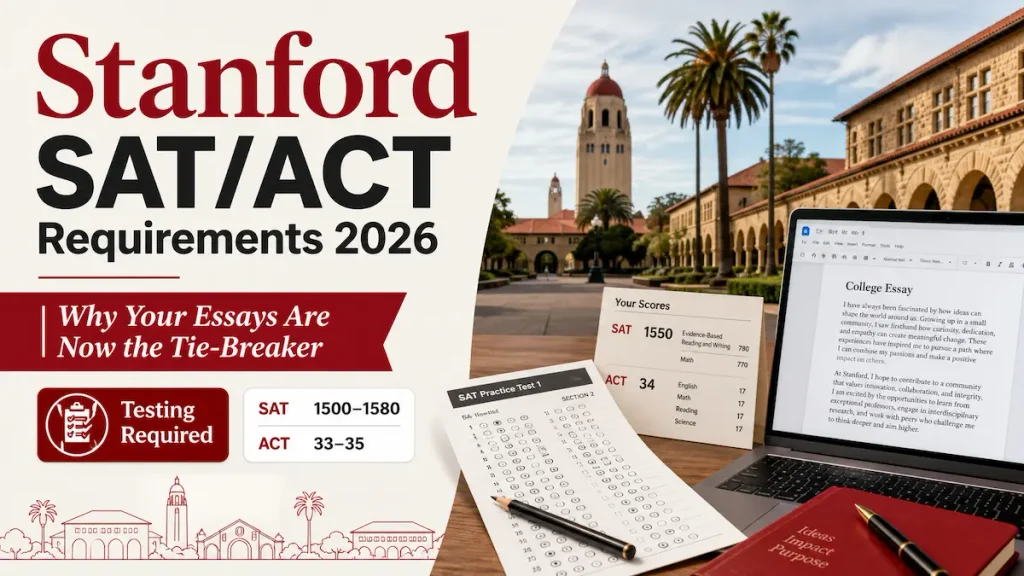
That does not mean the application has become test-driven. Stanford continues to review applicants holistically, with academic preparation considered alongside the rest of the application. Standardized testing is one component of that review, not a substitute for your transcript, recommendations, activities, or writing.
For Fall 2027 applicants, the practical strategy is therefore twofold:
- understand the current Stanford SAT/ACT Requirements and testing deadlines;
- make sure your essays reveal the intellectual vitality, personality, and contribution that a standardized score cannot communicate.
Already working on your Stanford writing supplement? Review all eight responses with our Stanford Supplemental Essay Grader.
And if you are working specifically on Stanford's famous roommate essay, see our Stanford Roommate Letter Guide.
Stanford SAT/ACT Requirements for Fall 2027
Stanford currently requires first-year applicants to submit either an ACT or SAT score. The university does not have a preferred test.
You do not need to send official scores when applying. Stanford allows applicants to self-report their highest ACT and/or SAT scores in the application. If admitted and you choose to enroll, Stanford then requires official score reports for the sittings you self-reported.
Current Stanford Testing Rules
- SAT or ACT: required
- Preferred exam: none
- Minimum SAT score: none
- Minimum ACT score: none
- Self-reporting during application: allowed
- Official scores before enrollment: required if admitted
- SAT superscoring: yes
- ACT superscore reporting: yes
- SAT/ACT writing sections: optional
- Recommended score age: within the past five years
Stanford SAT and ACT Score Ranges
Stanford does not publish a cutoff score.
The latest official testing page reports that, among students in the Class of 2029 who submitted scores, the middle 50% scored:
| Test | Middle 50% |
|---|---|
| SAT | 1520–1570 |
| ACT | 34–36 |
These figures should be interpreted carefully. The Class of 2029 applied during a test-optional cycle, so the distribution reflects students who chose to submit scores rather than the entire admitted class.
That means you should not treat 1520 as an admissions cutoff or 1570 as a target that guarantees anything.
Stanford explicitly states that there is no minimum test score required and no score that guarantees admission.
What Is a Competitive Stanford SAT Score?
A score near or above the current middle-50% range can place you within the testing profile of many successful applicants, but your score is only one part of the academic picture.
A useful way to think about the Stanford SAT/ACT Requirements is:
- below the current middle 50%: the rest of the academic record becomes even more important;
- within the middle 50%: your testing is broadly consistent with many successful applicants;
- above the middle 50%: the score is strong, but it still does not differentiate you automatically.
Stanford's review remains contextual and holistic.
Does Stanford Superscore the SAT?
Yes.
Stanford superscores the SAT by considering the highest individual Evidence-Based Reading and Writing and Math scores across submitted sittings.
That means a student who earns:
- 760 Reading/Writing + 770 Math on one test;
- 750 Reading/Writing + 800 Math on another;
can present a superscored total using the strongest section results.
Does Stanford Superscore the ACT?
Yes, Stanford allows applicants to report an ACT Superscore Composite along with their highest Math, English, and Reading section scores across sittings. The Science and Writing sections are optional in Stanford's current process.
⚠️ Critical 2026 Admissions Alert
With SAT/ACT scores mandatory again, a high test score is no longer enough. Harvard and Stanford are heavily scrutinizing supplemental essays to verify authenticity against AI and judge true institutional fit.
Audit Your Supplemental Essays Instantly →Stanford Testing Deadlines
Stanford recommends taking standardized tests well before application deadlines.
For first-year applicants, the latest possible test sittings currently listed are:
| Application Plan | ACT | SAT |
|---|---|---|
| Restrictive Early Action | by end of September | by end of October |
| Regular Decision | by end of December | by end of December |
Stanford notes that late-arriving scores may not be reviewed and that it cannot delay application review waiting for scores.
The standard application deadlines are currently:
- Restrictive Early Action: November 1
- Regular Decision: January 5
Can You Self-Report Stanford Test Scores?
Yes.
Applicants can self-report ACT and SAT scores in the application. Official reports are not required during the initial review.
If admitted and enrolling, Stanford requires official score reports for the sittings that were self-reported. Stanford may revoke an admission offer if official results do not match the self-reported information.
Stanford's testing codes are:
- SAT: 4704
- ACT: 0434
English Proficiency Requirements for International Applicants
This is an important correction to many outdated Stanford guides:
Stanford does not require TOEFL, IELTS, or another English proficiency exam for undergraduate international applicants.
Stanford states that fluency in English is a prerequisite for admission, but English proficiency exams themselves are not required. Applicants may self-report results if they want Stanford to consider them.
So I would remove the old claims about:
- TOEFL 100 minimum/recommended;
- IELTS 7.0 minimum;
- DET 130 recommended.
Those are not current Stanford undergraduate admission requirements.
Why Your Essays Still Matter When SAT/ACT Is Required
A required test score gives Stanford another standardized academic data point.
It does not replace the qualitative parts of the application.
Stanford's admissions process remains holistic, and the university continues to emphasize the individual student behind the transcript and testing profile.
That is where your writing becomes especially important.
A test score can show academic preparation.
It cannot show:
- what genuinely excites you intellectually;
- how you think about a problem;
- what kind of roommate you might be;
- how you contribute to groups;
- what your everyday personality feels like;
- which experiences shaped your perspective.
Stanford's current supplement includes five short responses and three 100–250 word essays designed to reveal exactly those dimensions.
If your testing profile is strong but your supplement sounds generic, your application is still leaving valuable information on the table.
Use our Stanford Supplemental Essay Grader to review all eight Stanford responses as one complete portfolio.
Stanford SAT/ACT Requirements vs. Essays: What Matters More?
This is the wrong question.
Stanford is not choosing between your test score and your essays.
The application is reviewed as a whole.
A stronger strategy is:
testing establishes academic evidence → essays reveal the person behind the evidence
Your SAT or ACT result can support academic readiness.
Your essays can reveal:
- intellectual vitality;
- voice;
- self-awareness;
- curiosity;
- judgment;
- community contribution;
- personality.
That combination is much more useful than treating essays as a literal “tie-breaker.”
Stanford Roommate Letter: Where Scores Cannot Help You
No standardized test can tell Stanford what living with you might actually be like.
That is why the Roommate Letter plays such a different role in the application.
It rewards:
- real personality;
- concrete habits;
- warmth;
- humor;
- daily routines;
- roommate-relevant details.
If you are drafting that response now, use our Stanford Roommate Letter Guide to see how to make the essay specific without forcing quirkiness.
Stanford vs. Other Highly Selective Testing Policies
Your comparison image can stay, but I would change its title.
Stanford is not an Ivy League university, so:
“Ivy League Standardized Testing Comparison”
is technically incorrect if Stanford appears in the table.
Better:
Ivy League + Stanford Standardized Testing Comparison (2026–2027)
or:
Highly Selective College Standardized Testing Comparison (2026–2027)
Also update Stanford's row to the current official range:
- SAT: 1520–1570
- ACT: 34–36
- Testing: required
- Superscoring: yes
I would also independently recheck every other school's row before republishing the image, because policies have been changing rapidly.
🎯 Beyond the Test Score
A strong SAT or ACT score can support your academic profile, but it cannot show how you think, what excites you, or what kind of classmate and roommate you would be. Stanford’s supplemental essays are where those dimensions become visible.
Check my Stanford Supplemental Essays →FAQ: Stanford SAT/ACT Requirements
Is the SAT or ACT required for Stanford in 2026–2027?
Yes. Stanford requires first-year applicants to submit either ACT or SAT scores.
Does Stanford have a minimum SAT score?
No. Stanford explicitly states that it has no minimum test score required for admission.
What SAT score is competitive for Stanford?
The latest official published middle 50% for score-submitters in the Class of 2029 is 1520–1570. That is useful context, not a cutoff.
What ACT score is competitive for Stanford?
Stanford's latest published middle 50% for Class of 2029 submitters is 34–36.
Does Stanford superscore the SAT?
Yes. Stanford considers the highest individual Reading/Writing and Math scores across sittings.
Does Stanford accept ACT superscores?
Yes. Applicants may report an ACT Superscore Composite along with their highest section scores.
Can I self-report scores?
Yes. Official ACT/SAT reports are not required for initial application review. Enrolling students must later provide official scores.
What are Stanford's SAT and ACT codes?
SAT: 4704
ACT: 0434
Does Stanford require TOEFL or IELTS?
No. Stanford does not require an English proficiency exam for undergraduate international applicants.
Final Thoughts on the Stanford SAT/ACT Requirements
The Stanford SAT/ACT Requirements are once again a mandatory part of the application, but they should not be treated as the entire admissions strategy.
A strong test score supports academic readiness.
It does not replace:
- course rigor;
- transcript performance;
- recommendations;
- activities;
- intellectual vitality;
- personality;
- community contribution;
- writing.
For Fall 2027 applicants, the strongest strategy is to prepare seriously for standardized testing while also building a Stanford supplement that reveals information no score can provide.
Once your testing plan is set, review your full supplement with the Stanford Supplemental Essay Grader.
And if you are working on Stanford's most personal writing prompt, see our Stanford Roommate Letter Guide.