
Caltech Supplemental Essay Grader 2026–2027: New Fall 2027 Prompts, STEM Essays & Strategy
Table
- Caltech Supplemental Essay Grader 2026–2027: What Changed for Fall 2027?
- New Fall 2027 Change #1: STEM Academic Interest Is Now 150–200 Words
- New Fall 2027 Change #2: Caltech Added “Scholarly Character”
- New Fall 2027 Change #3: Scientific Drive — Choose Two of Three
- Scientific Drive Option 1: Learning
- Scientific Drive Option 2: Pursuing
- Scientific Drive Option 3: Making
- New Fall 2027 Change #4: The Fun Question Is Now About Community Contribution
- Caltech Supplemental Essay Grader
- Elite Second Opinion
- My Essay Reviews
- Caltech Evaluation Comparison
- Optional Academic Context for Fall 2027
- Caltech Also Requires Fall 2027 Applicants to Review Its AI Policy
- Other Fall 2027 Caltech Application Changes Applicants Should Know
- Why Caltech Essays Are Different
- How the Caltech Supplemental Essay Grader Reviews Your Fall 2027 Essays
- Prompt-Specific Scoring
- Evidence-Based Feedback
- Portfolio Summary
- Avoid Accidental Repetition Across STEM Essays
- Avoid Generic STEM Enthusiasm
- Show Learning, Not Just Achievement
- Use Technical Detail Purposefully
- Avoid Prestige-Driven Writing
- How to Improve Your STEM Academic Interest Essay
- How to Improve the Collaboration Essay
- How to Improve the Process Essay
- How to Improve Scientific Drive — Learning
- How to Improve Scientific Drive — Pursuing
- How to Improve Scientific Drive — Making
- How to Improve the Caltech Fun Question
- Feedback First, Score Second
- Elite Second Opinion
- Compare Both Evaluations
- Combined Evaluation Score
- Use My Reviews During Revision
- Common Caltech Supplemental Essay Mistakes for Fall 2027
- Final Fall 2027 Caltech Essay Checklist
- Use the Caltech Supplemental Essay Grader Before You Submit
The Caltech Supplemental Essay Grader has been updated for the 2026–2027 application cycle and Fall 2027 entry, and Caltech has now officially published a new supplemental essay structure for this admissions year.
For Fall 2027, Caltech has replaced the previous STEM Curiosity / STEM Experience / Creativity in Action / choose-two-short-answers structure with a substantially different set of questions centered on STEM Academic Interest, Scholarly Character, Scientific Drive, and community contribution.
The new structure asks applicants to explain not only what they are interested in, but also how they learn when answers are uncertain, how other people affect their STEM thinking, how they pursue questions over time, how they make or repair things, and what they would contribute to the Caltech community. Caltech also explicitly says faculty may review applications from highly competitive candidates, so applicants should not be afraid of meaningful technical detail.
Before using the Caltech Supplemental Essay Grader, start with the most important thing: understand exactly what changed for Fall 2027.
Before submitting, applicants should verify the questions directly on Caltech’s official Supplemental Application Essays page. Caltech states that its questions change annually and are published during the summer.
Caltech Supplemental Essay Grader 2026–2027: What Changed for Fall 2027?
Caltech’s official admissions site now explicitly labels the current questions:
Fall 2027 Supplemental Application Essays.
So the earlier uncertainty about the page still displaying “Fall 2026” is over. Caltech has published the new cycle, and these are now the questions Fall 2027 applicants should prepare for. Caltech also reiterates that its supplemental questions change annually and are updated during the summer.
The biggest changes are structural.
Old Caltech Essay Structure
Older guides may still describe a supplement built around:
- STEM Academic Interest;
- STEM Curiosity;
- one STEM Experience;
- Creativity in Action;
- two short answers selected from four choices.
That is not the current Fall 2027 first-year structure.
New Caltech Fall 2027 Structure
The current application instead includes:
| Caltech Fall 2027 section | Requirement |
|---|---|
| Proposed Academic Interest | Select 1 or 2 areas |
| STEM Academic Interest | 150–200 words |
| Scholarly Character | Choose 1 of 2 prompts, max 200 words |
| Scientific Drive | Choose exactly 2 of 3 prompts, max 200 words each |
| Fun Question | 100–150 words |
| Academic Context | Optional |
Caltech confirms this structure on its official Fall 2027 supplemental essay page.
That means a complete scored Caltech writing portfolio now contains:
- one STEM Academic Interest response;
- one Scholarly Character response;
- two Scientific Drive responses;
- one Fun Question.
The optional Academic Context response provides background information but should not be treated like another competitive essay.
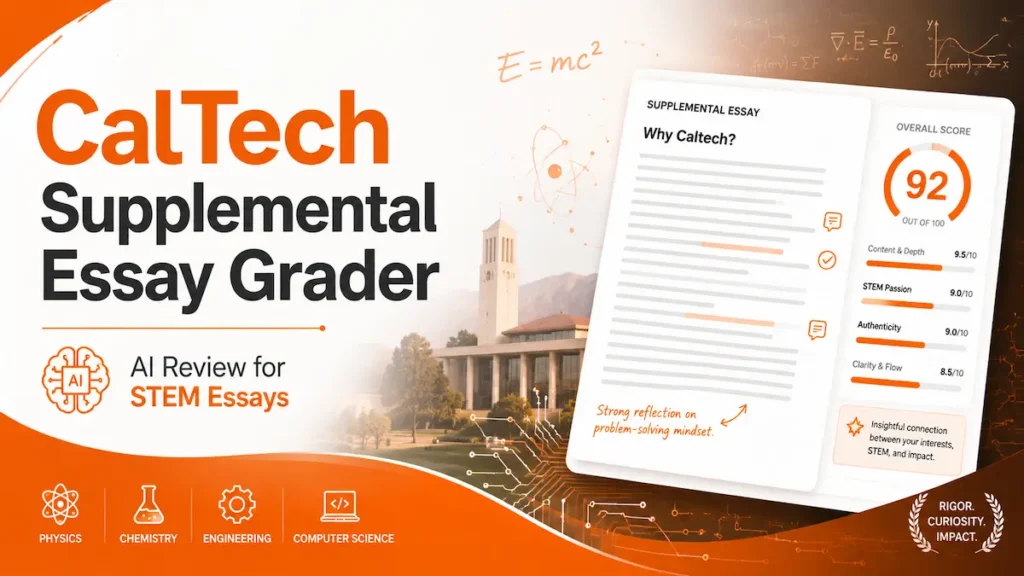
The Caltech Supplemental Essay Grader follows this new Fall 2027 structure.
New Fall 2027 Change #1: STEM Academic Interest Is Now 150–200 Words
Caltech first asks applicants to identify one or two current academic areas of interest.
Students are not committing themselves permanently to those fields. Caltech notes that students do not declare a major until the end of the first year and explicitly says applicants are not obligated to follow the academic-interest choice if admitted.
The written question then asks why you chose your proposed area of interest.
Official Fall 2027 limit: 150–200 words.
This is an important change because older versions of the question used different limits.
A strong answer should move beyond:
I love computer science because technology can change the world.
Caltech already knows computer science is important.
The useful question is:
Why does this particular field keep pulling your attention?
Strong responses often reveal:
- a mechanism you tried to understand;
- something you repaired;
- an experiment;
- an observation;
- a mathematical question;
- a programming problem;
- a contradiction between a model and reality;
- a specific technical system;
- a question that became more complicated the longer you investigated it.
For example, saying you are interested in Applied Physics is only the beginning.
A much stronger response might explain how unpredictable sensor readings made you curious about the boundary between ideal physical models and noisy real-world systems.
The Caltech Supplemental Essay Grader evaluates whether the academic direction is specific, intellectually motivated, personally grounded, and supported by actual evidence.
New Fall 2027 Change #2: Caltech Added “Scholarly Character”
One of the most significant additions for Fall 2027 is Scholarly Character.
Caltech frames this section around a central question:
How do you learn when there is no easy answer?
Applicants choose one of two prompts, with a maximum of 200 words.
Scholarly Character Option 1: Collaboration
This prompt focuses on STEM as shared learning.
Caltech asks about a time when another person or group affected your STEM learning—perhaps because:
- you needed help;
- you helped someone else;
- someone changed your thinking;
- collaboration altered your approach;
- you contributed to another person’s understanding.
This is not a generic teamwork essay.
Weak:
My team taught me that everyone has different ideas and collaboration is important.
That could describe almost any group project.
Stronger:
Show the intellectual exchange.
What did another person notice that you missed?
What did you explain to someone else?
Which assumption changed?
What did your teammate’s reasoning cause you to test differently?
What contribution did you make to the group’s understanding?
The strongest collaboration response shows mutual learning, not merely dividing responsibilities.
Scholarly Character Option 2: Process
The second option focuses on the thought behind the outcome.
Caltech asks about a STEM problem, project, or concept where your approach mattered as much as the final result. It specifically asks how you worked through uncertainty, persisted creatively, and what you would still defend about your process regardless of the outcome.
This makes failure usable.
A response does not need to end:
And then everything worked perfectly.
A stronger Caltech essay may show:
Initial assumption → failed approach → uncertainty → diagnostic change → evidence → revised understanding.
Caltech’s own Fall 2027 essay-writing advice encourages students discussing scientific process to be honest about difficulties and explain what persistence taught them and how they later applied those lessons.
New Fall 2027 Change #3: Scientific Drive — Choose Two of Three
Another major structural change is Scientific Drive.
Applicants must choose exactly two of three questions.
Each response can contain up to 200 words.
The three options are:
- Learning
- Pursuing
- Making
These prompts are related, but they evaluate different forms of STEM engagement.
Scientific Drive Option 1: Learning
The Learning question is Caltech’s current STEM rabbit-hole prompt.
This is the place to nerd out.
But “I love quantum mechanics” is not yet a rabbit hole.
A real rabbit hole has movement.
You might show:
Question → investigation → surprising result → new question → deeper investigation.
Good material could involve:
- why two algorithms with similar theoretical complexity behave differently;
- an unexpected chemical reaction;
- a mathematical proof you could not stop thinking about;
- orbital resonance;
- a biological mechanism;
- an engineering failure;
- a strange statistical result;
- a concept where your original understanding stopped working.
Caltech explicitly allows applicants to be specific or broad, and its admissions advice says faculty may review highly competitive applications, so useful technical detail is welcome.
The Caltech Supplemental Essay Grader therefore does not penalize technical language merely for being technical.
But terminology needs to reveal thought.
Scientific Drive Option 2: Pursuing
Pursuing focuses on sustained intellectual engagement.
Caltech asks about a STEM:
- question;
- problem;
- idea;
- project
that has held your attention over time.
Then it asks:
- What attracted you?
- How did you pursue it?
- What do you still want to understand?
The phrase over time matters.
One afternoon of Googling something may demonstrate curiosity.
It may not demonstrate sustained pursuit.
A stronger answer shows progression:
Initial observation → first investigation → later investigation → complication → methodological change → unresolved question.
You do not need a university laboratory.
A student who performs repeated experiments at home, notices bad measurements, improves the setup, and develops a more sophisticated question may have a better essay than someone who merely lists a prestigious research internship.
Scientific Drive Option 3: Making
Making focuses on STEM as creation.
Caltech explicitly invites applicants to discuss something they:
- created;
- tested;
- repaired;
- modeled;
- coded;
- built;
- redesigned.
The artifact does not need to be impressive.
A phone stand can work.
A watering system can work.
A website can work.
A repaired bicycle can work.
What matters is what happened during the process.
A useful structure is:
Problem → initial design → failure → diagnosis → revision → testing → insight.
Weak:
I built a website. Some links broke, so I fixed them. I learned perseverance.
Stronger:
Explain:
- what caused the links to break;
- how you diagnosed the failure;
- what you changed;
- how you tested the repair;
- what that taught you about debugging or design.
The Caltech Supplemental Essay Grader rewards visible process rather than the prestige of the finished object.
New Fall 2027 Change #4: The Fun Question Is Now About Community Contribution
The current Fall 2027 supplement also includes a new Fun Question.
Caltech asks what you would be excited to:
- do;
- share;
- teach;
- make;
- start;
- contribute
as part of the Caltech community.
Official limit: 100–150 words.
This is not simply another academic essay.
It gives you room to show a different dimension of yourself.
Maybe you would:
- start a repair table;
- teach people to cook a family recipe;
- organize strange map competitions;
- build ridiculous devices;
- host chess variants;
- create a bad-design museum;
- organize a niche film group;
- share music;
- teach a skill;
- build something with other students.
The strongest answers usually combine:
personal enthusiasm + concrete activity + shared experience.
Weak:
I would start a technology club because technology is important and students could learn from each other.
That is plausible but generic.
Stronger:
Show exactly what people would do together and why you would be excited to participate.
Caltech Supplemental Essay Grader
Fall 2027 first-year prompts
Caltech Essay Focus
Show how you think, explore STEM questions, create, collaborate, and pursue ideas that genuinely matter to you. Each response is reviewed against its own official prompt and rubric.
What You’ll Get From Your Caltech Review
A prompt-specific review of every required response, followed by a complete portfolio assessment.
Prompt-by-Prompt ScoresDirect points and feedback using the rubric for each Caltech response.
Evidence-Based FeedbackClear reasons, exact evidence when available, and concrete recommendations.
Portfolio SummaryStrengths, priorities, and the next best action across the full submission.
Elite Second OpinionAn optional independent review using 3 paid Universal Credits.
Caltech cares about context. Is there anything about your academic preparation, coursework, school context, or learning experiences that would help us better understand your readiness for Caltech? Leave this blank if it does not apply to you.
Your Caltech review is being prepared. This can take 1–2 minutes. Please keep this page open.
Complete your Primary Review first to unlock an independent second evaluation and side-by-side comparison.
Need more reviews now?
Your account includes 2 free essay reviews for life. Paid Universal Credits are always used first and work across all graders.
Need more credits? View all pricing plans →
Optional Academic Context for Fall 2027
Caltech also provides an optional academic-context question.
It asks whether anything about your:
- academic preparation;
- coursework;
- school context;
- learning experiences
would help Caltech understand your readiness more accurately.
This is context, not a secret sixth competition essay.
Use it when something genuinely helps explain your educational environment.
Examples could include:
- limited course availability;
- school scheduling constraints;
- unusual academic preparation;
- disruptions;
- access limitations;
- circumstances affecting coursework.
Do not manufacture hardship just because the field exists.
In the Caltech Supplemental Essay Grader, Academic Context is preserved as context and is not directly scored.
Caltech Also Requires Fall 2027 Applicants to Review Its AI Policy
This is another important Fall 2027 directive.
Caltech explicitly states that all Fall 2027 applicants must review its ethical-use-of-AI guidelines before submitting supplemental essays.
That matters for any student using an essay-review tool.
The Caltech Supplemental Essay Grader should be used for:
- evaluation;
- identifying weak evidence;
- understanding scoring;
- spotting repetition;
- finding underdeveloped reasoning;
- prioritizing revisions.
It should not be used to fabricate:
- research;
- accomplishments;
- experiments;
- adversity;
- technical experiences;
- personal facts.
Your experiences and evidence must remain yours.
Other Fall 2027 Caltech Application Changes Applicants Should Know
The essay changes are not the only new Fall 2027 developments.
Caltech requires first-year applicants to submit the SAT or ACT. For Fall 2027, ACT Science and Writing are optional, and Caltech says it evaluates individual ACT sections rather than the composite. Caltech also uses score buckets in its admissions review.
The current Fall 2027 application deadlines are:
- Restrictive Early Action: November 1, 2026
- Regular Decision: January 4, 2027
Caltech says REA testing must be completed before November 30 and RD testing before December 31, 2026.
Those requirements do not affect the essay score produced by the Caltech Supplemental Essay Grader, but applicants should understand the complete Fall 2027 application context.
Why Caltech Essays Are Different
Caltech is unapologetically STEM-focused.
Its official essay guidance explicitly encourages applicants to lean into STEM, and Caltech notes that faculty may review applications from highly competitive students.
That means you do not need to strip useful technical detail from the essay because you are afraid an admissions reader will not understand it.
But technical vocabulary alone is not enough.
A strong Caltech response should make clear:
- what you noticed;
- what you wanted to understand;
- what you tried;
- what failed;
- what changed;
- what evidence mattered;
- what remained confusing;
- why the question continued to matter.
A paragraph full of terminology without visible reasoning may sound advanced while revealing very little.
How the Caltech Supplemental Essay Grader Reviews Your Fall 2027 Essays
Once you understand the new questions, the Caltech Supplemental Essay Grader helps evaluate the complete Fall 2027 response set using prompt-specific criteria.
It does not apply one generic “good college essay” rubric to every response.
A STEM Academic Interest essay has a different purpose from Scholarly Character.
Collaboration is different from Process.
Learning is different from Pursuing.
Pursuing is different from Making.
And the Fun Question should not be evaluated like a technical research statement.
This prompt-specific architecture is central to the current grader. The review provides criterion-level scoring, supporting reasoning, evidence, identified weaknesses, and revision guidance.
Prompt-Specific Scoring
Each required response receives its own evaluation against the rubric built for that exact Fall 2027 question.
For example, STEM Academic Interest can examine:
- academic direction;
- specificity of STEM interest;
- intellectual motivation;
- personal grounding;
- clarity and compression.
Scholarly Character changes according to the option selected.
Scientific Drive also changes according to Learning, Pursuing, or Making.
This prevents polished prose from automatically receiving a high score when it fails to answer the actual prompt.
Evidence-Based Feedback
For each criterion, the Caltech Supplemental Essay Grader can provide:
Points
How strongly the response satisfies that criterion.
Reason
Why those points were awarded.
Verified Evidence
When an exact excerpt is used as evidence, it must come from the student’s actual response.
The system should not invent quotations that cannot be verified.
Missing or Underdeveloped
What genuinely remains weak or incomplete.
Recommendation
A specific improvement connected to that weakness.
This is why the feedback matters more than simply seeing:
87/100.
The useful question is:
What produced the 87, and what would actually make the response better?
Portfolio Summary
The Caltech Supplemental Essay Grader also examines the required responses as a portfolio.
It can surface:
- recurring strengths;
- repeated themes;
- areas that need more specificity;
- overlapping stories;
- portfolio revision priorities;
- a next best action.
The portfolio analysis does not secretly add or subtract points from the individual essay scoring.
This matters because a Caltech applicant can write five individually good essays that collectively reveal only one dimension of themselves.
Avoid Accidental Repetition Across STEM Essays
Caltech wants significant STEM content.
That does not mean every response should tell the same STEM story.
A portfolio might become repetitive if:
- Academic Interest = robotics;
- Scholarly Character = same robotics project;
- Scientific Drive Learning = same robotics project;
- Scientific Drive Making = same robotics project;
- Fun Question = robotics club.
Instead, use the different questions to show different dimensions:
- intellectual curiosity;
- collaboration;
- uncertainty;
- sustained investigation;
- making;
- community;
- personality.
The Caltech Supplemental Essay Grader can flag potentially repetitive patterns, but repetition should be interpreted conservatively. Common STEM vocabulary by itself should not automatically mean the portfolio lacks range.
Avoid Generic STEM Enthusiasm
One of the most common weaknesses is enthusiasm without evidence.
Weak:
I have always loved science.
Weak:
Engineering combines creativity and logic.
Weak:
AI will change the future.
Those statements may be true.
But they tell Caltech very little about your STEM mind.
Stronger writing answers:
- What problem held your attention?
- What did you initially misunderstand?
- What did you test?
- What failed?
- What did you measure?
- What evidence changed your thinking?
- What question remained unresolved?
Show Learning, Not Just Achievement
Awards, research, competitions, Olympiads, advanced classes, and technical credentials may strengthen an application.
But the essays should reveal something different.
Instead of simply telling Caltech what you accomplished, show:
- where you got stuck;
- what assumption failed;
- what you changed;
- which tradeoff appeared;
- what someone else taught you;
- how evidence altered your approach;
- what you understand differently now.
A modest project with excellent reflection may reveal more scholarly character than a paragraph listing six impressive achievements.
Use Technical Detail Purposefully
Caltech gives applicants unusual permission to get technical.
Use it.
But technical detail should serve the narrative of thought.
Naming:
- gradient descent;
- Fourier transforms;
- orbital mechanics;
- graph search;
- spectroscopy;
- PCR;
- RSA
does not automatically make an essay intellectually sophisticated.
A stronger relationship is:
technical concept → question → action → evidence → insight.
That sequence reveals why the technical detail matters.
Avoid Prestige-Driven Writing
The current Fall 2027 supplement does not contain a conventional long “Why Caltech?” essay.
So do not force:
- JPL;
- Nobel Prize references;
- famous faculty;
- rankings;
- laboratories;
- Caltech prestige
into responses that are asking about your own learning.
Institutional references should never substitute for:
- intellectual substance;
- evidence;
- authentic motivation;
- investigation;
- reflection.
The Caltech Supplemental Essay Grader does not automatically reward name-dropping.
How to Improve Your STEM Academic Interest Essay
Do not stop at:
I want to study computer science because I enjoy solving problems.
Instead, identify:
- which part of the field interests you;
- what experience made that interest concrete;
- which mechanism or problem keeps pulling your attention;
- what you still do not understand.
You do not need to pretend you already know your lifelong specialization.
Caltech itself reminds students that the academic-interest choice is not binding.
How to Improve the Collaboration Essay
Avoid making the response entirely about group logistics.
“We divided the work” is not necessarily intellectual collaboration.
Show:
- what another person contributed;
- what you contributed;
- what idea changed;
- where someone challenged an assumption;
- how the group’s understanding improved.
Then explain what you now do differently because of that experience.
How to Improve the Process Essay
Make the process visible.
Weak:
My experiment failed several times, but I persisted.
Stronger:
My measurements kept drifting, so I first repeated the trial. When that failed, I isolated the release angle, then compared manual and video timing, which exposed a problem with how I defined the swing boundary.
Now the reader can see the reasoning.
How to Improve Scientific Drive — Learning
Choose an actual rabbit hole.
Then show why it became one.
You might explain:
- the first question;
- what you researched;
- what you tested;
- what surprised you;
- what explanation failed;
- which new question appeared.
Do not turn the response into a miniature textbook.
It is still about your curiosity.
How to Improve Scientific Drive — Pursuing
Pursuing requires evidence of sustained engagement.
Give the reader some sense of progression over time.
Then show what you did when the investigation became difficult or unclear.
A useful structure:
initial interest → repeated engagement → methodological problem → adaptation → unresolved question.
How to Improve Scientific Drive — Making
Making should reveal more than the finished product.
Explain:
- what you made;
- why;
- how;
- what failed;
- what you changed;
- what happened after the change;
- what the process taught you.
Iteration often reveals more engineering character than the sophistication of the artifact.
How to Improve the Caltech Fun Question
Do not interpret “Fun Question” as “find another impressive STEM accomplishment.”
The strongest answer may be technical.
Or it may not.
What matters is whether the proposed contribution feels:
- concrete;
- personal;
- authentic;
- genuinely communal.
Instead of:
I would start a technology club.
show what would actually happen during one meeting.
What would people make?
What would they argue about?
What would you teach?
What would you want someone else to bring?
That creates a community the reader can picture.
Feedback First, Score Second
The Caltech Supplemental Essay Grader produces a numerical evaluation, but that score is a guidance tool.
It is not an admission probability.
A 96 does not mean a 96% chance of admission.
Caltech’s admissions process evaluates the full application.
The useful purpose of the score is to make the feedback interpretable.
A maximum score is possible when the response affirmatively satisfies every criterion.
But the absence of an obvious problem is not enough by itself to justify maximum points.
Elite Second Opinion
After completing the Primary Evaluation, eligible students with paid Universal Credits can request an Elite Second Opinion through the Caltech Supplemental Essay Grader.
It costs 3 paid Universal Credits.
The second evaluation reviews the exact same submission using:
- the same prompts;
- the same rubrics;
- the same criteria;
- the same maximum points;
- the same evidence rules.
It does not see the Primary Evaluation before completing its own analysis.
That independence matters.
Two evaluators may agree that an essay is weak while disagreeing slightly on the exact number of points.
That is useful information.
Compare Both Evaluations
Once the Elite Second Opinion exists, the Caltech Supplemental Essay Grader can compare both evaluations directly.
The comparison can show:
- Primary score;
- Independent score;
- Combined Evaluation Score;
- score difference;
- response-by-response differences;
- criterion-by-criterion differences;
- evidence from both evaluations;
- shared revision priorities;
- Primary-only concerns;
- second-opinion-only concerns.
The purpose is not to hide disagreement.
It is to make evaluator judgment visible.
Combined Evaluation Score
When both evaluations exist, the grader calculates a Combined Evaluation Score.
This is simply the arithmetic mean of:
Primary Evaluation + Independent Second Evaluation.
It is calculated locally.
It is not a third AI evaluation.
Both original evaluations remain available so the student can inspect the reasoning behind any difference.
Use My Reviews During Revision
Completed evaluations are stored in My Reviews, allowing students to return to their Caltech feedback during revision.
A useful workflow is:
Draft → Primary Evaluation → Read Feedback → Revise
Or, for students using the second evaluation:
Primary → Elite Second Opinion → Compare → Revise
Do not chase a score endlessly.
Use the evidence to decide which revision matters.
Common Caltech Supplemental Essay Mistakes for Fall 2027
Watch for:
- answering last year’s prompts;
- using the old essay structure;
- missing the 150-word minimum for STEM Academic Interest;
- generic STEM enthusiasm;
- technical vocabulary with no visible reasoning;
- treating Collaboration like generic teamwork;
- treating Process like a victory story;
- choosing two Scientific Drive responses that reveal the exact same thing;
- résumé dumping;
- vague claims of impact;
- prestige-driven Caltech references;
- explaining results without showing process;
- generic reflections like “I learned perseverance”;
- turning the Fun Question into another résumé entry;
- inventing experiences;
- ignoring Caltech’s AI guidelines.
Final Fall 2027 Caltech Essay Checklist
Before submitting, verify:
- Did you use the Fall 2027 Caltech supplemental prompts?
- Did you select one or two academic areas?
- Is STEM Academic Interest between 150 and 200 words?
- Did you select exactly one Scholarly Character prompt?
- Is Scholarly Character no more than 200 words?
- Did you select exactly two different Scientific Drive prompts?
- Is each Scientific Drive response no more than 200 words?
- Is the Fun Question between 100 and 150 words?
- Did you use Academic Context only when genuinely useful?
- Does every STEM response contain evidence rather than broad enthusiasm?
- Does Collaboration show intellectual exchange?
- Does Process show actual reasoning under uncertainty?
- Does Pursuing demonstrate sustained engagement?
- Does Making show iteration?
- Does the Fun Question reveal a real contribution?
- Did you avoid repeating the same story everywhere?
- Did you review Caltech’s ethical-use-of-AI guidelines?
- Have you checked the complete portfolio with the Caltech Supplemental Essay Grader?
Use the Caltech Supplemental Essay Grader Before You Submit
The Caltech Supplemental Essay Grader now reflects the official Fall 2027 supplemental essay structure, not the previous cycle.
This year’s change is significant.
Caltech has shifted toward questions that explicitly examine:
- academic direction;
- scholarly character;
- collaboration;
- process;
- scientific learning;
- sustained pursuit;
- making;
- community contribution.
That creates a much richer picture of the applicant than simply asking whether they “love STEM.”
Caltech wants to see what happens after curiosity begins.
What did you do?
What did you test?
Who changed your thinking?
Where did your method fail?
What did you build?
What did you learn from imperfect evidence?
What question are you still carrying?
Once your drafts are complete, use the Caltech Supplemental Essay Grader to evaluate each response against its current prompt, inspect the evidence behind the feedback, compare independent evaluations if needed, and prioritize the revisions that genuinely strengthen the portfolio.
The goal is not to make every essay sound more impressive.
It is to make your Caltech application more specific, more intellectually revealing, more evidence-based, and more recognizably yours.
Explore More Top STEM & Tech University Essay Graders: