Cornell Supplemental Essays 2026–2027: Official Fall 2027 Prompts, Word Limits & Strategy Guide
Table
- Cornell Supplemental Essay Grader
- My Essay Reviews
- What Changed in the Cornell Supplemental Essays for 2026–2027?
- How Many Cornell Supplemental Essays Do You Have to Write?
- Understanding Cornell's “Any Person, Any Study” Philosophy
- Cornell Supplemental Essays: Prompts and Strategies by College
- Common Mistakes in the Cornell Supplemental Essays
- Test Your Draft With Our Cornell Supplemental Essay Grader
- Cornell Supplemental Essay Final Checklist
- Final Thoughts on the Cornell Supplemental Essays 2026–2027
- Explore More Ivy League Essay Guides
Last updated: August 2026 for the 2026–2027 admissions cycle / Fall 2027 entry.
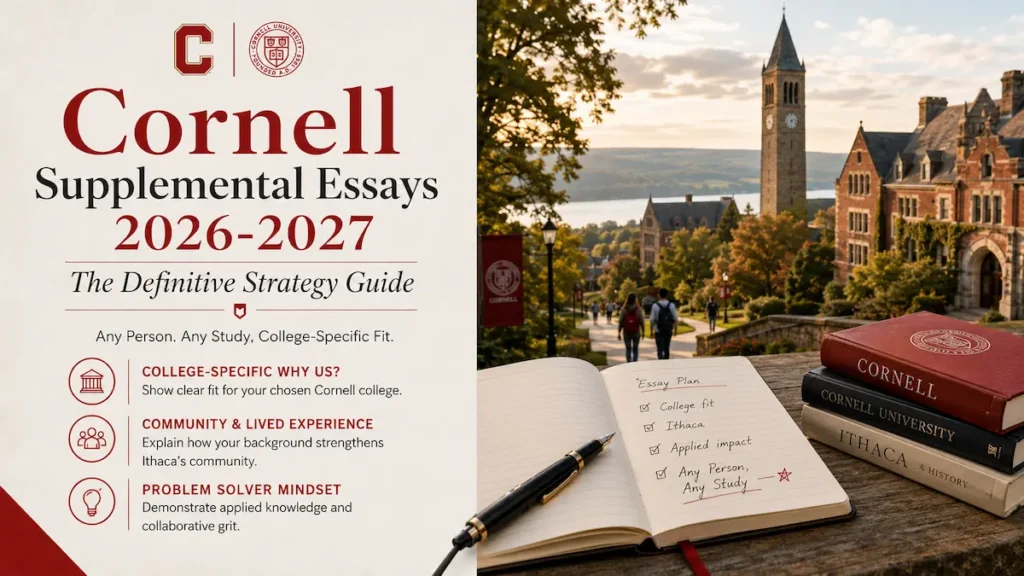
Mastering the Cornell Supplemental Essays requires a different strategy than almost any other Ivy League supplement. Cornell is not asking every applicant to answer one general “Why Cornell?” question. For Fall 2027 entry, applicants respond to the writing supplement required by the specific undergraduate college or school to which they apply. Cornell’s first-year application instructions explicitly tell applicants to select a Cornell college or school and complete its college- or school-specific essay or essays.
That distinction matters. You are not simply applying to Cornell University. You are applying to a defined academic community inside Cornell: Arts & Sciences, the College of Agriculture and Life Sciences, Architecture, Art, and Planning, Duffield Engineering, the Brooks School of Public Policy, SC Johnson College of Business, Human Ecology, or ILR.
A strong response therefore needs to do more than praise Cornell. It should demonstrate why your interests, experiences, questions, and working style belong inside the specific college or school you selected.
Already have a draft? Use our Cornell Supplemental Essay Grader below to evaluate your response against the prompt and rubric for your selected Cornell college or school.
Use the Cornel Supplemental Essay Grader
Cornell Supplemental Essay Grader
Review your Cornell Fall 2027 college- or school-specific Writing Supplement responses for genuine fit reasoning, prompt alignment, and authentic voice.
Cornell Fall 2027 writing supplement: Cornell has no university-wide essay this cycle — you answer only the prompt(s) for the Cornell college or school you are applying to. Choose that college below and its official prompts, with their official word limits, load automatically.
What You’ll Get From Your Cornell Review
See whether your responses answer the actual prompt with real fit reasoning and an authentic voice — feedback first, score second.
College Fit Reasoning
Prompt Alignment
Authentic Voice
Independent Second Opinion
Paste your Cornell responses below to get criterion-level feedback, revision priorities, and a saved review.
Your account includes 1 free essay review for life. Paid Universal Credits are always used first.
Elite Second Opinion
Get an independent second review of the same Cornell responses and compare where both evaluations agree or differ.
Complete and save a Cornell review to unlock this option.
Buy More CreditsNeed more reviews now?
Need more credits?
View all pricing plans →
Instant activation after payment. 1 Universal Credit = 1 comprehensive Cornell supplement review.
What Changed in the Cornell Supplemental Essays for 2026–2027?
The biggest strategic point for Fall 2027 applicants is that there is no single universal Cornell essay that everyone answers. Cornell directs first-year applicants to the requirements of their chosen undergraduate college or school.
The number, length, and purpose of the Cornell Supplemental Essays therefore vary considerably.
Duffield Engineering, for example, requires two 200-word essays plus four 100-word short responses. Arts & Sciences uses one longer intellectual-curiosity response. CALS requires two separate responses. AAP changes the writing direction depending on whether you apply to Architecture, Fine Arts, or Urban and Regional Studies.
This makes one mistake especially dangerous: writing a generic “Why Cornell?” response first and trying to adapt it afterward.
Instead, start with your selected college's actual prompt.
How Many Cornell Supplemental Essays Do You Have to Write?
The number of Cornell Supplemental Essays depends on your undergraduate college or school. Cornell confirms that first-year applicants apply directly to one Cornell college or school and complete the corresponding supplement.
Here is the current Fall 2027 structure:
| Cornell College or School | Writing Supplement Structure |
|---|---|
| College of Agriculture and Life Sciences — CALS | 2 responses, 350 words each |
| College of Architecture, Art, and Planning — AAP | 1 essay, up to 650 words; prompt varies by program |
| College of Arts & Sciences | 1 essay, up to 650 words |
| Jeb E. Brooks School of Public Policy | Main essay, plus DC Start response when applicable |
| SC Johnson College of Business | 1 essay, up to 650 words |
| David A. Duffield College of Engineering | 2 × 200-word essays + 4 × 100-word short answers |
| College of Human Ecology — CHE | 1 essay, up to 550 words |
| School of Industrial and Labor Relations — ILR | 1 essay, up to 650 words |
Cornell's current Human Ecology page specifically sets the first-year CHE writing supplement at 550 words. Duffield Engineering's official page confirms its six-response structure and exact 200/100-word limits.
The practical rule is simple:
Do not write a general Cornell essay. Write the essay your specific Cornell college or school is asking for.
You can verify the current official prompts here: Official Cornell First-Year Writing Supplement Prompts
Understanding Cornell's “Any Person, Any Study” Philosophy
Cornell's breadth can tempt applicants into writing about everything they might want to study. That usually weakens the essay.
The stronger interpretation of Cornell's academic breadth is not “I can study anything.” It is:
I have a serious question or direction, and Cornell gives me the right structure for investigating it.
Your Cornell Supplemental Essays should therefore avoid abstract prestige language. A strong response usually demonstrates a clear academic direction, a real question or problem, evidence of action or exploration, selected-college fit, and specific Cornell opportunities that actually advance the applicant's goals.
That distinction becomes important in every college-specific prompt below.
Cornell Supplemental Essays: Prompts and Strategies by College
1. College of Agriculture and Life Sciences — CALS
Structure: 2 responses, 350 words each.
CALS separates two ideas that applicants often try to squeeze into one essay:
- Why your intended major?
- Why Cornell CALS?
That separation should guide your strategy.
CALS Essay 1: Your Major Interest
Your first response should explain the experiences, questions, interests, and goals that led you toward the major you selected.
Avoid opening with something broad like:
“I have always cared about the environment.”
Instead, identify the experience or question that made the field intellectually important to you.
For example:
“Testing water quality in irrigation channels near my town made me curious about why the same farming practices produced different soil and water outcomes across neighboring fields.”
Now the essay has something to investigate.
CALS Essay 2: Why Cornell CALS?
The second response shifts from your interest to your environment.
What about CALS makes it the right place for you to develop that interest?
Strong CALS responses tend to connect academic goals with real-world problems such as:
- agriculture;
- food systems;
- environmental sustainability;
- climate resilience;
- animal science;
- biological systems;
- public health;
- plant science;
- data-driven ecology;
- community impact.
The goal is not to create a Cornell-resource shopping list. Explain what you would do with those opportunities.
Think:
past experience → current question → CALS resource → future action
rather than:
course + professor + lab + club + course + program
The first essay proves why the major. The second proves why CALS.
2. College of Architecture, Art, and Planning — AAP
Structure: 1 essay of up to 650 words, with a different writing direction depending on Architecture, Fine Arts, or Urban and Regional Studies.
AAP is one of the clearest examples of why generic Cornell advice does not work.
Architecture / B.Arch Strategy
Do not simply tell Cornell that you are creative or that you have always loved buildings.
Start with something tangible:
- a model;
- a design failure;
- a structure;
- an unusual room;
- a public space;
- a drawing;
- a material constraint;
- a building you studied;
- a design decision that changed your thinking.
The strongest Architecture responses tend to show process.
For example:
You built something. It failed. You changed your assumptions. A constraint forced another decision. The revised result made you notice something about space, structure, materials, or use.
That is far stronger than:
“Architecture combines my love of art and mathematics.”
Your essay should reveal how you think architecturally.
Fine Arts / BFA Strategy
For Fine Arts, the interesting question is not simply what medium you use.
Ask:
What are you trying to understand through your work?
Your response might explore:
- a recurring visual idea;
- tension between two materials;
- memory;
- identity;
- place;
- observation;
- representation;
- social experience;
- experimentation.
Technique matters, but the essay should reveal an artistic mind, not just a portfolio inventory.
Urban and Regional Studies Strategy
URS applicants should focus on actual urban complexity.
Potential areas include:
- housing;
- transportation;
- zoning;
- climate adaptation;
- migration;
- infrastructure;
- public space;
- regional inequality.
A strong URS essay does not say:
“Cities fascinate me.”
It investigates something:
Why does a transit improvement benefit one neighborhood but accelerate displacement in another?
That is a question capable of supporting serious study.
3. College of Arts & Sciences
Structure: 1 essay of up to 650 words.
This is Cornell's intellectual-curiosity essay.
The strongest responses are built around an intellectual passion, question, idea, or tension rather than a list of subjects.
Weak:
“I enjoy economics, psychology, and political science because they help me understand people.”
Stronger:
“Why do voters support climate policies until the policies impose visible local costs?”
Now economics, psychology, government, and environmental studies can become tools for exploring one question.
That is exactly what makes the liberal arts connection meaningful.
The Cornell-Specific Part
This is also where otherwise excellent Arts & Sciences essays often lose points.
Do not stop at:
“Cornell will allow me to study linguistics and anthropology.”
Explain what parts of Cornell's curriculum would advance different parts of your question.
The mistake is not failing to name enough courses.
The mistake is failing to explain why the curricular structure matters to the inquiry.
Your final essay should connect:
intellectual question → exploration already undertaken → disciplines/tools needed → Cornell curriculum
4. Jeb E. Brooks School of Public Policy
Brooks applicants should move beyond caring about a problem and show interest in understanding how policy actually works.
Potential subjects include:
- healthcare access;
- climate policy;
- education;
- inequality;
- government institutions;
- economic mobility;
- public systems;
- implementation.
A weak response sounds like:
“I want to help solve inequality.”
A stronger response might explain how volunteering at a food program revealed that eligibility rules, transportation, staffing, and administrative capacity can determine whether a benefit actually reaches the people it was designed to serve.
That moves from cause to policy problem.
Cornell has also introduced DC Start for eligible Fall 2027 Brooks applicants: selected first-year students can begin their first semester studying and living in Washington, D.C. Cornell describes it as an option for incoming public policy and health care policy students.
If you select DC Start and receive the additional prompt, do not frame Washington as an exciting place to visit.
Explain why starting your education inside an active policy environment would advance the questions you want to study.
5. Cornell SC Johnson College of Business
Cornell Business is not asking:
“Why do you want a successful business career?”
It wants to understand what kind of business student you are and what issues matter to you.
For Dyson, possible directions include:
- applied economics;
- entrepreneurship;
- sustainability;
- food systems;
- economic inequality;
- small business development;
- impact finance.
For Nolan, possibilities include:
- hospitality;
- service design;
- operations;
- guest experience;
- tourism;
- food and beverage;
- real estate;
- human-centered management.
Avoid building the essay around:
- Wall Street;
- salary;
- prestige;
- executive titles;
- “networking”;
- Cornell's Ivy League status.
Those outcomes tell the reader very little about how you think.
Start instead with a business problem you have actually noticed.
Maybe customers abandoned a family business because delivery times were unpredictable. Perhaps volunteer fundraising showed you that donor behavior changed depending on how impact was communicated. Maybe working in hospitality made you interested in the relationship between service design and employee workload.
Then explain why Dyson or Nolan provides the right environment for developing that interest.
6. David A. Duffield College of Engineering
Duffield Engineering has the most complex structure among the Cornell Supplemental Essays.
Cornell officially requires:
- 2 long essays — 200 words each
- 4 short responses — 100 words each
Because you have six responses, portfolio strategy matters.
Do not tell the same robotics story six times.
Each response should reveal something different.
Duffield Long Essay 1: Why Engineering?
Limit: 200 words.
Cornell currently asks applicants why they want to study engineering.
Go quickly to a technical problem, experience, or realization.
Weak:
“I enjoy math and science and want to use them to help people.”
Stronger:
“My soil-moisture sensor worked perfectly indoors and failed within two days in a community garden because condensation, uneven soil, and battery limitations had never appeared in our classroom tests.”
Now we see engineering thinking:
- constraint;
- failure;
- testing;
- redesign;
- humility;
- application.
Duffield Long Essay 2: Why Duffield Engineering?
Limit: 200 words.
This is where Cornell specificity matters.
Cornell itself says that applicants should explain why Duffield is a good fit for their interests and aspirations and how they would contribute to its community.
Do not simply write:
“I want to participate in project teams and research.”
Explain why those environments fit the way you learn.
For example:
“I am drawn to project-team culture because I learn most from testing an idea against constraints and having teammates challenge assumptions I did not realize I was making.”
Now the resource has strategic meaning.
Duffield Short Answer 1: What Brings You Joy?
Limit: 100 words.
Cornell asks this directly.
This answer can be technical, personal, quirky, quiet, or ordinary.
Possibilities:
- fixing bicycles;
- cooking;
- debugging;
- teaching your sibling;
- playing music;
- walking;
- building;
- solving puzzles;
- gardening.
Do not turn every answer into an achievement story.
A small, honest answer can be much stronger.
Duffield Short Answer 2: Your Unique Contribution
Limit: 100 words.
Cornell asks what you would contribute beyond what you have already detailed elsewhere in the application.
Do not repeat:
- club president;
- captain;
- research internship;
- award.
Instead, reveal how you function around other people.
Perhaps you:
- translate technical ideas;
- document team decisions;
- ask user-centered questions;
- encourage quieter teammates;
- connect technical work with ethics;
- notice overlooked practical constraints.
Duffield Short Answer 3: Meaningful Activity or Responsibility
Limit: 100 words.
Cornell asks you to choose one activity, organization, work/volunteer experience, or family responsibility and explain its significance.
The activity does not need prestige.
Its importance might come from:
- discipline;
- responsibility;
- teamwork;
- persistence;
- family obligation;
- confidence;
- service.
Duffield Short Answer 4: Meaningful Award or Achievement
Limit: 100 words.
Cornell asks which award or achievement has meant the most to you and why.
Do not spend 80 words explaining how competitive the award was.
Spend the response explaining why it mattered.
An ordinary accomplishment with real meaning can reveal more than a famous award with no reflection.
7. College of Human Ecology — CHE
Structure: 1 essay, 550-word limit.
The current first-year Human Ecology prompt begins from an extracurricular, community-engagement, or work experience connected to CHE's mission and your intended major. Cornell asks what that experience taught you about your community and its needs, the impact you can make, and how your CHE major will help you make that impact.
This is a highly applied prompt.
CHE describes its academic approach around interactions between people and their environments across scientific, social, and design perspectives.
Your essay should therefore build a chain:
experience → observation about people/community → need → intended major → CHE education → impact
Strong topics might involve:
- health equity;
- nutrition;
- child development;
- accessibility;
- public health;
- aging;
- community systems;
- design;
- family policy;
- human behavior.
Weak:
“I want to help people through healthcare.”
Stronger:
“Helping older neighbors interpret medication instructions made me notice that health outcomes depended not only on access to medicine but also on communication, household support, and the environment in which instructions were delivered.”
Now there is something Human Ecology can investigate.
Cornell's own CHE admissions guidance emphasizes alignment with the college mission, intended major, community engagement, and evidence-based problem solving.
8. School of Industrial and Labor Relations — ILR
Structure: 1 essay, up to 650 words.
ILR is about more than “business” or “helping workers.”
It is especially suited to applicants interested in:
- work;
- organizations;
- labor;
- employment law;
- workplace policy;
- conflict resolution;
- unions;
- inequality;
- human resources;
- economic justice.
Weak:
“I care about fairness in the workplace.”
Stronger:
“Working in my family's restaurant showed me that unstable scheduling affected far more than weekly wages; it changed childcare arrangements, transportation, and whether employees could take additional classes.”
That moves from a value — fairness — to an institutional question.
Strong ILR essays usually move:
experience → workplace/organizational problem → structural analysis → ILR fit
Common Mistakes in the Cornell Supplemental Essays
Mistake 1: Writing a Generic Ivy League Essay
Cornell readers do not need another paragraph about the benefits of attending an elite university.
Avoid relying on phrases such as:
- “world-class professors”;
- “prestigious Ivy League education”;
- “powerful alumni network”;
- “beautiful campus”;
- “top-ranked academics.”
These phrases may be complimentary, but they do not establish fit.
The important question is:
Why does your way of thinking belong inside this specific Cornell college or school?
Mistake 2: Naming Cornell Resources Without Explaining Them
Cornell specificity is not a scavenger hunt.
Weak:
“I want to join project teams, conduct research, and work with Cornell professors.”
Stronger:
“Because I learn through prototype failure and iteration, I am drawn to project-team environments where technical assumptions must survive testing, teamwork, and real constraints.”
The second sentence explains why the resource matters.
That is what admissions readers need.
Mistake 3: Choosing the Wrong College Strategy
A CALS essay should not read like an Arts & Sciences essay.
A Brooks response should not become a generic activism essay.
A Dyson essay should not be a finance résumé.
A Human Ecology essay should not ignore people and community context.
Before submitting, ask:
- Does my response clearly fit the college or school I selected?
- Could I replace “Cornell” with another university name without changing much?
- Have I explained why this college's academic structure matters?
- Does my past experience connect logically to what I want to do at Cornell?
If your essay could be recycled for another university, it probably needs another revision.
Mistake 4: Overloading the Essay With Résumé Details
Your Cornell Supplemental Essays are not an expanded activities section.
Cornell already has the rest of your application.
Use your supplement to reveal:
- how you think;
- why something matters to you;
- what question you are pursuing;
- how an experience changed your direction;
- what you want to investigate next;
- why the selected Cornell college fits that progression.
One deeply explained experience can outperform five impressive experiences listed without reflection.
Mistake 5: Treating Prestige as Evidence
Prestige is not fit.
A famous professor, competitive program, impressive research center, or highly ranked department does not automatically strengthen your essay.
The resource becomes useful only when you can answer:
What would I actually investigate, build, test, question, or contribute there?
That is the difference between name-dropping and genuine academic alignment.
Mistake 6: Making the Essay Too Polished to Sound Human
Strong admissions writing should be controlled, but it should still sound like a student thinking.
Avoid replacing every simple sentence with admissions language such as:
“Through this transformative interdisciplinary journey, I aspire to leverage Cornell's unparalleled ecosystem…”
That tells Cornell almost nothing.
Specificity beats decoration.
Test Your Draft With Our Cornell Supplemental Essay Grader
A general AI essay checker can tell you that your grammar is strong while missing the central Cornell question:
Does this response actually fit the college or school you selected?
Our Cornell Supplemental Essay Grader evaluates your response using the specific route you selected and looks at the criteria relevant to that prompt.
Depending on your Cornell college or school, that can include:
- intellectual focus;
- selected-major alignment;
- selected-college fit;
- Cornell curricular specificity;
- practical engagement;
- architectural or artistic reasoning;
- policy thinking;
- business issue alignment;
- engineering motivation;
- contribution and voice;
- clarity and coherence.
It is also designed to avoid rewarding essays simply for prestige, scale, awards, or name-dropping. Instead, the focus is on the quality of the applicant's evidence, reasoning, fit, and reflection.
After the Primary Evaluation, eligible users can request an Independent Second Evaluation of the exact same response. The two evaluations use the same Cornell prompt, rubric, criteria, and maximum points, and the comparison identifies where they agree and where they see different revision priorities.
Grade My Cornell Supplemental Essay Now
Cornell Supplemental Essay Final Checklist
Before submitting your Cornell Supplemental Essays, ask:
- Did I answer the correct college or school prompt?
- Did I follow the correct word limit?
- Is there a specific academic question, problem, or direction?
- Does my experience provide evidence rather than just claims?
- Did I explain why my selected Cornell college or school fits?
- Are Cornell resources connected to something I actually want to do?
- Did I avoid generic Ivy League language?
- Did I avoid prestige and name-dropping as substitutes for fit?
- Did I connect past experience to future academic action?
- Does the response sound like a real person rather than a brochure?
- Did I avoid inventing or exaggerating Cornell resources?
- Have I revised for precision rather than simply adding polish?
Final Thoughts on the Cornell Supplemental Essays 2026–2027
The Cornell Supplemental Essays are not about proving that Cornell is prestigious. Cornell already knows that.
Your job is to demonstrate that you understand where inside Cornell your academic life belongs.
For Fall 2027 applicants, college- and school-specific writing makes that distinction especially important. Cornell instructs first-year applicants to apply directly to one undergraduate college or school and complete its corresponding supplement.
A strong Cornell response therefore feels difficult to transplant to another institution. Its central question may belong to you, but the academic pathway should make sense specifically at Cornell.
The best Cornell Supplemental Essays tend to be:
- specific;
- intellectually serious;
- grounded in real experience;
- appropriately personal;
- clear about academic direction;
- selective with Cornell resources;
- focused on action rather than prestige.
Before submitting, use the Cornell Supplemental Essay Grader to test whether your draft actually demonstrates the criteria that matter for your selected Cornell college or school.
Ready to See If Your Cornell Essay Is Actually Ready?
Don't submit simply because your essay sounds polished.
Use the Cornell Supplemental Essay Grader to receive a Cornell-specific evaluation of your draft, identify the strongest and weakest parts of your response, and see what should be revised before submission.
Explore More Ivy League Essay Guides
Cornell's supplement is only one part of an Ivy League application strategy. Each university uses supplemental writing differently: some emphasize intellectual curiosity, others community, academic fit, personal perspective, or highly specific institutional questions.
Continue with our guides to:
- Harvard Supplemental Essays
- Yale Supplemental Essays
- Princeton Supplemental Essays
- Brown Supplemental Essays
- Dartmouth Supplemental Essays
- UPenn Supplemental Essays
- Columbia Supplemental Essays
Explore More Elite Admissions Guides: Complete your Ivy League research with our comprehensive 2026-2027 strategy library.