Brown Supplemental Essays 2026-2027: Fall 2027 Prompts and Strategy Guide
Table
- Brown Supplemental Essays 2026-2027 at a Glance
- What Are the Brown Supplemental Essays for Fall 2027?
- What Brown Supplemental Essays Evaluate
- Brown Supplemental Essay Grader
- ${esc(title)}
- Brown Evaluation Comparison
- My Essay Reviews
- Caltech Evaluation Comparison
- UC PIQ Evaluation Comparison
- Brown Supplemental Essay Prompt 1: Open Curriculum
- What the Brown Open Curriculum Essay Really Evaluates
- How to Structure Brown Essay 1
- Brown Supplemental Essay Prompt 2: Growing Up and Contribution
- Avoid the “And at Brown...” Ending
- Brown Supplemental Essay Prompt 3: The Class You Would Teach
- Brown Supplemental Essay Prompt 4: What Brings You Joy
- Brown Supplemental Essays Strategy: Build a Four-Essay Portfolio
- Brown Supplemental Essays Examples: What Makes a Strong Topic?
- Common Brown Supplemental Essays Mistakes
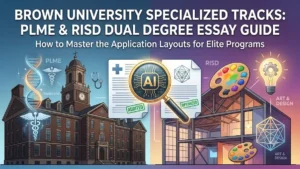
- Brown PLME Essays for 2026-2027
- Brown | RISD Dual Degree Essay
- Final Brown Supplemental Essays Checklist
- Final Strategy for the Brown Supplemental Essays
The Brown Supplemental Essays for the 2026–2027 application cycle include four required essays for first-year applicants applying for Fall 2027 admission. Brown requires two responses of 150–250 words and two shorter essays of 100–150 words. The prompts focus on the Open Curriculum, your upbringing and contribution to Brown, a class you would teach, and something that brings you joy.
This is a significant change from previous versions of the Brown Supplemental Essays. Applicants should not rely on older guides that still describe three longer essays plus short takes such as “three words” or a one-sentence “Why Brown?” response.
Last reviewed: September 2026. This guide reflects Brown University’s officially published 2026–2027 application questions for Fall 2027 admission.
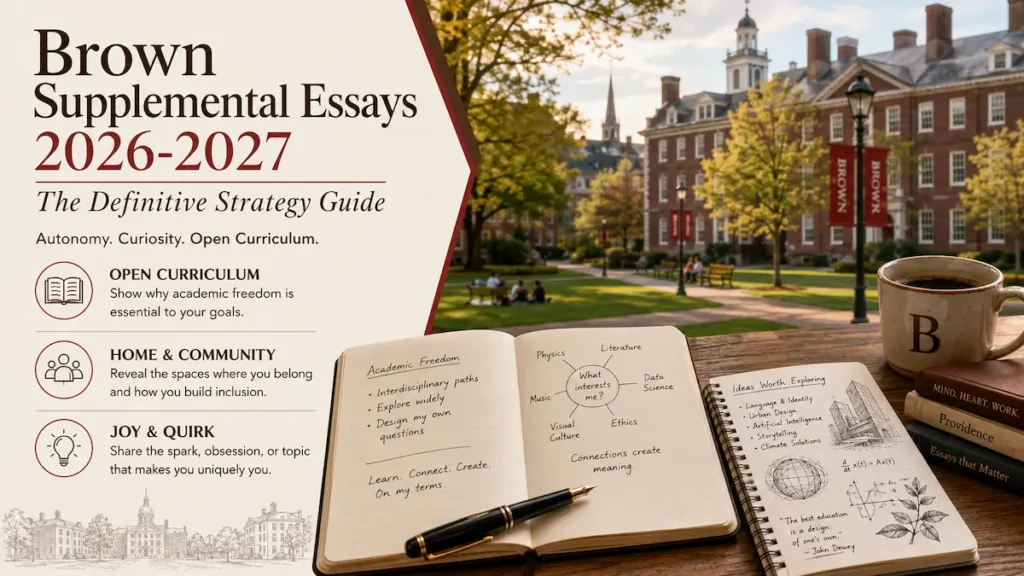
Brown Supplemental Essays 2026-2027 at a Glance
| Brown essay | Focus | Word limit |
|---|---|---|
| Essay 1 | Brown student qualities + Open Curriculum | 150–250 words |
| Essay 2 | Growing up + contribution to Brown | 150–250 words |
| Essay 3 | A class you would teach | 100–150 words |
| Essay 4 | Something that brings you joy | 100–150 words |
All four Brown Supplemental Essays are required for standard first-year applicants. Brown states that its supplemental essays are submitted through the Common Application.
Students applying to special programs have additional requirements. Program in Liberal Medical Education (PLME) applicants must complete additional PLME essays, while applicants to the Brown | RISD Dual Degree Program must complete its separate program essay.
Applicants should always confirm the final wording and application requirements on Brown University’s official Undergraduate Admission website before submitting.
What Are the Brown Supplemental Essays for Fall 2027?
The Brown Supplemental Essays 2026-2027 are designed to reveal something that grades, test scores, activities, and recommendation letters cannot fully communicate: how you think, what has shaped you, what you would contribute, and what you might do with Brown’s unusual level of academic freedom.
This year’s structure is especially revealing.
Instead of asking applicants simply to explain their academic interests, the new Open Curriculum question connects Brown’s educational philosophy with qualities Brown associates with its students, including intellectual curiosity, creativity, humility, collaboration, openness, resilience, and a desire to make a positive difference.
That changes the strategy for the first of the Brown Supplemental Essays.
A strong response now needs to answer two questions simultaneously:
1
What kind of thinker and learner are you?
2
How would that way of thinking shape what you do with Brown’s Open Curriculum?
The remaining essays test a different dimension of the applicant: contribution, intellectual personality, and genuine joy.
Together, the four Brown Supplemental Essays should create a coherent human profile rather than four disconnected mini-essays.
What Brown Supplemental Essays Evaluate
The Brown Supplemental Essays evaluate much more than writing ability or enthusiasm for an Ivy League university.
Brown’s Open Curriculum gives students unusual freedom to shape their education. Brown itself explains that students are expected to take an active role and assume responsibility for the direction of their learning.
That makes academic self-direction especially important.
Across the four Brown University supplemental essays, admissions readers can look for several major signals:
Intellectual curiosity
Do you pursue questions because you genuinely want to understand them?
Academic self-direction
Can you make productive choices without a rigid core curriculum determining your path?
Humility
Are you capable of learning from people, evidence, failure, and unfamiliar perspectives?
Collaboration
Do you make intellectual or community spaces better for other people?
Open Curriculum maturity
Do you understand that freedom creates responsibility?
Contribution
Can you connect your experiences to something you would actually bring to Brown?
Intellectual personality
What do you find interesting enough that you would want to teach other people about it?
Authenticity
What gives you satisfaction or joy when you are not trying to impress an admissions committee?
Specificity
Could these essays only belong to you?
A useful test is simple: if another highly qualified applicant could replace your name on the essay without changing much else, the response probably needs more specificity.
Use the Brown Supplemental Essay Grader
The Brown Supplemental Essays need to work together as one coherent admissions profile. A strong Open Curriculum essay can be weakened by generic short takes. A moving background essay can fall flat if it does not show what you would contribute to Brown. A polished “Why Brown?” sentence can still sound like it belongs to any Ivy League school.
Brown Supplemental Essay Grader
Review the four current Brown essays with prompt-specific rubrics and verified evidence.
Current Brown 2026–2027 contract: four required essays. Applicants selecting PLME or the Brown | RISD Dual Degree complete additional program responses separately.
How We Evaluate Brown’s 2026–2027 Essays
Each of Brown’s four current essays is reviewed against its own prompt-specific criteria, with verified evidence and actionable revision feedback.
Prompt-Specific ScoringEach of Brown’s four current essays is evaluated with its own rubric and word-limit expectations.
Open Curriculum ResponseReviews how clearly you connect Brown’s current Open Curriculum prompt to your own learning approach and qualities.
Upbringing & ContributionEvaluates whether your response connects a real part of your upbringing to what it shaped in you and the contribution you describe.
Class & Joy ResponsesReviews the two shorter 100–150 word essays for specificity, personal perspective, voice, and appropriate depth.
Evidence-Based FeedbackCriterion feedback is tied to verified excerpts from your own responses, with concrete revision recommendations.
Independent Second EvaluationAdd an Elite Second Opinion and compare both evaluations criterion by criterion, including a Combined Evaluation Score.
Your Brown portfolio review is being prepared. This can take 2–3 minutes. Please keep this page open.
Complete your Primary Review first to unlock an independent second evaluation and side-by-side comparison.
Buy CreditsNeed more reviews now?
Buy Universal Credits and continue instantly.
For a complete breakdown of the program, requirements, and essays, see our Brown PLME Essays and Program in Liberal Medical Education guide
Brown Supplemental Essay Prompt 1: Open Curriculum
What the Fall 2027 Brown Open Curriculum Essay Asks
For the 2026–2027 cycle, Brown introduces the Open Curriculum question with characteristics associated with Brown students in President Christina Paxson’s 2025 Convocation Address.
The prompt then asks applicants to explain how those characteristics—or other characteristics they possess—would shape their approach to the Open Curriculum.
Word limit: 150–250 words.
This makes the first of the Brown Supplemental Essays different from a standard “Why Major?” essay.
Brown is not only asking:
What do you want to study?
The deeper question is:
What kind of person will you be when given the freedom to direct your own education?
What the Brown Open Curriculum Essay Really Evaluates
A strong Brown Open Curriculum essay should connect three elements:
personal characteristic → intellectual behavior → Brown academic opportunity
For example, intellectual curiosity is not valuable merely because you claim to be curious.
Show what curiosity makes you do.
Perhaps you notice that wildfire models explain physical risk but do not explain why some neighborhoods recover faster than others. That question might lead you toward environmental science, public policy, economics, sociology, and spatial analysis.
Now Brown’s Open Curriculum has a purpose.
You are not asking Brown for freedom because freedom sounds attractive. You have demonstrated why an interdisciplinary problem requires it.
Weak direction
“I love the Open Curriculum because I can explore many different interests and take the classes I want.”
The problem is not that the statement is false.
The problem is that thousands of applicants could say it.
Stronger direction
“My fascination with wildfire recovery began with maps, but the questions the maps could not answer—who rebuilds, who leaves, and why—pushed me toward economics, environmental science, and public policy.”
That gives the admissions reader an intellectual trajectory.
The Brown Supplemental Essays become stronger when Brown-specific opportunities solve a problem already visible in the applicant’s thinking.
How to Structure Brown Essay 1
A practical structure is:
1
Start with evidence of a characteristic.
Do not announce:
“I am intellectually curious.”
Show curiosity operating through a question, observation, decision, experiment, disagreement, or experience.
2. Explain where that characteristic leads intellectually.
What questions do you now want to pursue?
3. Connect that behavior to the Open Curriculum.
Explain why Brown’s structure is useful for this particular way of thinking.
4. Show intentionality.
Freedom alone is not the goal. Explain what you would build with it.
The strongest Brown Supplemental Essays 2026-2027 treat the Open Curriculum as a tool for purposeful exploration, not as permission to avoid requirements.
Brown Supplemental Essay Prompt 2: Growing Up and Contribution
What Brown Essay 2 Asks
The second required response asks applicants to reflect on an aspect of growing up that inspired or challenged them and explain what unique contribution that experience could allow them to make to the Brown community.
Word limit: 150–250 words.
This is both a background essay and a contribution essay.
A response that explains where you come from but never shows how that experience affects the person Brown would actually meet on College Hill is only doing half the job.
What This Brown Supplemental Essay Really Evaluates
Brown wants to understand the relationship between:
experience → meaning → behavior → contribution
Your subject does not need to involve hardship.
“Growing up” could include:
family responsibilities;
a neighborhood;
language;
migration;
a family business;
rural or urban life;
siblings;
cultural traditions;
a school environment;
intellectual influences;
community expectations;
economic circumstances;
regular interaction with people different from you.
The important question is not how dramatic the story sounds.
It is what the experience taught you to notice, value, question, or do.
Weak direction
“I grew up in a diverse community, which taught me to value different perspectives.”
The conclusion is positive but abstract.
Stronger direction
“Translating school forms for my parents taught me to notice the moment an institution assumes everyone understands its language.”
Now the experience produces a recognizable habit of mind.
The applicant might then explain how that sensitivity affects the way they organize, communicate, include others, design systems, or participate in communities.
That is contribution.
Avoid the “And at Brown...” Ending
One of the most common problems in Brown supplemental essay examples is an artificial last sentence:
“And at Brown, I will bring this perspective to the diverse Brown community.”
That sentence contributes almost nothing.
Instead, show what the contribution looks like in practice.
Would you ask different questions?
Create something?
Mentor people?
Challenge assumptions?
Build bridges between groups?
Listen differently?
Organize differently?
The second of the Brown Supplemental Essays should help an admissions reader imagine what changes, however slightly, when you enter a room.
Brown Supplemental Essay Prompt 3: The Class You Would Teach
What Brown Essay 3 Asks
Brown asks applicants to imagine teaching a class about any subject, academic or otherwise.
Word limit: 100–150 words.
This question appeared in previous Brown applications, but it is now elevated into one of the four primary required Brown Supplemental Essays rather than functioning as a tiny short take.
The additional space matters.
You now have enough room to show not only what you would teach but also how you think about the subject.
What Brown Is Looking for in the Class Essay
This is an intellectual personality prompt.
Your proposed class can reveal:
what you notice;
what you know unusually well;
how you connect ideas;
what you find funny or strange;
what you want other people to understand;
how you approach learning;
what experiences have shaped your interests.
Do not assume that an academically prestigious topic is automatically better.
A class about constitutional law can be boring.
A class about supermarket layouts can be fascinating.
What matters is the mind behind the class.
Weak class idea
“Leadership 101: How to Become a Successful Leader.”
It is broad, predictable, and reveals very little about the applicant.
Stronger class idea
“Designed to Confuse: The Hidden Life of Public Forms.”
The class could examine how hospital paperwork, immigration documents, financial-aid forms, school notices, and government applications influence who can successfully navigate institutions.
That topic immediately tells us something about the applicant’s interests and way of seeing the world.
Give the Class an Actual Curriculum
For this Brown supplemental essay, ask yourself:
- What would students investigate?
- What surprising question would the course answer?
- What might they read, build, compare, debate, observe, or test?
- Why are you the person imagining this class?
You do not need to answer every question explicitly.
But thinking through them prevents the essay from becoming merely a clever course title.
Brown Supplemental Essay Prompt 4: What Brings You Joy
What the Brown Joy Essay Asks
The final required essay asks applicants to describe something that brings them joy, whether large or small, ordinary or extraordinary.
Word limit: 100–150 words.
The Brown joy essay is deceptively simple.
Applicants often damage it by trying too hard to make the topic impressive.
Do not.
This may be the best opportunity in the Brown Supplemental Essays to stop constructing an admissions argument and let the reader meet you.
What the Brown Joy Essay Really Evaluates
The joy essay can reveal:
voice;
attention;
emotional texture;
relationships;
humor;
rituals;
curiosity;
affection;
wonder;
personality outside achievement.
A strong topic could be:
making tortillas with a grandparent;
finding obscure songs;
repairing an old radio;
walking a dog before sunrise;
reorganizing a bookshelf;
teaching a younger sibling to cook;
watching storms arrive;
drawing subway passengers;
playing pickup basketball;
solving crossword clues with a parent.
The topic does not need prestige.
It needs life.
Use Concrete Detail
Compare:
“I love cooking with my grandmother because spending time with family makes me happy.”
with:
“My grandmother never measures the cinnamon. She shakes the jar twice, looks at the pot, and somehow knows.”
The second sentence gives the reader a scene.
Specific sensory or behavioral details are especially valuable in short Brown University supplemental essays because they can communicate character without lengthy explanation.
Do Not Turn Joy Into Another Résumé Essay
An applicant may be tempted to write:
“What brings me joy is conducting biomedical research because I hope to cure disease.”
That could be sincere.
But if the other Brown Supplemental Essays already establish your academic ambition, consider whether the joy essay can add a dimension of you the admissions committee has not yet seen.
The entire supplement is a portfolio.
Each answer should contribute something new.
Brown University lists the official 2026–2027 supplemental essay prompts on its Undergraduate Admission: How to Apply page, including the four required essays and the additional questions for special programs.
Brown Supplemental Essays Strategy: Build a Four-Essay Portfolio
Applicants often optimize each response individually but forget to examine the Brown Supplemental Essays together.
That is a mistake.
Imagine an admissions reader finishes all four answers.
What four things do they now know about you?
Ideally, each essay performs a different job.
| Essay | Best role in the application |
|---|---|
| Open Curriculum | How you think and learn |
| Growing Up | What shaped you and what you contribute |
| Class You Would Teach | Your intellectual personality |
| Joy | Your human personality |
If all four essays discuss robotics, your application may become one-dimensional even if every essay is individually strong.
If every response emphasizes helping others, the repetition may also reduce the amount of new information Brown learns.
The best Brown Supplemental Essays 2026-2027 have both coherence and range.
The essays should feel like the same person wrote them, but they should not tell the same story four times.
Brown Supplemental Essays Examples: What Makes a Strong Topic?
A useful Brown supplemental essay example is not something applicants should imitate sentence by sentence.
Its purpose is to demonstrate the difference between a generic concept and an applicant-owned idea.
Example: Open Curriculum
Generic:
“I have many interests, so Brown’s Open Curriculum would allow me to explore them.”
Stronger concept:
A student interested in language preservation realizes that linguistics alone cannot answer questions about why communities abandon or protect endangered languages. They want to combine linguistics with history, computer science, education, and public policy.
The second idea explains why interdisciplinary freedom is necessary.
Example: Growing Up
Generic:
“My family taught me the importance of hard work.”
Stronger concept:
Working weekends in a family restaurant taught an applicant to identify what needs to happen before anyone explicitly assigns the task.
That small behavioral insight can lead naturally into how the student contributes to teams and communities.
Example: Class You Would Teach
Generic:
“The Psychology of Success.”
Stronger concept:
“Why We Keep Things,” exploring ticket stubs, inherited tools, screenshots, childhood objects, and digital archives to understand memory and attachment.
Example: Joy
Generic:
“Music brings me joy.”
Stronger concept:
Searching with a sibling for hilariously bad cover versions of famous songs every Friday night.
The difference is specificity.
Strong Brown Supplemental Essays do not merely identify values. They create evidence for them.
Common Brown Supplemental Essays Mistakes
1. Using outdated Brown essay prompts
This is especially important for Fall 2027 applicants.
Older guides may still describe three longer essays plus short answers such as three descriptive words or a one-sentence Why Brown response.
That is not the current official structure for the 2026–2027 application cycle.
Use the current Brown essay prompts and verify them against Brown’s admissions website before submission.
2. Treating the Open Curriculum as unlimited freedom
Brown’s Open Curriculum is not compelling merely because it offers flexibility.
Brown describes an educational system in which students assume meaningful responsibility for their learning.
Your Brown Open Curriculum essay should therefore communicate intentionality.
3. Writing four versions of your résumé
Brown already receives your activities section.
The Brown Supplemental Essays should add interpretation, character, thought process, relationships, and perspective—not simply repeat accomplishments in paragraph form.
4. Making every essay about Brown
Not every sentence needs a university-specific reference.
The Open Curriculum response naturally requires significant Brown context.
The joy essay usually does not.
Forcing Brown programs or campus organizations into the joy response can make an authentic essay suddenly feel strategic.
5. Naming courses without explaining intellectual purpose
A list of Brown courses is not evidence of fit.
Neither is dropping the names of professors, laboratories, institutes, or concentrations without explaining why they matter to your questions.
Institutional specificity is useful only when it clarifies applicant specificity.
6. Confusing “unique contribution” with being unique
You do not need an extraordinary biography to answer Essay 2.
The word “unique” does not mean nobody else has ever shared your experience.
Your contribution becomes distinctive through the particular combination of experience, interpretation, habits, and actions you bring.
7. Making the class essay a gimmick
A quirky course title cannot compensate for an empty idea.
The strongest Brown class essays have both personality and substance.
8. Overengineering the joy essay
The joy essay does not require a life lesson.
Sometimes the strongest ending is simply a precise observation that lets the joy remain joy.
Brown PLME Essays for 2026-2027
Students applying to Brown’s Program in Liberal Medical Education have additional essays beyond the standard Brown application questions.
For a complete breakdown of the program, requirements, and essays, see our Brown PLME Essays and Program in Liberal Medical Education guide
Brown currently lists three additional PLME responses, each with a 250-word limit, addressing:
- the applicant’s motivation for medicine;
- why Brown’s PLME is the appropriate pathway;
- a personal quality or dimension beyond medicine that could contribute to becoming an effective physician.
Because PLME is a specialized eight-year undergraduate and medical education pathway, the strategy for the Brown PLME essays differs significantly from the standard Brown Supplemental Essays.
A strong PLME application needs more than enthusiasm for becoming a doctor. Applicants should demonstrate sustained reasoning about medicine, intellectual breadth, fit with Brown’s educational structure, and personal qualities relevant to the practice of medicine.
If you are applying to PLME, treat those essays as a separate portfolio rather than extensions of your general Brown responses.
Brown | RISD Dual Degree Essay
Applicants to the five-year Brown | Rhode Island School of Design Dual Degree Program also complete an additional program-specific essay.
The current Brown | RISD prompt has a 650-word limit and focuses on why the combination of Brown and RISD provides the right undergraduate education for the applicant, how the student might integrate the different academic and creative approaches of the two institutions, and what they could contribute to the interdisciplinary Dual Degree community.
This should not become a generic “Why Brown + Why RISD?” response.
The strongest answers explain why the applicant needs the intersection of the two institutions.
Final Brown Supplemental Essays Checklist
Before submitting your Brown Supplemental Essays, check all four responses as a portfolio.
Brown Essay 1: Open Curriculum
- Have you demonstrated a real characteristic rather than merely naming one?
- Does the essay reveal how you approach learning?
- Is there a clear intellectual direction?
- Do you understand the Open Curriculum as responsibility as well as freedom?
- Does Brown’s academic structure have a specific purpose in your answer?
Brown Essay 2: Growing Up and Contribution
- Is the experience concrete?
- Have you explained what it changed or taught you?
- Does the essay move from background to contribution?
- Can the reader imagine how that contribution might appear in a real community?
Brown Essay 3: Class You Would Teach
- Is the class specific?
- Does the topic reveal something new about you?
- Is there enough substance behind the title?
- Can the reader imagine what students would actually explore?
Brown Essay 4: Joy
- Does the essay show rather than merely explain?
- Are there concrete details?
- Does your natural voice appear?
- Is the topic genuinely meaningful to you?
- Have you resisted turning it into another accomplishment essay?
Full Brown Supplement
- Do the four essays reveal different dimensions of you?
- Is there unnecessary repetition?
- Could these essays belong to another applicant?
- Have you removed generic Ivy League language?
- Are all word limits correct?
- Have you checked the current official Brown admissions requirements?
- Have you reviewed your drafts with the Brown Supplemental Essay Grader?
If you need multiple reviews while revising, you can also view the available credit packs on the College Essay Grader pricing page.
Final Strategy for the Brown Supplemental Essays
The strongest Brown Supplemental Essays do not spend every sentence trying to convince Brown that the applicant is exceptional.
They make the reader understand how the applicant thinks.
For Fall 2027, the four required essays give Brown four different windows into that person: how you would use academic freedom, what shaped you, what you would enjoy teaching, and what gives you joy.
Use that range.
In the Open Curriculum essay, show intellectual direction rather than simply praising flexibility.
In the growing-up essay, move from experience to contribution.
In the class essay, reveal the strange, serious, playful, or unexpected things your mind likes to investigate.
In the joy essay, allow yourself to be a human being rather than an application.
When the Brown Supplemental Essays 2026-2027 work together, the result should not feel like four arguments for admission.
It should feel like four pieces of evidence about the same thoughtful, specific, multidimensional person.
Before submitting, use the Brown Supplemental Essay Grader to identify generic language, weak Open Curriculum reasoning, thin reflection, repeated material, unclear contribution, and missed opportunities for specificity.
Explore More Elite Admissions Guides: Looking for other Ivies? Browse our comprehensive 2026-2027 strategy library for the world's most selective schools.