
UC Personal Insight Questions Strategy 2026-2027: How to Write Strong UC PIQs for Fall 2027
- What’s Current for UC Personal Insight Questions in 2026-2027?
- The Basics of the UC Personal Insight Questions
- UC PIQ Analyzer 2026-2027: Evidence & Impact Grader
- UC PIQ Analyzer
- UC PIQ Evaluation Comparison
- My Essay Reviews
- Caltech Evaluation Comparison
- UC PIQ Evaluation Comparison
- Common Mistakes: Why Your UC PIQ May Feel Weaker Than Expected
- UC PIQs vs. Common App Personal Statement
- How to Choose Your 4 UC PIQ Prompts
- UC PIQ Guides: Prompt-by-Prompt Strategy
- PIQ #1: Leadership Experience
- PIQ #2: Creative Side
- PIQ #3: Greatest Talent or Skill
- PIQ #4: Educational Opportunity or Barrier
- PIQ #5: Significant Challenge
- PIQ #6: Academic Subject
- PIQ #7: Community Improvement
- PIQ #8: Strong Candidate / Additional Insight
- How to Build a Strong Four-PIQ Portfolio
- What Should Each PIQ Add?
- Use Context Without Turning the PIQ Into an Explanation of Your Circumstances
- Evidence Beats Adjectives
- Reflection Should Come From the Experience
- How to Improve a PIQ With Strong Activities but Weak Insight
- How to Improve a PIQ With Strong Reflection but Weak Evidence
- The Additional Comments Section Is Not a Fifth PIQ
- Applying to UC Berkeley? Review All Four PIQs Together
- What You Get From the UC PIQ Analyzer
- Elite Second Opinion and Compare Both Evaluations
- How to Use Your UC PIQ Feedback
- Final UC PIQ Review for Fall 2027
- Frequently Asked Questions About UC PIQs
- Explore More UC Admissions Resources
If you are applying to the University of California for Fall 2027, your Personal Insight Questions are one of the most important opportunities to show what grades, courses, activities, and awards cannot explain on their own.
A strong UC Personal Insight Questions Strategy 2026-2027 is not about writing four miniature Common App essays. It is about choosing four questions that reveal different, meaningful parts of your experience and answering them with enough context, action, evidence, and reflection for an admissions reader to understand who you are.
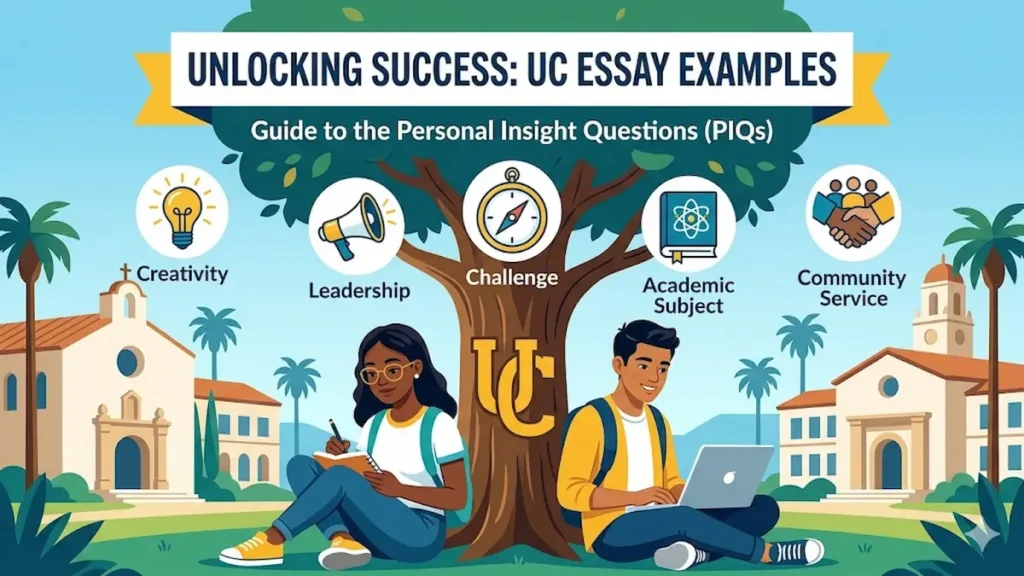
The Fall 2027 UC application opened on August 1, 2026. UC’s current first-year PIQ instructions require applicants to choose 4 of 8 Personal Insight Questions, with a maximum of 350 words per response. UC also states that all eight questions receive equal consideration, meaning there is no admissions advantage to choosing one PIQ over another.
That changes the strategic question.
You should not ask:
“Which PIQ looks most impressive?”
Instead ask:
“Which four questions let UC understand the most important things about me?”
The UC PIQ Analyzer on this page can help you review one response at a time, identify what is already working, see what remains underdeveloped, and determine what you should revise before submission.
What’s Current for UC Personal Insight Questions in 2026-2027?
For students applying for Fall 2027, UC’s current first-year Personal Insight Question structure remains straightforward: eight available questions, four required responses, and a maximum of 350 words for each response. Applicants are told to select the questions most relevant to their experiences and individual circumstances.
For your UC Personal Insight Questions Strategy 2026-2027, the most important official rule may be that all eight PIQs are equal in application review. UC explicitly says there is no advantage or disadvantage to choosing particular questions.
That means PIQ #6 is not automatically superior because it is academic. PIQ #1 does not become more valuable simply because it involves leadership. PIQ #5 does not become stronger merely because it discusses hardship.
The best four depend on your actual experiences.
UC also continues not to consider SAT or ACT scores when making admissions decisions or awarding scholarships. If applicants later report those scores, UC says they may be used for certain other purposes, including satisfying some minimum requirements or course placement after enrollment.
That does not mean your PIQs replace academics. It means the PIQs have a different job: giving the application information about your experiences, thinking, circumstances, decisions, interests, and development that numbers alone cannot communicate.
The Basics of the UC Personal Insight Questions
The foundation of any UC Personal Insight Questions Strategy 2026-2027 is understanding what the PIQs actually are.
They are not one 650-word personal statement divided into four pieces.
They are four separate opportunities to provide useful information about yourself.
UC describes the questions as a way to get to know your personality, background, interests, and achievements in your own voice. Applicants choose whichever four are most relevant to their experience and circumstances.
That means your four responses should not compete to tell the same story.
One might explain your academic curiosity. Another might demonstrate leadership. Another might show how you responded to a difficult situation. Another might reveal creativity, responsibility, community contribution, or a skill that matters to you.
The goal is not four impressive stories.
The goal is four useful pieces of evidence about the same person.
UC PIQ Analyzer 2026-2027: Evidence & Impact Grader
Does your PIQ clearly show what you did, why it mattered, and what it reveals about you? Our AEE evaluates your response using University of California expectations.
UC PIQ Analyzer
Expert evaluation based on UC Personal Insight Question expectations: clear context, specific action, reflection, and impact.
Your account includes 2 free essay reviews for life. Paid Universal Credits are always used first.
What You’ll Get From Your UC PIQ Review
Go beyond a single score with prompt-specific feedback, evidence-backed revision guidance, and an optional independent second evaluation.
Complete your Primary Review first to unlock an independent second evaluation and side-by-side comparison.
Need more reviews now?
Buy Universal Credits and continue instantly. Credits work across all our university-specific AI essay graders.
Instant activation after payment. 1 Universal Credit = 1 comprehensive UC PIQ review.
Before writing your responses, review UC’s official guidance here: UC Personal Insight Questions for first-year applicants.
Common Mistakes: Why Your UC PIQ May Feel Weaker Than Expected
A useful UC Personal Insight Questions Strategy 2026-2027 begins by removing the habits that waste the limited 350-word space.
1. Defining the Prompt Instead of Answering It
Students sometimes begin with something like:
“Leadership is the ability to illuminate a path for others.”
That may sound polished, but UC already knows what leadership means.
The admissions reader needs to know what you did.
A stronger opening moves quickly into the situation:
“When three new tutors stopped attending our weekly sessions, I asked them individually what was making participation difficult.”
Now there is a person, problem, action, and decision.
For leadership, creativity, community involvement, talent, challenge, or academic interest, concrete behavior usually tells the reader more than a definition.
2. Significant Under-Writing
You do not have to use all 350 words.
But a 150-word PIQ often struggles because there is not enough room for context, action, outcome, and reflection.
A response can identify what happened without showing why it mattered.
If your PIQ feels unfinished, ask whether you have adequately explained the situation, your individual responsibility, what you did, what happened afterward, and what changed in your understanding.
Do not add filler simply to reach 350 words. Use additional space only when it adds information.
3. Writing Like a Common App Personal Statement
The Common App allows one broader narrative of up to 650 words. The UC PIQ format asks first-year applicants to answer four separate questions, each capped at 350 words.
That difference should affect your writing.
A long atmospheric introduction, extended metaphor, quotation, or dramatic setup may consume valuable space before the response answers the actual question.
For UC, getting to the point is usually an advantage.
4. Making Claims Without Evidence
Compare:
“I made a significant impact on my school.”
with:
“I replaced our text-heavy recycling signs with photographs of the cafeteria items students were sorting incorrectly and spent the following week answering questions beside the bins.”
The second response lets the reader observe the contribution.
You do not need enormous results.
You need credible ones.
5. Inventing Numbers to Make the Outcome Sound Bigger
Do not turn:
“More students returned for tutoring.”
into:
“Student retention increased 47%.”
unless you actually know that number.
Specificity does not mean statistics.
A truthful observation can be excellent evidence:
“Several students began requesting the same tutor for their next session.”
That is specific without pretending you collected data you never collected.
6. Focusing Almost Entirely on the Distant Past
A childhood experience can explain where an interest began, but the PIQ should normally help the reader understand the student who is applying now.
If you mention something from elementary or middle school, connect it to later actions, high-school experiences, current thinking, or present responsibilities.
7. Ending With Generic Reflection
Watch for endings such as:
“This taught me to never give up.”
The idea may be true, but it does not tell the reader enough.
A better reflection explains what changed:
“I stopped treating the first failed prototype as evidence that my idea was wrong and began treating it as information about what to test next.”
Now the learning is specific to the experience.
UC PIQs vs. Common App Personal Statement
A sound UC Personal Insight Questions Strategy 2026-2027 treats the two formats differently.
The Common App Personal Statement provides space for one broader narrative or central theme. UC instead asks first-year applicants for four shorter responses selected from eight questions.
Your comparison graphic works very well here because students can understand the distinction immediately.
I would keep the image exactly in this section:
Comparison: Common App vs. UC PIQs
| Feature | Common App Personal Statement | UC Personal Insight Questions |
|---|---|---|
| Purpose | One broader personal narrative | Four short responses showing different parts of you |
| Length | Up to 650 words | Up to 350 words per response |
| Quantity | 1 main essay, plus school supplements | 4 responses selected from 8 prompts |
| Style | More narrative and reflective | More direct, specific, and interview-style |
| Testing | Depends on institution | UC currently does not consider SAT/ACT for admission decisions |
| Letters of recommendation | Depends on institution | Generally not submitted with the UC application; some campuses or majors may request them later |
| Best use | A central story or theme | Four distinct examples of context, action, reflection, and impact |
The strategic takeaway beneath it can remain simple:
Do not compress your Common App essay into 350 words four times.
Build four responses that each contribute useful information about your academic, personal, family, community, creative, or intellectual profile.
How to Choose Your 4 UC PIQ Prompts
The strongest UC Personal Insight Questions Strategy 2026-2027 begins before you write: choosing the right four questions.
Because UC gives all eight questions equal consideration, you do not need to find the four supposedly preferred by admissions officers.
Instead, start with your strongest experiences.
Imagine you are considering writing about tutoring, caring for a younger sibling, building an app, learning statistics through a community college course, working part-time, and organizing a neighborhood project.
Ask what each story would reveal.
The tutoring story might demonstrate how you communicate and lead. The job might show responsibility and adaptation. The statistics course might reveal intellectual curiosity. The app might show creativity and iterative problem-solving.
Then look for unnecessary overlap.
If three PIQs all describe being president of the same robotics club, even excellent individual responses may leave the reader with a narrow picture.
A useful test is:
If I removed this PIQ, what would UC no longer know about me?
If the answer is “almost nothing,” the response may be redundant.
UC PIQ Guides: Prompt-by-Prompt Strategy
Your UC Personal Insight Questions Strategy 2026-2027 should reflect what each individual question is actually asking. These guides go deeper into each prompt:
- How to Answer UC PIQ Prompt 1: Leadership Experience
- How to Answer UC PIQ Prompt 2: Creativity
- How to Answer UC PIQ Prompt 3: Greatest Talent or Skill
- How to Answer UC PIQ Prompt 4: Educational Opportunity or Barrier
- How to Answer UC PIQ Prompt 5: Significant Challenge
- How to Answer UC PIQ Prompt 6: Academic Subject
- How to Answer UC PIQ Prompt 7: Community Improvement
- How to Answer UC PIQ Prompt 8: Strong Candidate / Additional Insight
PIQ #1: Leadership Experience
Leadership does not require being president, captain, founder, or CEO of something.
The useful question is what happened because you accepted responsibility.
A strong response makes the leadership visible through decisions: perhaps you noticed a problem, changed a process, taught someone, mediated disagreement, organized people, or helped a group function more effectively.
Do not spend half the response explaining your title.
Show the moment where your contribution mattered.
A useful structure is:
context → responsibility → decision → action → effect → changed understanding
PIQ #2: Creative Side
Creativity can appear through visual art or music, but it can also appear through engineering, coding, research, entrepreneurship, design, organization, problem-solving, or adapting something that did not work.
A strong creative PIQ often reveals iteration.
Perhaps your first design failed. Perhaps your solution created another problem. Perhaps a constraint forced you to rethink your original approach.
Those moments can tell the reader much more about creativity than simply describing the finished product.
PIQ #3: Greatest Talent or Skill
Do not simply announce your greatest skill and provide awards as proof.
Explain how the skill developed.
What were you like before?
What did practice, feedback, difficulty, repetition, or experience change?
Then show the skill being used.
If your skill is explaining difficult ideas, give the reader a moment where you actually changed an explanation after realizing another person did not understand.
That is evidence.
PIQ #4: Educational Opportunity or Barrier
This question gives you two routes: taking advantage of an educational opportunity or overcoming an educational barrier.
An opportunity might involve dual enrollment, advanced coursework, a specialized program, mentorship, research, independent learning, an internship, or access to something unavailable in your normal curriculum.
A barrier might involve limited school resources, financial circumstances, family responsibilities, health, language, access, or another legitimate issue that affected your education.
The response becomes valuable when it moves from circumstance to response.
What did you do with the opportunity?
What did you do about the barrier?
How did it change your education?
PIQ #5: Significant Challenge
Do not treat PIQ 5 as a competition for the most dramatic hardship.
The prompt asks about the challenge, the steps you took, and the effect on academic achievement.
That means your response needs action.
If you spent 280 words explaining the difficulty and 70 words explaining what you did, the balance may be wrong.
Also be precise about academic impact.
If your grades remained stable but your work became rushed or you missed smaller deadlines, say that.
Credibility is better than exaggeration.
PIQ #6: Academic Subject
PIQ 6 becomes much stronger when the academic interest has a specific intellectual hook.
Compare:
“Computer science fascinates me because technology changes the world.”
with:
“I became interested in why two programs can produce the same answer while requiring radically different amounts of time as the input grows.”
The second statement gives the reader a question.
Then show what you did with that interest.
Classes are useful context, but independent reading, experiments, projects, discussions, research, tutoring, competitions, or self-directed investigation can demonstrate continued pursuit.
PIQ #7: Community Improvement
Define the community naturally.
It might be your school, neighborhood, family, workplace, cultural group, religious community, online community, team, or another group that genuinely matters to you.
Then distinguish your action from the group's action.
If every important sentence begins with “we,” the reader may struggle to identify your contribution.
You do not need to take sole credit for collaborative work. Just make your actual responsibility visible.
PIQ #8: Strong Candidate / Additional Insight
PIQ 8 works best when you have something important to add that the rest of the application does not adequately communicate.
Avoid a paragraph of adjectives:
“I am motivated, hardworking, curious, resilient, and passionate.”
Instead, choose one meaningful quality, circumstance, habit, responsibility, perspective, or experience and provide evidence.
Ask:
What would an admissions reader fail to understand about me if I did not include this response?
That question can help determine whether PIQ 8 adds real value.
How to Build a Strong Four-PIQ Portfolio
The four responses should be able to stand individually, but you should also read them together before submitting.
Imagine a set containing an academic subject PIQ, leadership response, community response, and creative response.
That combination is not automatically strong.
What matters is what the essays actually reveal.
Four different prompt numbers can still tell essentially the same story.
Conversely, two responses may both involve technology while revealing completely different dimensions: one might show intellectual curiosity and the other creative iteration.
Look at function, not just topic.
What Should Each PIQ Add?
A useful way to review your set is to give every response a one-sentence purpose.
For example:
PIQ 1: Shows how I changed my approach to leadership after listening to students.
PIQ 2: Shows how I solve practical problems by building and revising digital tools.
PIQ 6: Shows how classroom learning developed into independent academic investigation.
PIQ 7: Shows how I contribute to my school through observation and practical service.
If those four descriptions feel meaningfully different, the portfolio has useful range.
Use Context Without Turning the PIQ Into an Explanation of Your Circumstances
UC asks applicants to choose the questions most relevant to their experiences and individual circumstances.
Context therefore matters.
But context should help the reader understand your actions.
If your school did not offer advanced mathematics and you enrolled at a community college, the lack of advanced courses explains why the opportunity mattered.
You do not need several paragraphs explaining everything your school did not offer.
Give the reader enough context to understand the choice, then return to what you did.
Evidence Beats Adjectives
Do not tell UC:
“I am persistent.”
Show the situation where persistence became necessary.
Do not tell UC:
“I care deeply about my community.”
Show what you noticed and what you did.
Do not tell UC:
“I am intellectually curious.”
Show the question you kept investigating after the assignment ended.
This is one of the simplest ways to improve a PIQ.
When a positive adjective appears, ask whether the surrounding paragraph already provides enough evidence for the reader to infer it.
Reflection Should Come From the Experience
Reflection does not need to be philosophical.
It needs to be specific.
Suppose a tutoring experience taught you that explaining more was not always helpful.
A useful reflection might be:
“I stopped measuring a tutoring session by how much material I explained and began paying attention to how much the student could explain back.”
That is much stronger than:
“I learned the importance of communication.”
The first statement reveals a changed behavior.
How to Improve a PIQ With Strong Activities but Weak Insight
Some students already have impressive experiences but still produce weak PIQs because the response reads like a résumé.
If you already established what you accomplished, stop adding more accomplishments.
Use the space to answer harder questions.
Why did you make that decision?
What did you initially misunderstand?
Where did your first approach fail?
What did someone else help you notice?
What changed afterward?
The activity may get the reader's attention. Your thinking is what makes the response personal.
How to Improve a PIQ With Strong Reflection but Weak Evidence
The opposite problem also occurs.
You may write:
“I learned that leadership requires listening.”
Good.
Now prove it.
What happened that made you realize that?
Who were you listening to?
What did they tell you?
What did you change because of it?
What happened afterward?
Reflection becomes credible when the reader can trace it back to an actual experience.
The Additional Comments Section Is Not a Fifth PIQ
UC's current application guidance says the Additional Comments field is for circumstances or information you did not have an opportunity to address elsewhere; it specifically says this should not become another essay.
Use it for clarification or context when necessary.
Do not use it to sneak a fifth PIQ into the application.
Applying to UC Berkeley? Review All Four PIQs Together
The UC PIQ Analyzer on this page is designed for reviewing one response at a time.
If UC Berkeley is one of your priority campuses, you can then use the UC Berkeley PIQ Grader to review the complete set of four responses together.
That second step helps you answer a different question.
The individual analyzer asks:
“How strong is this PIQ?”
The Berkeley portfolio review asks:
“What do these four PIQs communicate when read together?”
That distinction matters when individual responses are strong but repetitive as a group.
What You Get From the UC PIQ Analyzer
The goal of the UC Personal Insight Questions Strategy 2026-2027 is not to chase a score. It is to get feedback that tells you what to improve.
Select the PIQ you are answering, paste your completed draft, and the analyzer reviews the response against the criteria relevant to that specific prompt.
You receive an overall UC PIQ Score, followed by criterion-level feedback showing where the response is strong and where it remains underdeveloped.
For each important area, the feedback can show the points awarded, reasoning, evidence from your own response, what is missing or underdeveloped, and a specific recommendation.
The review also identifies overall strengths, top revision priorities, and a next best action.
That is the part that matters.
A score such as 87/100 gives you a reference point. The useful question is why it earned 87 and what would make the response better.
Elite Second Opinion and Compare Both Evaluations
If you want another perspective on the same PIQ, you can unlock an Elite Second Opinion.
The response is reviewed independently a second time using the same prompt and evaluation criteria.
You can then open Compare Both Evaluations to see the Primary Evaluation, Independent Second Evaluation, Combined Evaluation Score, criterion-by-criterion differences, areas where both evaluations award the same points, shared revision priorities, and concerns raised by only one evaluation.
The Combined Evaluation Score is useful as a reference, but the strongest value comes from the comparison.
If both independent evaluations tell you that your academic direction is too vague, that deserves attention.
If one evaluator identifies a problem and the other does not, read both explanations before deciding what to change.
How to Use Your UC PIQ Feedback
Start with the biggest substantive weakness, not the easiest sentence to rewrite.
If the review says your personal role is unclear, changing adjectives will not fix it.
If it says the impact lacks evidence, look for a truthful observation.
If it says the reflection is generic, explain what actually changed.
If it says your academic direction is broad, identify the specific question, topic, method, or next step that genuinely interests you.
Then revise.
Do not invent evidence simply because a recommendation suggests adding specificity.
The recommendation should help you identify information you genuinely have—not create information you do not.
Final UC PIQ Review for Fall 2027
Before submitting, read all four responses consecutively.
Ask whether every answer directly addresses its selected prompt, whether your individual actions are visible, whether important claims have credible evidence, whether the reflection shows real development, and whether each response adds something new.
Also ask whether someone who knew nothing about you before reading the application would understand more than your activities and achievements afterward.
That is the standard that matters.
The best UC Personal Insight Questions Strategy 2026-2027 is not about sounding extraordinary in every paragraph. It is about giving UC admissions readers four clear, truthful, specific windows into your experiences, choices, thinking, development, and potential contribution.
Draft the responses. Review them individually. Compare the four as a set. Strengthen the evidence that is already true.
Then use the UC PIQ Analyzer to see what is working, what remains underdeveloped, and which revision should come next.
Frequently Asked Questions About UC PIQs
Are there “best” UC PIQ prompts?
No. UC states that all eight questions receive equal consideration and that choosing particular prompts provides no advantage or disadvantage.
The best prompts are the ones that let you provide your strongest relevant evidence.
Do I need to use all 350 words?
No. The official rule is a maximum of 350 words, not a requirement to reach exactly 350.
Use enough space to answer the prompt effectively without padding the response.
Should I reuse my Common App essay?
Usually not as-is.
A Common App personal statement may contain material that can inspire a UC response, but the PIQ should be reconstructed around the specific question being answered.
Should I write poetically?
You can have a strong voice without writing like a novel.
Clarity, specificity, evidence, and personal insight matter more than decorative language.
Can I include links to my portfolio?
Do not depend on an external link to make your response understandable.
The PIQ itself should contain the information the reader needs.
Does grammar matter?
The PIQ still needs to be readable.
Grammar and spelling become a problem when they interfere with clarity. Do not sacrifice natural voice simply to make every sentence sound formal.
Does UC consider SAT or ACT scores?
UC currently states that SAT and ACT scores are not considered in admissions decisions or scholarship awards. Reported scores can be used for certain other purposes, including eligibility or course placement after enrollment.