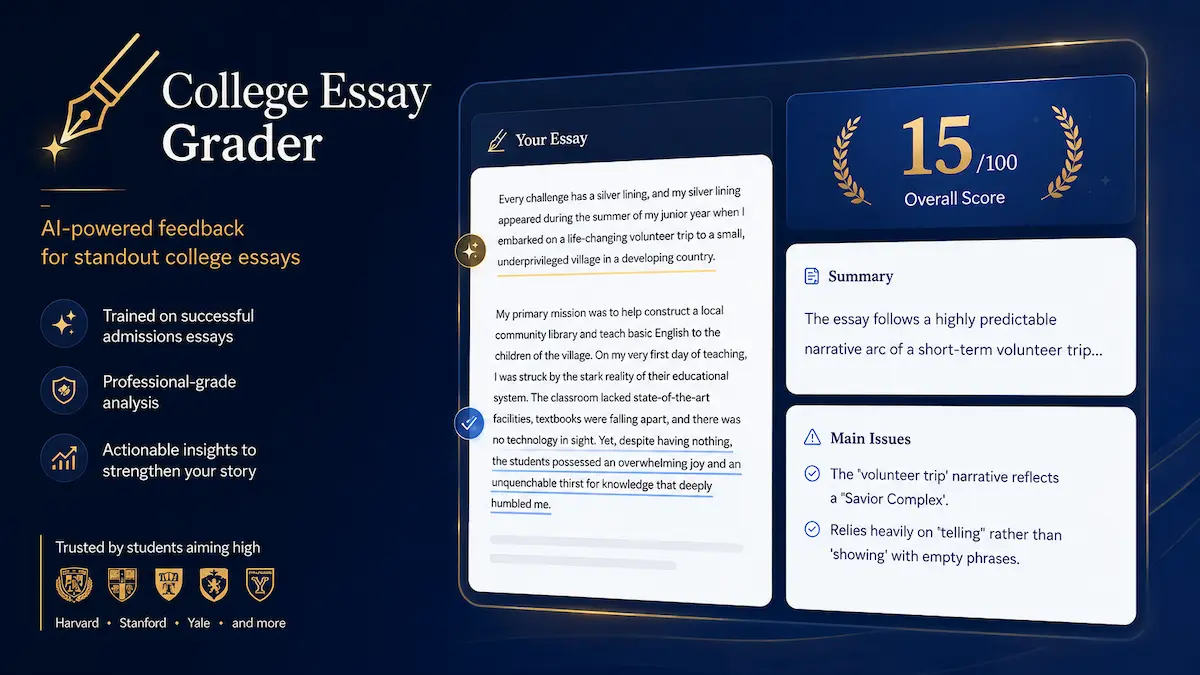
Is Your Ivy League Essay Strong Enough? Get Your Score & Detailed Feedback

Get an instant score, detailed admissions feedback, and specific revision suggestions to strengthen your Ivy League Personal Statement before you submit.

Built for students applying to Harvard, Yale, Princeton, Columbia, Brown, Cornell, Dartmouth, and Penn

Common App Personal Statement Grader | College Essay Grader

Common App Personal Statement Grader

Review your Common App personal statement the way a strict but fair admissions reader would: concrete story, narrative arc, real reflection, personal stakes, and an authentic voice — feedback first, score second.

Common App focus: The first-year essay is a broad personal statement — never a university-specific supplement. The seven official prompts are unchanged for the 2026–2027 cycle, and your choice of prompt is never scored: the essay is evaluated on its own substance. The official limit is 650 words.

What You'll Get From Your Common App Review

See whether your essay shows a specific applicant-owned story, a real arc with genuine reflection, and personal stakes a reader cannot find in your transcript — criterion by criterion, with literal evidence from your own text.

Criterion-by-Criterion Evaluation
Specific Evidence
Narrative Arc & Reflection
Authentic Voice Check
Independent Second Opinion
Improvement Tracking

Paste your personal statement below to get criterion-level feedback, revision priorities, and a saved review.

Your account includes 1 free essay review for life. Paid Universal Credits are always used first.

Your Personal Statement

Words: 0 / 650

Elite Second Opinion

Get an independent second review of the same Common App personal statement and compare where both evaluations agree or differ.

Cost: 3 Universal Credits Current credits: — Paid credits only

Complete and save a Common App personal statement review to unlock this option.

Need more reviews now?

Instant activation after payment. 1 Universal Credit = 1 Common App personal statement review.

Applying to specific universities? Use our Supplemental Essay Grader to ensure your 'Why Us' essays have the perfect institutional fit.

Writing an Ivy League Personal Statement That Actually Reveals Who You Are

A strong Ivy League Personal Statement is not about sounding impressive in every sentence. It is about giving admissions readers information about you that they cannot get from your grades, activities list, awards, recommendations, or test scores.

The strongest essays tend to be specific, reflective, personal, and difficult to transfer to another applicant.That is why standard proofreading fails. It improves the surface but misses the admissions strategy.

A grammatically polished essay can still be weak if it:

  • tells a story without meaningful reflection,
  • repeats achievements already visible elsewhere,
  • relies on clichés or generic lessons,
  • sounds overly manufactured,
  • describes qualities instead of demonstrating them,
  • or never gives the reader a clearer understanding of the person behind the application.
The College Essay Grader is designed to help you identify those problems before you submit.

It reviews your draft for narrative effectiveness, specificity, reflection, authenticity, writing execution, and other admissions-relevant strengths and risks, then gives you structured feedback you can use to revise the essay yourself.

Why Proofreading Is Not Enough for an Ivy League Personal Statement

Proofreading matters.

Grammar, punctuation, clarity, sentence structure, and word choice all affect how easily an admissions reader can follow your essay.

But proofreading answers only one question:

Is the essay well written?

A competitive college essay has to answer a more important question:

Does the essay reveal something meaningful and memorable about the applicant?
Students sometimes spend hours polishing sentences when the underlying essay still has a strategic problem.

For example, an essay may be technically excellent but still:

  • read like an expanded résumé,
  • spend too much time describing what happened and too little explaining why it mattered,
  • use a familiar topic without a distinctive perspective,
  • rely on conclusions such as “I learned perseverance,”
  • make the applicant sound accomplished but not personally knowable,
  • or contain a story that never connects to the applicant’s present way of thinking.
That is why revision has to go beyond proofreading.

The 3 Core Qualities of a Strong Ivy League Personal Statement

A strong Ivy League Personal Statement should help an admissions reader understand how you think, what matters to you, and what makes your perspective distinct.

Narrative Strength

A strong personal statement gives the reader a clear experience, idea, or progression to follow. It uses specific details and meaningful reflection instead of simply listing achievements or summarizing your résumé.

Reflection & Insight

The essay should reveal more than what happened. Strong reflection shows what you noticed, questioned, understood differently, or changed as a result of the experience.

Authentic Voice

Your writing should sound like a thoughtful student, not a template or manufactured admissions persona. Clear, natural language and specific personal details help your real perspective come through.

What Our Ivy League Personal Statement Grader Looks For

Your personal statement is reviewed as an admissions essay, not simply as a piece of academic writing.

The evaluation focuses on areas such as:

Narrative Strength

Does the essay give the reader a clear experience, progression, idea, or story to follow?

A strong essay does not need a dramatic event. Ordinary experiences can become excellent personal statements when the details, choices, observations, and reflection are genuinely revealing.

Specificity

Could this essay belong only to you?

Specific details make abstract qualities believable.

Instead of simply claiming that you are curious, resilient, compassionate, independent, or ambitious, the essay should give the reader evidence through actions, decisions, observations, conversations, habits, or moments.

Reflection

What does the essay reveal about how you think?

Reflection is more than adding a lesson at the end.

Strong reflection can show:

  • what you noticed,
  • what changed in your thinking,
  • what you misunderstood initially,
  • what question stayed with you,
  • how your behavior changed,
  • what tension you still think about,
  • or why an experience matters to you now.
Genuine reflection focuses on internal cognitive and behavioral shifts rather than generic moral conclusions.

Authentic Voice

Does the writing sound like a thoughtful student or like a manufactured admissions persona?

Your essay does not need to sound casual, but it should still sound human.

Overly formal language, corporate phrasing, exaggerated life lessons, and excessive polishing can make an essay feel less personal rather than more sophisticated.

Writing Execution

Strong ideas still need clear execution.

The grader considers whether the structure, pacing, transitions, sentences, and organization allow the reader to understand the essay without unnecessary friction.

Overall Admissions Value

The most important question is not whether the essay makes you sound perfect.

It is whether the essay adds meaningful information to the rest of your application.

A useful personal statement should help the reader understand something about your perspective, character, motivations, relationships, interests, choices, growth, or way of thinking that would otherwise be difficult to see.

What Makes an Ivy League Personal Statement Memorable?

There is no single formula for an Ivy League essay.

You do not need:

  • a traumatic experience,
  • an extraordinary accomplishment,
  • an international service trip,
  • a research breakthrough,
  • a dramatic opening line,
  • or a life-changing event.
What matters is what you do with the material.

A seemingly small experience can reveal far more about an applicant than a prestigious accomplishment if the essay contains genuine specificity and reflection.

A useful test is:
After reading the essay, what does the admissions reader understand about me that they did not know before?

If the answer is only:

  • “I work hard.”
  • “I care about helping people.”
  • “I learned not to give up.”
  • “I value diversity.”

the essay probably needs another layer.

Those qualities become meaningful when the reader can see where they come from and how they affect your actual behavior.

Show the Reader Instead of Naming Your Qualities

One of the most common personal statement mistakes is telling the admissions reader what to think.

For example:

Weak:
“This experience taught me that I am resilient and determined.”

That gives the conclusion but very little evidence.

A stronger essay allows the reader to reach that conclusion through what actually happened.

Show:

  • the decision you made,
  • what you tried,
  • what failed,
  • what you noticed,
  • the tradeoff you faced,
  • how you responded,
  • or what changed afterward.
The goal is not to eliminate reflection.
The goal is to earn the reflection with evidence.

Your Essay Does Not Need to Be About Your Biggest Achievement

Students applying to highly selective colleges often feel pressure to choose the most impressive topic available.

That can backfire.

Admissions readers already have sections of the application devoted to:

  • activities,
  • awards,
  • academics,
  • leadership,
  • employment,
  • honors,
  • and extracurricular accomplishments.

Your Ivy League Personal Statement can do something different.

It can reveal:

  • an unusual habit,
  • a family dynamic,
  • a recurring question,
  • an ordinary responsibility,
  • a personal contradiction,
  • a small obsession,
  • an intellectual curiosity,
  • a relationship,
  • a mistake,
  • a place,
  • a routine,
  • an unexpected interest,
  • or an experience that changed how you understand something.
Prestige is not the same as insight.

Common Ivy League Personal Statement Mistakes

1. The Résumé Dump

The essay becomes another list of accomplishments:

clubs, internships, competitions, leadership positions, volunteer work, awards, research, and projects.

Your activities section already provides much of that information.

The personal statement should explain something behind those facts rather than simply repeating them.

2. The Generic Growth Essay

The essay describes an obstacle and concludes with:

“I learned perseverance.”
“I learned the importance of hard work.”
“I learned to never give up.”

Those lessons are not inherently bad, but thousands of applicants can reach the same conclusion.

Ask instead:
What changed specifically in the way I think, decide, notice, respond, or act?

3. The Essay About an Accomplishment Instead of a Person

An impressive accomplishment can be a useful setting for an essay.

But the accomplishment itself cannot do all the work.

The admissions reader should learn about you, not merely about the project, competition, organization, award, or outcome.

4. The Savior Narrative

Service experiences require particular care.

An essay can unintentionally portray other people primarily as problems the applicant arrived to solve.

Stronger service essays tend to show listening, humility, complexity, sustained involvement, reciprocal learning, and a realistic understanding of the applicant's role.

5. Trauma Without Reflection

Difficult experiences can absolutely become meaningful personal statements.

But describing suffering is not the same as reflecting on it.

The essay still needs to reveal agency, perspective, change, tension, understanding, or meaning.

The experience should serve the story you are telling about yourself rather than forcing the reader to focus exclusively on what happened to you.

6. The Over-Polished Voice

An essay can be technically flawless and still feel impersonal.

Watch for language that sounds like:

  • a corporate biography,
  • a LinkedIn profile,
  • a motivational speech,
  • a scholarship template,
  • or an adult attempting to imitate a teenager.
Your writing should be polished enough to communicate clearly while still sounding recognizably like you.

7. Trying Too Hard to Sound “Ivy League”

There is no universal Ivy League personality.

You do not need to manufacture intellectual sophistication, leadership, ambition, social impact, or any other supposedly ideal applicant trait.

Instead, give the reader concrete evidence of your actual interests, behaviors, choices, relationships, questions, and perspective.

Specificity is usually more persuasive than branding yourself.

Common App Personal Statement Prompts 2026–2027

The official 2026–2027 Common App personal statement continues to offer seven essay prompt options.

The prompts give students considerable flexibility in choosing what story to tell.

Your choice of prompt matters, but it is usually less important than the quality of the essay itself.

The prompt is a doorway.

The real objective is to write an essay that helps an admissions reader understand something meaningful about you beyond the rest of your application.

If you are still deciding which Common App topic to use, explore our prompt-specific guides:

Before submitting, always confirm the current wording in Common App itself or on the official Common App essay prompts page.

How the College Essay Grader Works

1. Paste Your Personal Statement

Add your Common App essay or other main college personal statement to the grader.

2. Receive a Structured Evaluation

Your draft is reviewed against admissions-relevant criteria rather than grammar alone.

The analysis identifies strengths, weaknesses, underdeveloped areas, and potential risks within the essay.

3. Review Evidence From Your Own Draft

Feedback should be useful enough to tell you why something is working or not working.

Where appropriate, the evaluation connects its findings to evidence from your own writing instead of relying only on generalized advice.

4. Identify Your Highest-Priority Revisions

Not every sentence needs to change.

The objective is to identify the revisions most likely to improve the essay's clarity, specificity, reflection, narrative effectiveness, and overall admissions value.

5. Revise in Your Own Voice

The grader is designed to help you evaluate and revise your writing.

It should not replace your experiences, ideas, judgment, or voice.

You decide what to change and write the final version yourself.

What Your Essay Score Means

Your essay score is a diagnostic tool.

It is not an admission probability and should not be interpreted as one.

College admissions decisions depend on many factors beyond the personal statement, including academics, course rigor, recommendations, activities, institutional priorities, context, and the rest of the application.

Use the score to compare the strength of your own drafts, identify weaknesses, and prioritize revision.

The feedback is more important than chasing a perfect number.

Ivy League Personal Statement Final Checklist

Before submitting your Ivy League Personal Statement, ask:

  • Does my essay reveal something that is not obvious from my activities list?
  • Is the topic specific enough to feel personal?
  • Have I included concrete details rather than only abstract claims?
  • Does the essay spend enough time on reflection?
  • Can the reader understand why this experience, idea, or story matters to me?
  • Does my voice sound natural?
  • Have I avoided repeating my résumé?
  • Have I removed clichés that are not supported by specific evidence?
  • Does the essay show something about how I think?
  • Does the ending feel earned rather than attached?
  • Could another applicant plausibly submit essentially the same essay?
  • After reading it, would someone understand me better?
A strong personal statement does not need to make you sound flawless.
It should make you specific, understandable, thoughtful, and memorable.

Ivy League Supplemental Essays Need Different Graders

Your Common App personal statement is only one part of an Ivy League application.

Supplemental essays have different purposes and should not be evaluated using the same rubric as a 650-word personal statement.

A “Why Us?” response, intellectual-interest essay, community essay, short take, academic response, or school-specific supplement has its own prompt, constraints, and evaluation criteria.

That is why College Essay Grader also offers university-specific graders built around the current requirements for individual schools.

For the 2026–2027 cycle, we have updated graders for major Ivy League universities including Harvard, Yale, Princeton, Brown, Columbia, Cornell, Dartmouth, and the University of Pennsylvania. Current pages on the site already reflect substantial Fall 2027 changes at schools such as Yale, Brown, Cornell, Dartmouth and Penn.

Frequently Asked Questions

What is an Ivy League Personal Statement?

An Ivy League Personal Statement generally refers to the main personal essay submitted as part of an application to an Ivy League university, often through the Common Application.

Its purpose is not to summarize the entire application. It gives the admissions reader an opportunity to understand the applicant's voice, perspective, experiences, values, interests, relationships, or way of thinking in greater depth.

How long is the Common App personal statement?

The Common App personal statement allows up to 650 words. The limit should be treated as available space rather than a target that must always be reached.

Use enough words to develop the essay effectively without adding material solely to reach the maximum.

What makes an Ivy League Personal Statement strong?

There is no universal Ivy League essay formula.

Strong personal statements generally combine specific evidence, meaningful reflection, authentic voice, clear writing, and information that contributes something new to the application.

Does my personal statement need an extraordinary topic?

No.

A familiar or ordinary topic can become an excellent essay if the treatment is specific and revealing.
The quality of your observation and reflection usually matters more than the apparent prestige of the event.

Should I write about trauma?

Only if it is genuinely the story you want to tell and the essay reveals more than the difficult event itself.

The reader should come away understanding something meaningful about you—not only understanding that something painful happened.

Can I use an essay grader to write my college essay?

The grader is best used as a feedback and revision tool.

Use it to identify weaknesses, evaluate structure and reflection, locate generic passages, and determine what you may want to revise.

Your experiences, decisions, ideas, and final writing should remain your own.

What is the biggest personal statement mistake?

One of the biggest is genericity.

An essay can be perfectly grammatical and still fail to distinguish the applicant.
The strongest test is simple:

Does this essay contain enough specific experience, thought, detail, and perspective that it genuinely feels like mine?

Go up