
NYU Supplemental Essay Grader 2026–2027: Fall 2027 Bridge Builder Essay Review

Explore Top STEM / Tech Giants essay graders for UT Austin, Michigan, UC Berkeley, Purdue, UIUC, Carnegie Mellon, MIT, Caltech, and more.
10 articles
NYU Supplemental Essay Grader 2026–2027: Fall 2027 Bridge Builder Essay Review

MIT Supplemental Essay Grader 2026–2027: New Fall 2027 Prompts, Short Answers & Review
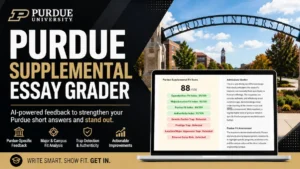
Purdue Supplemental Essay Grader 2026–2027: Fall 2027 Prompts, Tips & Review
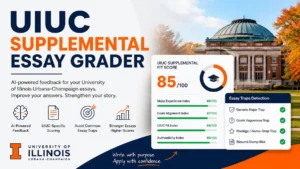
UIUC Supplemental Essay Grader 2026–2027: Fall 2027 Essay Prompts, Tips & Review
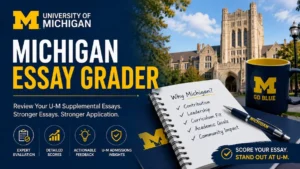
University of Michigan Supplemental Essays 2026–2027: Fall 2027 Prompts, Tips & Strategy

UC Berkeley PIQ Grader 2026–2027: Personal Insight Questions, Examples & Fall 2027 Strategy

UT Austin Essay Grader 2026–2027: Fall 2027 Essay Prompts, Tips & Review

Carnegie Mellon Supplemental Essay Grader for Fall 2027: Review Your CMU Essays Before You Submit
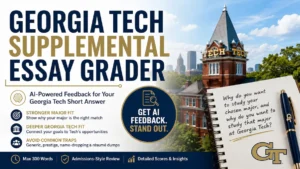
Georgia Tech Supplemental Essay Grader 2026–2027: New First-Year Essay Rules & Common App Review
Caltech Supplemental Essay Grader 2026–2027: New Fall 2027 Prompts, STEM Essays & Strategy
The Top STEM / Tech Giants category brings together essay graders for universities where applicants often need to prove more than general academic strength. Schools like MIT, Caltech, Carnegie Mellon, Georgia Tech, Purdue, UIUC, UT Austin, Michigan, and UC Berkeley frequently expect essays that show intellectual depth, problem-solving ability, research interest, technical curiosity, collaboration, and a clear reason for choosing a specific major or academic environment.
For many applicants, the hardest part is not writing a polished essay. The harder challenge is showing fit. A strong STEM or tech-focused application should explain what kind of problems the student wants to solve, how previous experiences shaped that direction, and why the university’s academic structure makes sense for those goals. These graders help identify when an essay sounds too generic, too résumé-like, too prestige-focused, or too disconnected from the student’s intended field.
STEM-heavy universities often receive applications from students with strong grades, rigorous courses, competitions, research, coding projects, engineering activities, or science experience. Because many applicants look strong on paper, essays become a chance to show judgment, motivation, reflection, and academic direction. A strong essay should connect the student’s experiences to a specific field without sounding forced or exaggerated.
These AI essay graders are built to review university-specific prompts and detect common weaknesses such as vague “I love technology” statements, recycled “Why Us” essays, weak major alignment, shallow activity descriptions, and essays that describe achievements without explaining growth or impact.
Start with the university-specific grader for the school you are applying to. If you are applying to several STEM, engineering, business, or technology-focused universities, compare the feedback across different graders to see whether your essays are truly tailored or simply repeating the same application story. The strongest applications usually keep a consistent academic identity while adapting each essay to the university’s actual prompts and expectations.