Georgetown Supplemental Essays 2026–2027: Fall 2027 Prompts, Tips & Strategy Guide
Last updated: September 2026 for the 2026–2027 admissions cycle and Fall 2027 entry. Verified against Georgetown University’s official Undergraduate Admissions requirements.
The Georgetown Supplemental Essays for 2026–2027 include four required responses: two short essays, one personal or creative essay, and one school-specific essay tied to the undergraduate school or program you select.
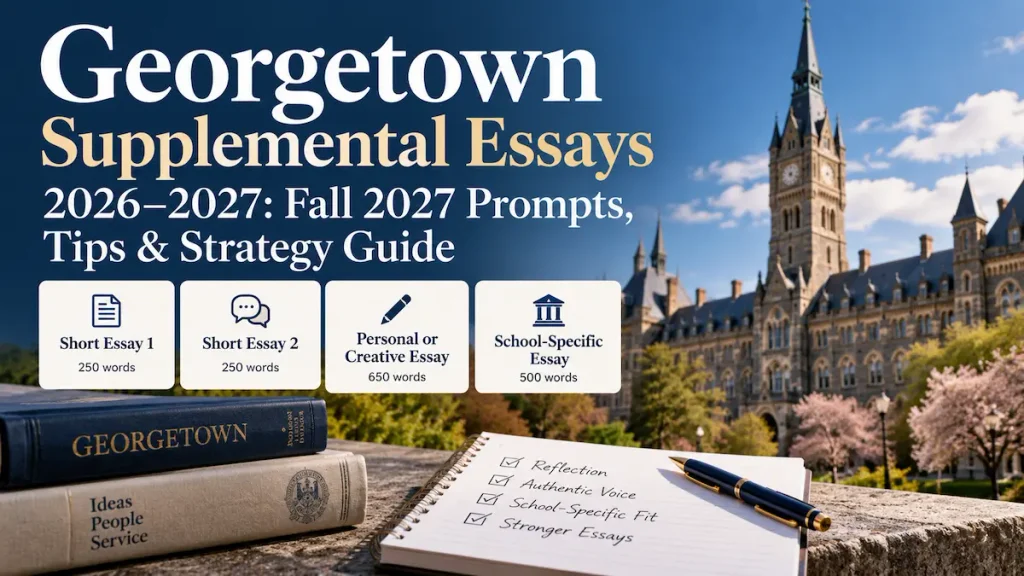
For Fall 2027 applicants, Georgetown requires:
Short Essay 1: 250 words
Short Essay 2: 250 words
Personal or Creative Essay: 650 words
School-Specific Essay: 500 words
Georgetown also introduced a major application change for this cycle: applicants may now apply through either the Georgetown Application or the Common Application. The university says both application methods are intended to remain as similar as possible, including the writing supplement.
That means the essay strategy is the same regardless of which platform you use.
The most important thing to understand is that the Georgetown Writing Supplement is not one generic essay set. Three prompts are common to all applicants, but the fourth depends on the school or program you choose.
Georgetown Supplemental Essays 2026–2027 at a Glance
| Georgetown Essay | Word Limit | Main Job |
|---|---|---|
| Short Essay 1 | 250 words | Meaningful activity |
| Short Essay 2 | 250 words | Engagement across difference |
| Personal or Creative Essay | 650 words | Personal identity and story |
| School-Specific Essay | 500 words | Academic/program fit |
Georgetown officially describes the Writing Supplement as two short essays and two long essays.
There is no fifth Georgetown-specific essay.
And Georgetown makes an important distinction regarding the Common App personal statement: applicants are not required to submit the Common App personal statement as part of Georgetown’s own review, but if your Common App essay fits Georgetown’s 650-word personal/creative prompt, you may reuse it there.
What Changed for Georgetown Applicants in Fall 2027?
The biggest application change is not actually a prompt change.
It is the application platform.
Beginning with students applying for Fall 2027, Georgetown accepts the Common Application in addition to its traditional Georgetown Application. Georgetown says applicants should choose one application method only, and there is no advantage to using one over the other.
The essay requirements remain aligned across both platforms.
For students using the Georgetown Application, all four essays appear in the Georgetown Application Supplement.
For Common App users, all four appear in Georgetown’s Writing Supplement.
That is useful because it means your writing strategy does not need to change based on the application platform.
Georgetown Short Essay 1: School or Summer Activity
Official prompt: Georgetown asks you to briefly discuss the significance of the school or summer activity in which you have been most involved.
Word limit: 250 words.
This is not an invitation to rewrite your activities list.
The key word is:
significance
Georgetown already knows what the activity is.
What the admissions reader needs is:
why it mattered;
what role you actually played;
what changed because of your involvement;
what the activity reveals about you.
How to Write Georgetown Short Essay 1
A useful structure is:
activity → role → meaningful moment → why it matters
Weak:
“Debate club has been very important to me because I learned communication, leadership, and teamwork.”
This is generic.
Stronger:
“During my second year, I realized that the students who spoke least were often the ones who had noticed the argument everyone else missed. I started running pre-round sessions where each teammate had to identify one weakness before anyone proposed a strategy.”
Now the reader sees:
behavior;
responsibility;
observation;
growth.
That is more useful than a résumé summary.
Georgetown Short Essay 2: Someone With a Different Point of View
Georgetown asks applicants to describe an event involving someone with a different viewpoint and explain what they learned from the experience.
Word limit: 250 words.
This prompt is not asking whether you won the disagreement.
It is asking how you behave when someone sees something differently.
A strong response should show:
what the disagreement actually involved;
how you engaged;
what you noticed;
what changed in your understanding.
Avoid the “I Proved I Was Right” Essay
Weak:
“My classmate disagreed with me, but after I explained my reasoning, she eventually understood my point.”
That mainly shows persuasion.
A stronger response might show:
“I initially thought she opposed my proposal because she had misunderstood it. When I asked what worried her, I realized she had identified a consequence I had never considered.”
That reveals:
listening;
humility;
inquiry;
changed understanding.
The essay does not need to end in agreement.
It needs to show meaningful engagement.
Georgetown Essay 1: Personal or Creative Essay
Georgetown’s 650-word personal essay asks you to describe yourself in your own words and reflect on your background, experiences, skills, and talents.
Word limit: 650 words.
This is the most open-ended Georgetown essay.
It can work as:
a personal narrative;
a reflective essay;
a creative structure;
a background story;
an identity essay;
a growth narrative.
Georgetown explicitly says that if your Common App personal statement fits this prompt, you may reuse it here.
Should You Reuse Your Common App Essay?
You can.
But only if it genuinely answers Georgetown’s prompt well.
Do not reuse it simply because it already exists.
Ask:
Does this essay actually show who I am, where I come from, how I think, or what shaped me?
If yes, reuse may make sense.
If the Common App essay is very narrow and leaves Georgetown knowing little about your broader identity, you may benefit from writing something different.
Georgetown School-Specific Essay: Why This School or Program?
The fourth Georgetown essay is school-specific.
Word limit: 500 words.
The current Georgetown application presents different prompts for seven undergraduate schools or programs:
College of Arts & Sciences
McCourt School of Public Policy
Earth Commons Institute
Berkley School of Nursing
School of Health
Walsh School of Foreign Service
McDonough School of Business
These seven routes are also exactly what your grader currently exposes in the selector.
This is not simply a generic “Why Georgetown?” essay.
Each route asks a different version of: Why this academic path at Georgetown?
Georgetown College of Arts & Sciences Essay
Applicants to the College of Arts & Sciences are asked to describe their interest in studying in the College and, for some academic areas such as sciences, mathematics, or languages, are encouraged to make specific reference to their intended major.
A strong response should explain:
what questions interest you;
what you have already explored;
why the College's broad academic environment fits those questions;
how Georgetown's integrated liberal arts model matters to you.
Avoid:
“Georgetown has excellent professors and many majors.”
That is interchangeable.
Stronger:
existing curiosity
→
academic direction
→
Georgetown College connection
McCourt School of Public Policy Essay
McCourt applicants are asked to explain their motivations for studying public policy and dedicating their undergraduate work toward a future connected to public service. Georgetown also highlights the program’s two-campus structure, with time on both the Hilltop and Capitol Campus.
A strong essay should go beyond:
“I want to change public policy.”
Instead, identify:
a policy problem;
why it matters to you;
how you became interested in it;
what skills you want to develop;
why Georgetown's policy environment is useful for that work.
Earth Commons Institute Essay
Applicants to the Environment and Sustainability joint program are asked to explain their motivations for studying environment and sustainability at Georgetown and using that education to create positive change.
The program itself is jointly offered by Georgetown’s College of Arts & Sciences and the Earth Commons Institute. Georgetown describes it as interdisciplinary and hands-on.
Avoid vague language like:
“I care about the planet.”
Instead, identify a concrete environmental question, system, or problem.
Berkley School of Nursing Essay
The Berkley School of Nursing prompt asks applicants to explain the factors that influenced their interest in studying nursing at Georgetown.
This essay should explain nursing specifically.
Do not write a generic healthcare essay.
Useful directions include:
patient interaction;
care coordination;
communication;
advocacy;
clinical reasoning;
long-term relationships;
public health context.
Georgetown officially describes its Nursing program as integrating clinical skills with biological, physical, and social sciences.
Georgetown School of Health Essay
School of Health applicants are asked to explain what influenced their interest in health care and specifically address one intended major:
Global Health
Health Care Management & Policy
Human Science
This means the essay has two jobs:
why health + why this academic route
Avoid:
“I want to help people through healthcare.”
That is too broad.
A stronger response identifies the actual problem or question that attracts you.
Walsh School of Foreign Service Essay
SFS applicants are asked to explain their motivations for studying international affairs at Georgetown and pursuing a future connected to global service.
A strong SFS essay should show:
a real global issue or question;
how your interest developed;
how you think about complexity;
why interdisciplinary international study matters.
Avoid vague language such as:
“I want to solve global problems.”
• What problem?
• What part of it interests you?
• What do you want to understand?
McDonough School of Business Essay
McDonough applicants are asked to explain their primary motivations for studying business at Georgetown. The official prompt emphasizes global, ethical, analytical, financial, and diverse perspectives.
A weak essay focuses on:
money;
prestige;
networking;
entrepreneurship as a buzzword.
A stronger essay starts with a real business question:
incentives;
organizational behavior;
markets;
consumer behavior;
finance;
strategy;
ethical decision-making;
global systems.
Then connect that interest to Georgetown.
Georgetown Writing Supplement Grader
Review your four Georgetown Writing Supplement responses — two short essays, your personal or creative essay, and the school-specific essay for the one school or program you choose — against the official prompts, with criterion-level scores, verified evidence and revision feedback.
Official Georgetown Writing Supplement: four required responses, each graded against its own official prompt and word limit — Short Essay 1 (250 words), Short Essay 2 (250 words), the personal or creative essay (650 words) and the school-specific essay (500 words) for one of the seven official schools or programs. There is no fifth essay and no Common App slot of its own.
What You’ll Get From Your Georgetown Review
Each response is evaluated against its own current prompt, criteria and maximum points — feedback first, score second — and the report also reads your four responses as one submission.
Prompt-by-Prompt Scores
Verified Literal Evidence
Cross-Response Strengths
Independent Second Opinion
Paste your four responses below to receive cross-response strengths, revision priorities and a saved review.
Your account includes 1 free essay review for life, shared across every grader. Paid Universal Credits are always used first. Elite Second Opinion always costs 3 paid Universal Credits — free reviews are never accepted for it.
That field is optional application-selection context: it is never scored and never counted as evidence. Your school or program is not typed there — you choose it from the official list below, and that choice is what loads the school-specific prompt.
Words: 0 / 250
Words: 0 / 250
Words: 0 / 650
School-specific essay: choose the one school or program you are applying to. Georgetown publishes a different question for each of the seven routes, and your essay is graded against the one you select — its official prefix and question appear under the selector, so you can check them (and switch routes) before submitting.
Words: 0 / 500
Elite Second Opinion
Get an independent second review of the exact same responses by a different provider, then compare where both evaluations agree or differ.
Complete and save a Georgetown review to unlock this option.
Buy More CreditsNeed more reviews now?
Need more credits?
View all pricing plans →
Instant activation after payment. 1 Universal Credit = 1 comprehensive Georgetown Writing Supplement review of all four responses. Elite Second Opinion = 3 Universal Credits.
How Do You Write a Strong Georgetown School-Specific Essay?
Regardless of school, a useful structure is:
past experience or question → academic direction → Georgetown-specific opportunity → why the connection matters
The center of gravity should remain your intellectual or professional trajectory.
Do not spend 500 words cataloging programs.
One or two well-chosen Georgetown-specific details are more effective than ten names with no reasoning.
Georgetown Essays: Common Mistakes
1. Treating the Activity Essay Like a Résumé
Georgetown already has your activities information.
Explain significance, not just participation.
2. Winning the Disagreement Essay
The point is learning, not victory.
3. Writing a Generic Personal Essay
Your 650-word essay should reveal something substantial about you.
4. Writing a Generic "Why Georgetown" Essay
The school-specific essay is not generic. It should respond to the actual route you selected.
5. Name-Dropping Without Explanation
A center, professor, course, or program only matters if you explain why it connects to your existing interests.
6. Repeating the Same Story Four Times
Each response should add information.
7. Ignoring the School-Specific Prompt
The seven routes are different.
Do not use a McDonough essay for SFS or a School of Health argument for Nursing.
How Should All Four Georgetown Essays Work Together?
Think of the four essays as a portfolio.
| Essay | What it can reveal |
|---|---|
| Short Essay 1 | Meaningful involvement |
| Short Essay 2 | Engagement across difference |
| Personal/Creative Essay | Identity and personal context |
| School-Specific Essay | Academic/professional direction |
A strong set gives Georgetown multiple views of the same applicant without repeating the same story.
Ask:
If I removed this essay, what would Georgetown no longer know about me?
If two essays produce the same answer, revise one.
How the Georgetown Writing Supplement Grader Reviews Your Essays
The Georgetown Writing Supplement Grader follows the current four-response structure:
Short Essay 1
Short Essay 2
Personal or Creative Essay
School-Specific Essay
Each response is evaluated against its own current prompt and criteria.
The grader also reads the four essays together as one submission so it can identify:
prompt-by-prompt performance;
verified evidence;
cross-response strengths;
repeated weaknesses;
portfolio-level revision priorities.
That matches the current grader structure you showed.
Georgetown Supplemental Essays FAQ
How many Georgetown supplemental essays are required for 2026–2027?
Georgetown requires four responses: two short essays and two long essays.
What are the Georgetown supplemental essay word limits?
The current limits are:
-Short Essay 1: 250 words
-Short Essay 2: 250 words
-Personal/Creative Essay: 650 words
-School-Specific Essay: 500 words.
Can I use the Common App personal statement for Georgetown?
Yes, if it fits Georgetown’s personal/creative essay prompt. Georgetown explicitly says applicants may reuse it in that case.
Does Georgetown use the Common App now?
Yes. Georgetown began accepting the Common Application for applicants entering in Fall 2027 while continuing to offer its own Georgetown Application.
Is there an advantage to using the Georgetown Application instead of Common App?
Georgetown says there is no advantage to either application method. Applicants should use one application only.
Is the school-specific essay the same for everyone?
Is the school-specific essay the same for everyone?
How many Georgetown school-specific essay options are there?
There are currently seven undergraduate school/program routes in the first-year Writing Supplement:
College of Arts & Sciences, McCourt, Earth Commons, Nursing, School of Health, SFS, and McDonough.
Does Georgetown require standardized testing?
Yes. Georgetown currently requires SAT or ACT scores for first-year applicants.
Final Georgetown Supplemental Essays Checklist
Before submitting:
I completed all four required Georgetown essays.
Short Essay 1 is 250 words or fewer.
Short Essay 2 is 250 words or fewer.
My personal/creative essay is 650 words or fewer.
My school-specific essay is 500 words or fewer.
My activity essay explains significance, not just participation.
My disagreement essay shows learning rather than victory.
My personal essay reveals something substantial about me.
My school-specific essay matches the correct school or program.
I verified any Georgetown-specific resource I mention.
I avoided generic prestige language.
Each essay contributes new information.
The writing remains accurate and authentically mine.
Use the Georgetown Writing Supplement Grader Before You Submit
The Georgetown Supplemental Essays 2026–2027 require more than one type of writing.
The current structure is:
250-word activity essay → 250-word disagreement essay → 650-word personal essay → 500-word school-specific essay
That means the strongest application does not repeat one polished admissions persona four times.
Instead, it shows:
what you do → how you engage → who you are → where you are going
Before submitting, use the Georgetown Writing Supplement Grader to review whether your four responses are direct, specific, non-repetitive, and aligned with the current school-specific prompt.
Explore More University Essay Graders
Compare your Georgetown supplements with other university-specific essay graders built around each school’s current prompts, word limits, and evaluation context. These tools review prompt fulfillment, school-specific reasoning, personal context, specificity, reflection, and overall supplement strategy—not just grammar or writing style.
Browse more graders for selective universities to see how your essays perform across different supplemental structures, prompt types, and application contexts.