Notre Dame Supplemental Essays 2026–2027: Fall 2027 Prompts, Tips & Writing Guide
Table
- Notre Dame Supplemental Essays 2026–2027 at a Glance
- What Changed in the Notre Dame Supplemental Essays for Fall 2027?
- What Does Notre Dame Want From the Writing Supplement?
- Notre Dame Required Essay: Your “Non-Negotiables”
- Should the Non-Negotiable Essay Be a “Why Notre Dame?” Essay?
- How Many Notre Dame Short Answers Do You Choose?
- How Should You Choose Your Two Notre Dame Short Answers?
- Notre Dame Short Answer 1: Faith and Decisions
- Notre Dame Short Answer 2: Distinctive Experiences
- Notre Dame Short Answer 3: Service to Others
- Notre Dame Short Answer 4: What Would You Fight For?
- Notre Dame Writing Supplement Grader
- My Notre Dame Reviews
- Is One Notre Dame Short-Answer Combination Better Than Another?
- Why Applicant-Owned Reasoning Matters
- What Notre Dame Says About Authentic Voice
- Do Not Waste Notre Dame's Short Word Limits on Background
- Common Notre Dame Supplemental Essay Mistakes
- How the Notre Dame Writing Supplement Grader Reviews Your Responses
- Feedback First, Score Second
- Elite Second Opinion
- Notre Dame Supplemental Essays FAQ
- Final Notre Dame Supplemental Essays 2026–2027 Checklist
- Use the Notre Dame Writing Supplement Grader Before You Submit
- Explore More University Essay Graders
Updated September 2026 · Verified against the current University of Notre Dame Undergraduate Admissions Application Overview.
The Notre Dame Supplemental Essays for the 2026–2027 application cycle include one required short essay of up to 150 words and two short-answer responses of 50–100 words each, chosen from four current options.
Notre Dame confirms that the current Writing Supplement includes one required short essay and two short-answer responses selected from the available options. You can verify the current requirements on the official Notre Dame Undergraduate Admissions Application Overview
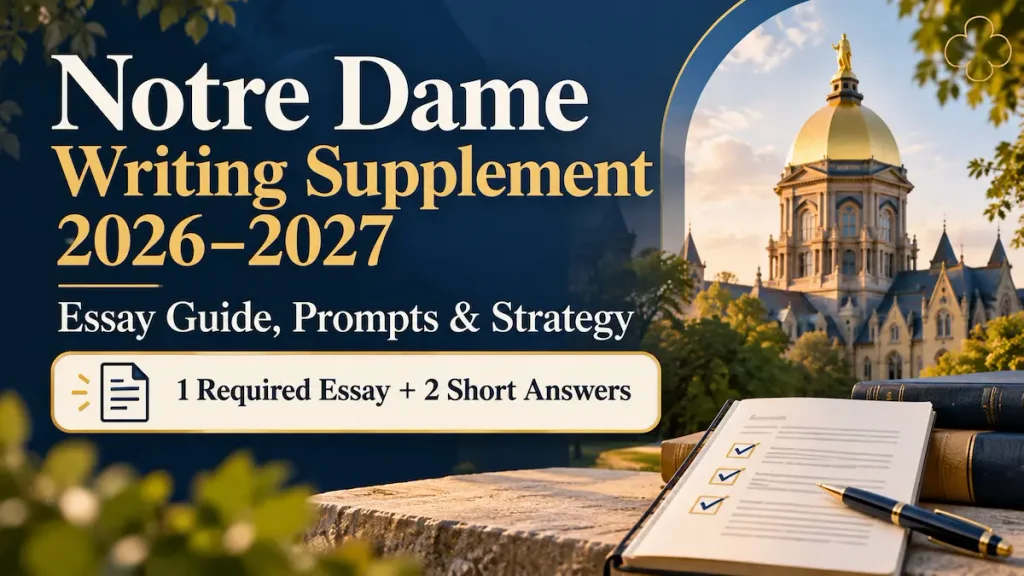
For students applying for Fall 2027 admission, the required essay focuses on your “non-negotiable” factor or factors when choosing a future college, while the optional short-answer choices explore faith, personal experience, service to others, and what you would fight for.
This structure is important because older Notre Dame essay guides can now be misleading. Previous admissions cycles used different combinations of required essays and short-answer questions, but the current official Notre Dame Application Overview lists one required essay plus exactly two short answers from four options.
If you are working on your Notre Dame Supplemental Essays 2026–2027, start with the current structure, understand what each prompt is actually trying to reveal, and choose the two short-answer questions that let Notre Dame learn something genuinely different about you.
Notre Dame Supplemental Essays 2026–2027 at a Glance
| Notre Dame Writing Section | Fall 2027 Requirement |
|---|---|
| Required Short Essay | 1 response |
| Required Essay Limit | 150 words maximum |
| Short Answers | Choose exactly 2 of 4 |
| Short Answer Length | 50–100 words each |
| Common App Personal Essay | Not graded as part of this supplement |
Notre Dame says the Writing Supplement is designed to help admissions officers get to know applicants outside of their academic profile and explicitly encourages students to let their personality show, take risks, and remember that there is no single correct answer.
That should guide the entire strategy.
The goal is not to sound like an imaginary “Notre Dame applicant.”
The goal is to give Notre Dame useful evidence about:
what you value;
how you make decisions;
how you relate to other people;
what has shaped you;
what you contribute;
what matters enough to act on.
What Changed in the Notre Dame Supplemental Essays for Fall 2027?
The biggest practical change is the current response count.
Older official Notre Dame materials describe previous structures such as:
one required essay plus three short answers from five choices;
or two brief essays plus three short-answer responses.
For the current application, Notre Dame’s Application Overview now specifies:
one required short essay + two short answers selected from four choices.
That means applicants should not rely on older Notre Dame essay guides without checking the current official application page.
For Fall 2027, you do not need to answer all four short-answer prompts.
You answer two.
That changes the strategy substantially because prompt selection becomes part of the application.
What Does Notre Dame Want From the Writing Supplement?
Notre Dame says the Writing Supplement gives the Admissions Committee a chance to know applicants in a more personal way beyond grades and other academic information.
Its current evaluation guidance also says essays can reveal:
the values that guide your life;
how you have affected communities you belong to;
what you care about;
family traditions;
challenges you have faced;
how you might engage with Notre Dame’s mission and community.
That gives us a much stronger strategy than trying to guess which answer sounds most prestigious.
A strong set of Notre Dame supplemental essays should make the admissions reader understand something about:
your priorities
→
your behavior
→
your values
→
your contribution
Notre Dame Required Essay: Your “Non-Negotiables”
The current required Notre Dame short essay asks applicants to explain the “non-negotiable” factor or factors they consider when searching for their future college home.
Maximum: 150 words.
This is not simply a traditional “Why Notre Dame?” essay.
It is closer to:
What do you need from a college environment, and why does that matter to you?
That distinction matters.
What Is a Good “Non-Negotiable” for Notre Dame?
Possible directions include:
academic culture;
collaborative learning;
undergraduate research;
faith or spirituality;
service;
residential community;
intellectual freedom;
campus traditions;
affordability or financial support;
experiential learning;
access to a particular kind of program;
community values.
Notre Dame’s own admissions guidance has previously suggested thinking about factors such as campus culture, academics, experiential learning, institutional values, cost, financial aid, residential life, research, and community.
The important word is not what.
It is why.
It is why.
Weak Non-Negotiable Essay
“My non-negotiables are strong academics, a supportive community, great professors, research opportunities, and school spirit.”
Nothing here is wrong.
But nearly every selective college applicant could say it.
There is no applicant-owned reasoning.
Stronger Non-Negotiable Essay
A stronger approach might look like:
“I need a college where disagreement does not end collaboration. In my robotics team, the best designs appeared when someone challenged an assumption without turning the disagreement personal. I want the same kind of intellectual environment in college.”
Now we have:
a specific non-negotiable;
evidence;
reasoning;
personal ownership.
That is much stronger than a checklist.
Should the Non-Negotiable Essay Be a “Why Notre Dame?” Essay?
Not exactly.
The prompt asks about your college-search priorities, not for a conventional list of Notre Dame resources.
Notre Dame-specific details can be useful if they demonstrate why the institution satisfies something that genuinely matters to you.
But do not turn the essay into:
“Notre Dame has X, Y, Z, and therefore it is perfect for me.”
A better structure is:
what matters to me
→
why it matters
→
how I know
Then, if appropriate:
why Notre Dame is compatible with that priority
The center of gravity should remain the applicant.
How Many Notre Dame Short Answers Do You Choose?
For Fall 2027, applicants select exactly two of four short-answer prompts.
Each answer must be 50–100 words.
The four current themes are:
1. Faith and decisions
2. Distinctive personal experiences
3. Service to others
4. What you would fight for
There is no reason to answer a third question.
The current application only asks for two.
How Should You Choose Your Two Notre Dame Short Answers?
Choose the pair that adds the most new information.
Do not choose based on which prompt sounds most impressive.
A useful test is:
Which two prompts allow Notre Dame to learn something it cannot already see in my Common App personal statement, activities list, recommendations, and required non-negotiable essay?
For example, if your Common App personal statement is already about your religious upbringing, you may decide another short-answer question gives the application more range.
If your application is already dominated by service work, the service prompt might still be useful—but only if you can reveal something beyond the activity description itself.
The goal is not to avoid overlap at all costs.
The goal is to avoid redundancy without added insight.
Notre Dame’s own essay guidance emphasizes using essays to help readers understand who you are rather than merely repeating information they already possess.
Notre Dame Short Answer 1: Faith and Decisions
The first current option asks how faith influences the decisions you make.
This question does not require you to write a theology essay.
Notre Dame is a Catholic university, but its admissions guidance has made clear that students come from varied religious and spiritual backgrounds. Previous official guidance on this prompt invited students from multiple faith traditions—and students whose relationship with faith has evolved—to describe how faith or spirituality shapes them.
The operative word is:
decisions
Do not merely explain what you believe.
Show what the belief does.
Weak Faith Answer
“My faith teaches me to be compassionate, kind, and respectful toward others.”
This is positive but abstract.
Stronger Direction
Think:
belief
→
tension or choice
→
behavior
For example:
a value that changed how you handled conflict;
a faith practice that shapes priorities;
a belief that caused you to reconsider an assumption;
a spiritual tradition that guides how you treat responsibility;
uncertainty or questioning that changed your decision-making.
Faith does not have to mean certainty.
Reflection can be stronger than proclamation.
Notre Dame Short Answer 2: Distinctive Experiences
The second option asks applicants to reflect on what is distinctive about their personal experiences and development, why those experiences matter, and how they would enrich the Notre Dame community.
This is the broadest of the four prompts.
Possible material might include:
family;
culture;
disability;
language;
community;
migration;
upbringing;
caregiving;
work;
financial circumstances;
school environment;
an unusual responsibility;
another formative experience.
The important strategic point is that the essay has two jobs:
1. explain what shaped you;
2. show how that experience affects what you bring to others.
Avoid the Generic Identity Conclusion
Weak:
“My experiences have taught me to value diversity, and I hope to bring my unique perspective to Notre Dame.”
The problem is not the value.
The problem is that “unique perspective” remains undefined.
Show the behavior.
For example:
what you notice;
what you ask;
how you communicate;
how you solve problems;
what responsibilities you tend to assume;
what perspective you bring into group decisions.
Notre Dame Short Answer 3: Service to Others
The third option asks how you foster service to others in your community.
Notre Dame describes service and care for others as part of its undergraduate ethos. Its current evaluation guidance also highlights how applicants have impacted their communities and how they may engage with Notre Dame’s mission.
Do not assume this requires formal volunteering.
Service can happen through:
family responsibilities;
tutoring;
advocacy;
peer support;
neighborhood work;
religious communities;
school organizations;
caregiving;
helping a team function;
another consistent form of contribution.
The key is foster.
That suggests behavior.
Weak Service Essay
“Service has always been important to me. I enjoy helping others and giving back to my community.”
That tells us your position.
It does not show your behavior.
Stronger Service Essay
Describe:
who needed something
→
what you noticed
→
what you did
→
why you continue
With only 50–100 words, one concrete episode or recurring behavior is often enough.
Notre Dame Short Answer 4: What Would You Fight For?
The fourth current option asks:
What would you fight for?
Notre Dame has used this theme for years in connection with its “What Would You Fight For?” identity and public storytelling. Official admissions materials describe it broadly: the subject can be academic, social, personal, local, or even unexpectedly small, provided it reveals something meaningful about the applicant.
Do not assume you need a global cause.
You might fight for:
access;
a person;
a local issue;
a tradition;
an intellectual principle;
environmental protection;
fair treatment;
an overlooked community;
better information;
another concern you genuinely act on.
Avoid the Hero Speech
Weak:
“I would fight for equality because everyone deserves an equal opportunity to succeed.”
Again, the value is admirable.
But it could belong to thousands of applicants.
A stronger answer narrows the concern.
Ask:
What exactly would I change, protect, defend, preserve, or challenge?
Specificity makes conviction believable.
Notre Dame Writing Supplement Grader
Review your Notre Dame 2026–2027 Writing Section responses against the official prompts, with criterion-level scores, verified evidence and revision feedback.
Official Notre Dame Writing Section: one (1) required short essay on your “non-negotiable” factor(s) when searching for your future college home — a maximum of 150 words — plus exactly two (2) short-answer questions you choose from the four options below, 50–100 words each. The Common App personal essay is never graded here.
What You’ll Get From Your Notre Dame Review
Each response you submit is evaluated against its own current prompt, criteria and maximum points — feedback first, score second.
Prompt-by-Prompt Scores
Verified Literal Evidence
Applicant-Owned Reasoning
Independent Second Opinion
Paste your essay and your two short answers below to receive cross-response strengths, revision priorities and a saved review.
Your account includes 1 free essay review for life, shared across every grader. Paid Universal Credits are always used first. Elite Second Opinion always costs 3 paid Universal Credits — free reviews are never accepted for it.
Both fields are optional application-selection context. They are never scored, never counted as evidence, and are never required.
Required Short Essay — Non-NegotiablesEveryone has different priorities when considering their higher education options and building their college or university list. Tell us about your “non-negotiable” factor(s) when searching for your future college home. 150 words or fewer.
Words: 0 / 150
Short answers: choose exactly two of the four questions below and answer each in 50–100 words. Notre Dame asks for two, not four — answering a third gains nothing, and one pair is never weighted differently from another.
Words: 0 / 100
Words: 0 / 100
Elite Second Opinion
Get an independent second review of the exact same responses by a different provider, then compare where both evaluations agree or differ.
Complete and save a Notre Dame review to unlock this option.
Buy More CreditsNeed more reviews now?
Need more credits?
View all pricing plans →
Instant activation after payment. 1 Universal Credit = 1 comprehensive Notre Dame Writing Section review. Elite Second Opinion = 3 Universal Credits.
Is One Notre Dame Short-Answer Combination Better Than Another?
Notre Dame’s current application does not identify a preferred pair of prompts.
The best choice therefore depends on which two answers allow you to reveal the strongest additional evidence about yourself.
Do not choose Faith merely because Notre Dame is Catholic.
Do not choose Service merely because Notre Dame talks about service.
Do not choose “What Would You Fight For?” because it sounds dramatic.
Choose the questions you can answer with the greatest combination of:
specificity;
authenticity;
reflection;
new information.
Why Applicant-Owned Reasoning Matters
Your current grader correctly emphasizes Applicant-Owned Reasoning.
That is especially important for the Notre Dame supplemental essays because the word counts are so short.
A response should not simply say:
“Community is important.”
why community matters to you
“Faith guides me.”
how faith changes a decision
“Service is important.”
what serving actually looks like in your life
“I would fight for justice.”
which issue you would act on and why
The more the reasoning could be copied into another applicant’s essay without changing anything, the weaker it probably is.
What Notre Dame Says About Authentic Voice
Notre Dame repeatedly emphasizes personal voice in its admissions guidance.
Its current Application Overview says the Writing Supplement exists to get to know applicants more personally and encourages applicants to let their personality show.
Notre Dame counselors also advise applicants to make essays personal and to ask whether someone who knows them well would recognize the voice as theirs.
This matters because students often over-edit supplemental responses until they sound polished but anonymous.
A 70-word answer does not need to sound like an academic journal.
It needs to sound deliberate and genuine.
Do Not Waste Notre Dame's Short Word Limits on Background
Notre Dame's admissions counselors have specifically warned that too much setup can consume valuable space while revealing little about the applicant.
That is especially important here:
required essay: 150 words;
short answers: 50–100 words.
You do not have room for:
three sentences of context
→
one sentence about yourself
Reverse that ratio.
Use only enough context to make your own reasoning understandable.
Common Notre Dame Supplemental Essay Mistakes
1. Using an Outdated Prompt Structure
Older Notre Dame guides may tell you to answer three or more short-answer questions.
For the current Fall 2027 application, Notre Dame requires one short essay and exactly two short answers from four options.
2. Treating the Non-Negotiable Essay as a Brochure
Do not spend 150 words naming Notre Dame programs.
Explain your actual decision criteria.
3. Choosing Short Answers for Prestige
There is no evidence that Faith, Service, or another option is automatically favored.
Choose based on what you can reveal.
4. Repeating the Common App Personal Statement
Your supplemental space is limited.
Use it to add information.
5. Abstract Values Without Evidence
Words like:
community;
service;
faith;
justice;
leadership;
compassion
need behaviors or observations behind them.
6. Spending Too Much Time Explaining the Topic
The admissions reader needs to learn about you, not just the cause, person, activity, or tradition you describe. Notre Dame counselors have explicitly warned about essays that end up revealing more about the subject than about the applicant.
7. Trying to Sound Like “Notre Dame”
Do not manufacture Catholic language, service language, or mission language simply because you think admissions wants to hear it.
Your own reasoning is stronger.
How the Notre Dame Writing Supplement Grader Reviews Your Responses
The Notre Dame Writing Supplement Grader follows the current Fall 2027 structure:
one required Non-Negotiables essay;
two selected short-answer prompts;
prompt-specific scoring;
verified evidence;
revision feedback;
saved review;
optional Independent Second Opinion.
The Common App personal statement is not evaluated as part of this grader.
Each response is reviewed against its own prompt and criteria, rather than applying one generic essay rubric to all three.
That distinction matters because the tasks are different.
The Non-Negotiable essay evaluates whether you identify and reason through a meaningful college-selection priority.
The short answers then evaluate the job of the specific prompt you selected.
Feedback First, Score Second
The numerical score is not an admissions probability.
It does not estimate whether Notre Dame will admit you.
The useful part is the reasoning behind it.
A strong grader should help identify:
which parts of the prompt you actually answered;
what literal evidence supports the evaluation;
where reasoning is vague;
where the response is generic;
where a revision would make the answer more specific;
which response-level problems repeat across the set.
The score summarizes the evaluation.
The feedback should drive the revision.
Elite Second Opinion
After a Primary Evaluation, the Notre Dame grader can provide an Independent Second Opinion using the same submitted responses and the same prompt-specific criteria.
The purpose is not to force two evaluations to agree.
It is to identify:
strengths both reviews see;
weaknesses both reviews see;
disagreements;
revision priorities that survive independent evaluation.
That can be particularly useful with very short responses, where a small wording choice may significantly affect how much evidence is visible.
How to Improve Your Notre Dame Essays Before Submitting
For the Non-Negotiable essay, ask:
Did I explain why this priority matters to me, or did I merely name it?
For Faith and Decisions:
Did I show a decision affected by faith, belief, or spiritual reflection?
For Distinctive Experiences:
Did I connect the experience to who I am and what I contribute?
For Service to Others:
Can the reader see what I actually do?
For What Would You Fight For?:
Is my cause specific enough that it feels personally owned?
For the set as a whole:
Does each answer teach Notre Dame something different?
Notre Dame Supplemental Essays FAQ
How many Notre Dame supplemental essays are required for 2026–2027?
Notre Dame currently requires one short essay plus two short-answer responses selected from four options.
How long is the required Notre Dame essay?
The required Non-Negotiables response has a 150-word maximum.
How long are the Notre Dame short answers?
Each selected short answer must be between 50 and 100 words.
How many short-answer prompts do you choose?
You choose exactly two of four.
What are the four Notre Dame short-answer topics?
The current options cover:
- faith and decisions;
- distinctive personal experiences;
- service to others;
- what you would fight for.
Is there still a Why Notre Dame essay?
There is no separate prompt titled “Why Notre Dame?” in the current Writing Supplement. The required Non-Negotiable essay asks what factors matter when selecting your future college home.
Should I mention Notre Dame in the Non-Negotiable essay?
You may, when a Notre Dame-specific detail genuinely demonstrates how the university aligns with a priority you have explained. But the prompt is fundamentally about your college-selection priorities.
Does Notre Dame prefer the faith prompt?
Notre Dame’s current admissions page does not identify a preferred short-answer option. The strongest choice is the prompt you can answer most specifically and authentically.
Do I need to be Catholic to answer the faith question?
No. Notre Dame’s own admissions guidance has discussed faith broadly and has welcomed applicants from different religious and spiritual backgrounds.
Can service mean helping family?
Yes. Notre Dame’s prior official guidance on the service prompt described community broadly, including family, neighborhood, school, religious groups, and other communities.
Are older Notre Dame essay guides reliable?
Only if they match the current Application Overview. Notre Dame has used different supplement structures in previous cycles, so applicants should verify the current official prompts before writing.
What are the Fall 2027 Notre Dame application deadlines?
Notre Dame currently lists November 1 for Restrictive Early Action and January 4 for Regular Decision.
Final Notre Dame Supplemental Essays 2026–2027 Checklist
Before submitting:
I used the current Fall 2027 prompt structure.
I wrote one required Non-Negotiable essay.
My required essay is 150 words or fewer.
I selected exactly two short-answer questions.
Both selected short answers are between 50 and 100 words.
My answers provide new information instead of repeating my Common App essay.
My Non-Negotiable essay explains why the factor matters.
My short answers show behavior, evidence, or reasoning rather than labels.
I avoided generic Notre Dame mission language that does not sound like me.
I preserved my own voice.
Each of the three responses contributes something different.
I reviewed the set together rather than treating each answer in isolation.
Use the Notre Dame Writing Supplement Grader Before You Submit
The Notre Dame Supplemental Essays 2026–2027 are short, but that makes precision more important, not less.
The current Fall 2027 Writing Supplement asks for:
one required 150-word Non-Negotiables essay
→
exactly two 50–100 word short answers from four options.
That gives you only a small amount of space to communicate:
what matters to you;
what shaped you;
how you act on your values;
what you contribute;
what you care enough to defend.
Do not waste that space trying to sound like an admissions brochure.
Use specific evidence.
Show applicant-owned reasoning.
Choose the two prompts that reveal something useful and new.
And before you submit, use the Notre Dame Writing Supplement Grader to identify where your responses are specific, where they remain generic, and which revisions will improve the evidence without replacing your own voice.
Explore More University Essay Graders
Compare your Notre Dame supplements with other university-specific essay graders built around each school’s current prompts, word limits, and evaluation context. These tools review prompt fulfillment, applicant-owned reasoning, school-specific fit, personal context, specificity, reflection, and overall supplement strategy—not just grammar or writing style.
Browse more graders for selective universities to see how your essays perform across different supplemental structures, prompt types, and application contexts.