Yale Supplemental Essay Grader: New Fall 2027 Prompts, Short Takes & Essay Changes
Table
- Yale Supplemental Essay Grader
- My Essay Reviews
- Yale Supplemental Essays 2026–2027: What Changed for Fall 2027?
- Yale Essays 2026–2027: Current Fall 2027 Requirements
- What Does Yale Look for in Supplemental Essays?
- Yale Academic Areas: How to Choose Up to Three
- Yale Academic Interest Essay: The New 200-Word Strategy
- Your Yale Academic Interest Essay Does Not Need to Sound Academic
- What a Strong Yale Academic Interest Essay Usually Includes
- Yale Short Takes 2026–2027: 200 Characters, Not 200 Words
- The Yale 400-Word Essay for Fall 2027
- Do You Still Need to Explain “Why Yale?” Anywhere?
- How the Yale Supplemental Essay Grader Reviews Your Fall 2027 Essays
- Why Specificity Matters Even More for Fall 2027
- Elite Second Opinion for Yale Essays
- Common Yale Supplemental Essay Mistakes for 2026–2027
- What Strong Yale Supplemental Essays Have in Common
- How to Improve Your Yale Essays Before Submitting
- Yale Supplemental Essays FAQ
- Use the Yale Supplemental Essay Grader Before You Submit
Last updated: September 2026 for the 2026–2027 admissions cycle and Fall 2027 entry. Verified against Yale Undergraduate Admissions and the September 2026 “What Yale Looks For” admissions guidance.
The Yale Supplemental Essay Grader has been updated for the 2026–2027 admissions cycle and Fall 2027 entry, following one of Yale’s most significant recent changes to its first-year writing supplement.
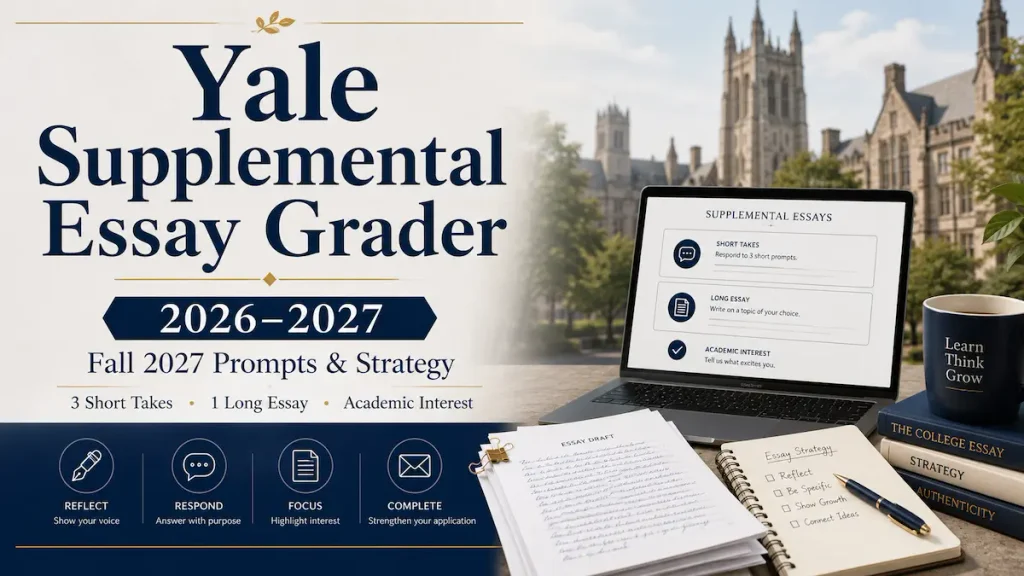
For Fall 2027 applicants, the old required “Why Yale?” essay is gone, four Short Takes have become three new 200-character responses, and Yale continues to require a 200-word Academic Interest response plus, for Common Application and Coalition Application applicants, one 400-word essay chosen from three prompts. QuestBridge applicants follow a different Yale-specific writing path.
Yale has also published new admissions guidance explaining how these essays should work. Admissions officers emphasize that the essays are supposed to be personal and reflective, not miniature academic papers. Even when you discuss an intellectual interest, Yale wants to understand how your mind works and why the subject genuinely excites you.
The newest advice is especially important for the Academic Interest response: Yale admissions officers say they like seeing applicants pose real questions because questions can demonstrate curiosity, intellectual openness, and a willingness to explore something that is not already settled in your mind.
Before using the Yale Supplemental Essay Grader, understand the current Fall 2027 structure, what Yale changed, and what each response is actually supposed to reveal.
Review Your Yale Essays Before Submitting
Yale Supplemental Essay Grader
Review your Yale first-year short answers and essays for genuine intellectual direction, precise Short Takes, and an authentic voice across the responses you choose to submit.
Yale 2026–2027 first-year writing focus: every applicant answers the academic-interest short answer (200 words or fewer) and names up to three academic areas. Common Application and Coalition applicants also answer exactly three Short Takes (200 characters each) and one of the three 400-word essays. QuestBridge applicants are not asked for the Short Takes or the 400-word essay, and Yale does not ask a “Why Yale” essay.
What You’ll Get From Your Yale Review
See whether your short answers show real intellectual direction, precise Short Takes, and an authentic voice — feedback first, score second.
Academic Direction
Intellectual Vitality
Short Take Precision
Independent Second Opinion
Paste your Yale responses below to get criterion-level feedback, revision priorities, and a saved review.
Your account includes 1 free essay review for life. Paid Universal Credits are always used first.
Yale asks different questions for Common Application / Coalition and QuestBridge applicants.
Areas: up to 3
Students at Yale have time to explore their academic interests before committing to one or more major fields of study. Many students either modify their original academic direction or change their minds entirely. As of this moment, what academic areas seem to fit your interests or goals most comfortably? Please indicate up to three from the list provided.
Academic Interest short answer — 200 words
Tell us about a topic or idea that excites you and is related to one or more academic areas you selected above. Why are you drawn to it?
Words: 0 / 200
Short Take 1 — 200 characters
Short Take 2 — 200 characters
Short Take 3 — 200 characters
The 400-word Yale essay
If you could teach any college course, write a book, or create an original piece of art of any kind, what would it be?
Characters: 0 / 200
What is one aspect of yourself that you hope to grow or develop during college?
Characters: 0 / 200
What is something about you that is not included anywhere else in your application?
Characters: 0 / 200
Words: 0 / 400
Elite Second Opinion
Get an independent second review of the same Yale responses and compare where both evaluations agree or differ.
Complete and save a Yale review to unlock this option.
Buy More CreditsNeed more reviews now?
Need more credits?
View all pricing plans →
Instant activation after payment. 1 Universal Credit = 1 comprehensive Yale supplement review.
Yale Supplemental Essays 2026–2027: What Changed for Fall 2027?
Applicants working from older Yale essay guides can easily prepare the wrong material.
For the 2026–2027 Yale supplemental essays, three changes matter most.
1. Yale Removed the Required “Why Yale?” Essay
The traditional Yale-specific fit response no longer appears in the current application.
That was a deliberate decision.
In Yale’s August 2026 application update, admissions officers explained that they still care about whether an applicant fits Yale’s learning environment, but they believe they can determine that from the rest of the application.
They explicitly told applicants not to squeeze a Why Yale response into another essay simply because the old prompt disappeared.
That means a closing paragraph such as:
“These experiences are why Yale is the perfect place for me.”
is usually wasting valuable space unless the actual prompt requires that connection.
For the current cycle, Yale wants you to spend that space telling them more about your thinking, experiences, interests, development, and perspective.
2. Four Yale Short Takes Became Three
Yale previously required four Short Takes.
For Fall 2027, Common Application and Coalition Application applicants answer three, each limited to 200 characters — approximately 35 words.
The new Short Takes focus on:
- something you would teach, write, or create;
- an aspect of yourself you hope to develop in college;
- something about you that is missing from the rest of your application.
These are not miniature essays.
At 200 characters, every word has to earn its place.
3. Yale Published New Guidance About What Strong Essays Reveal
The newest September 2026 admissions guidance adds an important distinction.
Yale says essays are not primarily evidence of polished writing ability. Instead, admissions officers use them to understand how you:
analyze;
investigate;
break something down;
communicate an idea;
engage with the world around you.
Yale also stresses that the essays themselves should remain personal and reflective.
That is an important Fall 2027 strategy change.
You do not need to turn every Yale essay into an academic demonstration.
You need to make your thinking visible.
Yale Essays 2026–2027: Current Fall 2027 Requirements
For Common Application and Coalition Application applicants, the current writing structure is:
| Yale writing section | Fall 2027 requirement |
|---|---|
| Academic Areas | Select up to 3 |
| Academic Interest | 200 words or fewer |
| Short Take 1 | 200 characters |
| Short Take 2 | 200 characters |
| Short Take 3 | 200 characters |
| Yale Essay | Choose 1 of 3 prompts, 400 words or fewer |
Yale confirms that all first-year applicants answer the Academic Areas and Academic Interest questions. The three Short Takes and the 400-word essay apply to Common Application and Coalition Application applicants. QuestBridge applicants complete the Yale-specific short-answer material through the Yale QuestBridge Questionnaire.
The Yale Supplemental Essay Grader follows this current application structure.
What Does Yale Look for in Supplemental Essays?
Yale’s official admissions guidance is unusually clear about this.
The university says its essays should help admissions officers understand the actual person behind the application. Yale encourages students to write honestly, thoughtfully, reflectively, and in their own voice.
At the same time, Yale’s first and most important admissions consideration remains academic potential.
Yale describes that broadly: not simply grades and scores, but also critical thinking, intellectual initiative, curiosity, and the ability to benefit from Yale’s liberal arts environment.
That gives applicants a useful target.
Strong Yale supplemental essays tend to reveal:
intellectual curiosity;
a specific way of thinking;
personal reflection;
openness to growth;
evidence rather than labels;
genuine voice;
something new that the rest of the application does not already communicate.
The goal is not to manufacture an “Ivy League voice.”
The goal is to let an admissions officer see your mind working on something that matters to you.
Yale Academic Areas: How to Choose Up to Three
The first Yale-specific question asks which academic areas currently fit your interests or goals most comfortably.
You may select up to three.
This should not become a prestige exercise.
Choosing:
Economics
Political Science
Global Affairs
is not automatically stronger than choosing:
Linguistics
History
Statistics.
Yale does not expect applicants to have their future major permanently decided. In fact, Yale students do not declare a major until later in their undergraduate experience, and admissions officers specifically emphasize openness to a broad liberal arts education.
The more important issue is whether the academic areas create a believable intellectual direction.
That matters because your next answer must discuss a topic or idea connected to one or more of those areas.
A useful test is:
Can I identify an actual question, problem, tension, mechanism, or idea connected to one of these fields that I genuinely want to understand better?
If you cannot, reconsider the selections.
Yale Academic Interest Essay: The New 200-Word Strategy
The Academic Interest prompt asks you to identify a topic or idea connected to one or more of your selected academic areas and explain why it excites you.
The response is limited to 200 words.
This is one of the most important Yale supplemental essays for Fall 2027 because Yale has now given unusually specific advice about what works.
Yale’s New September 2026 Advice: Ask Real Questions
In September 2026, Yale admissions officers offered a particularly useful clue about this response.
They said they like seeing question marks in the Academic Interest answer.
Why?
Because an authentic question can show that you are:
curious;
still investigating;
comfortable with uncertainty;
interested in learning rather than merely displaying knowledge.
Yale described that as a sign that the applicant is approaching the response in the right spirit.
This does not mean you should artificially insert a question mark just because Yale mentioned it.
It means the essay should ideally contain an unresolved intellectual problem.
It means the essay should ideally contain an unresolved intellectual problem.
Weak:
“I am fascinated by economics because it affects everyone and helps us understand society.”
This is positive but vague.
Stronger:
“Why do two families facing the same rent increase make completely different choices? I became interested in the gap between models of rational decision-making and the constraints households actually face.”
Now the reader sees:
an observation;
a specific question;
an intellectual tension;
genuine curiosity;
room for exploration.
That is much closer to what Yale’s newest guidance describes.
Your Yale Academic Interest Essay Does Not Need to Sound Academic
This is another important clarification from Yale’s September 2026 admissions guidance.
Yale explicitly says the essays themselves are not supposed to be academic in nature. They are personal and reflective.
An applicant may absolutely discuss an academic subject, but the response should reveal something about how your brain becomes interested in that subject, not simply prove that you know advanced terminology. Undergraduate Admissions
Avoid writing a compressed research abstract.
Instead, show:
observation
→
question
→
curiosity
→
direction
You can demonstrate serious intellectual engagement without sounding like a journal article.
What a Strong Yale Academic Interest Essay Usually Includes
A strong response will often contain:
- one specific topic, puzzle, contradiction, phenomenon, or question;
- a truthful origin for the curiosity;
- evidence that you have already thought about the idea;
- a direction you still want to explore.
Notice what is missing:
a list of achievements.
Yale’s admissions officers specifically warn applicants not to use limited essay space merely to repeat academic accomplishments or declare that they have academic interests. They want to know what excites your mind about the subject.
The Yale Supplemental Essay Grader evaluates this response for factors such as prompt fulfillment, specificity, intellectual development, genuine engagement, and clarity.
Yale Short Takes 2026–2027: 200 Characters, Not 200 Words
The Fall 2027 Yale Short Takes are exceptionally compressed.
Common Application and Coalition Application applicants receive 200 characters per response, roughly 35 words. Characters include spaces and punctuation.
Do not approach these prompts like conventional essays.
A useful formula is:
one idea + one revealing detail + zero filler
At this length, abstractions become expensive.
Yale Short Take 1: What Would You Teach, Write, or Create?
The first Short Take asks what you would create if you could teach a college course, write a book, or create an original work of art.
The prompt appears exactly in the current grader you provided. Markdown pegado
This is a chance to reveal imagination and intellectual personality.
Weak:
“I would teach a leadership course because leadership is important in today's world.”
The problem is not grammar.
The problem is interchangeability.
Thousands of applicants could say the same thing.
The problem is interchangeability.
Thousands of applicants could say the same thing.
Stronger:
““When Maps Lie”: borders, projections, missing data, and how design quietly changes what people think geography proves.”
Now we can see a particular mind.
The idea can be academic, artistic, funny, highly technical, or strange.
The idea can be academic, artistic, funny, highly technical, or strange.
What matters is that the reader thinks:
Of course this person would want to create that.
Yale Short Take 2: What Do You Hope to Grow or Develop?
The second Short Take asks applicants to name one aspect of themselves they hope to develop during college. Markdown pegado
This is not an invitation to manufacture a fake weakness.
Avoid:
“I need to stop being such a perfectionist.”
unless you can identify a real behavior behind it.
A more revealing response might be:
“I want to speak before every thought feels finished. I sometimes wait too long because I am still trying to eliminate every uncertainty.”
Now the reader sees:
self-awareness;
an actual behavior;
tension;
a plausible direction for growth.
That matches Yale’s broader interest in students who are willing to grow and stretch themselves, not applicants who present themselves as finished products.
Yale Short Take 3: What Is Missing From Your Application?
The third Short Take asks you to reveal something not included elsewhere in your application. Markdown pegado
This may be the most obviously personal of the three.
Do not waste it on adjectives:
hardworking, motivated, curious, ambitious.
Those are claims. Give Yale something observable.
For example:
“When homework stops making sense, I reorganize my desk. Moving everything gives frustration somewhere physical to go before I try again.”
That detail probably does not appear on a résumé. That is precisely why it can work.
Possible directions include:
a small ritual;
an odd habit;
a family joke;
a collection;
a recurring responsibility;
an obscure interest;
a tiny routine;
something you notice that other people overlook.
Think new information, not additional credentials.
The Yale 400-Word Essay for Fall 2027
Common Application and Coalition Application applicants choose one of three prompts and respond in 400 words or fewer.
There is no strategically superior prompt.
Yale has previously said it sees strong responses across all three essay choices rather than one prompt being a hidden “best option.”
Choose the prompt that gives you the strongest opportunity to reveal something substantial that is not already obvious elsewhere in the application.
Yale Essay Option 1: Opposing View
The first option asks you to reflect on an important issue you discussed with someone who held an opposing view and explain why the experience mattered.
The crucial word is meaningful.
This should not become a debate victory story.
Weak structure:
I believed X → they believed Y → I proved X → they understood.
That shows argument.
It does not necessarily show reflection.
It does not necessarily show reflection.
A stronger structure is:
I believed X → they challenged Y → I noticed Z → my understanding became more complicated.
Useful moments may include:
realizing that you had misunderstood the other position;
confronting a question you could not answer;
discovering that both people were prioritizing legitimate but competing values;
noticing that your own assumption was incomplete;
changing how you approached similar conversations afterward.
Avoid ending with:
“Everyone has different opinions and we should respect them.”
That may be true, but it is too generic to justify 400 words.
Show what specifically changed in your understanding.
Yale Essay Option 2: Meaningful Community
The second prompt asks you to reflect on membership in a community you feel connected to and explain why that community matters to you.
Yale allows you to define community broadly.
Community does not need to mean:
ethnicity;
religion;
sports;
school club.
It could be:
coworkers;
neighbors;
relatives;
online collaborators;
volunteers;
people who share a craft;
people who share a recurring responsibility.
Weak:
“My soccer team taught me teamwork and leadership.”
That summarizes.
It does not reveal the relationship.
It does not reveal the relationship.
Instead ask:
What did belonging require from you?
Who changed you?
What role did you gradually assume?
What would be missing from your life without this group?
What did this community teach you about yourself?
The essay should explain meaning, not just membership.
Yale Essay Option 3: Personal Experience
The third Yale essay asks applicants to reflect on an element of personal experience that could enrich their college experience and explain how it shaped them.
This is extremely flexible.
That flexibility can be useful, but it also creates a common problem:
rewriting the Common App personal statement.
Do not use 400 words to tell Yale something it already learned in another 650-word essay.
Look for a different dimension.
Possible sources include:
family responsibility;
employment;
moving between environments;
an unusual educational path;
responsibility at home;
a cultural or linguistic experience;
a recurring practice;
an experience that changed how you relate to other people.
Yale explicitly evaluates applicants in context and says students are not penalized for failing to pursue opportunities that were unavailable to them.
Prestige is not required.
Reflection is.
Reflection is.
Do You Still Need to Explain “Why Yale?” Anywhere?
No dedicated Why Yale essay exists in the current 2026–2027 supplement.
More importantly, Yale has specifically told applicants not to force one into another response.
This is worth emphasizing because a lot of old Yale admissions advice still recommends adding Yale-specific classes, professors, residential colleges, labs, and programs.
For Fall 2027, do not add those details simply to prove fit.
If a Yale-specific reference genuinely belongs in your response, fine.
But do not conclude every essay with some version of:
“This is why Yale is perfect for me.”
Yale says admissions officers can make the connection themselves.
Use the limited space to reveal more about you.
How the Yale Supplemental Essay Grader Reviews Your Fall 2027 Essays
The Yale Supplemental Essay Grader evaluates the current writing supplement using criteria specific to each response.
It does not treat the Academic Interest response, Short Takes, and 400-word essay like interchangeable personal statements.
For example:
- Academic Interest evaluates intellectual inquiry, specificity, development, and genuine engagement.
- Course, Book, or Artwork evaluates concept, perspective, specificity, and compression.
- Growth During College evaluates self-awareness, development direction, and compression.
- Something Not Elsewhere evaluates distinctiveness, specificity, insight, and compression.
- The 400-word Yale essay uses criteria specific to the selected prompt.
This matters because each Yale response has a different job.
Feedback First, Score Second
The Yale Supplemental Essay Grader provides a numerical score, but the score is not an admission probability and does not estimate your chances of getting into Yale.
The useful part is the feedback behind the score.
The grader can identify:
criterion-level performance;
evidence supporting the evaluation;
missing or underdeveloped areas;
revision recommendations;
the next best action.
A response should not receive invented criticism simply because it already performs well.
The goal is not to manufacture weaknesses.
The goal is not to manufacture weaknesses.
The goal is to identify what is actually supported by the writing.
Why Specificity Matters Even More for Fall 2027
Yale's newest official guidance strongly reinforces a principle already built into the grader:
show the mind, not the adjective.
Yale wants essays that reveal how applicants think and interact with the world.
Compare:
“I am intellectually curious and love learning.”
with:
“I started keeping a list of places where people ignore signs. Now I want to know whether bad instructions fail because of language, design, or assumptions about attention.”
The first tells Yale what trait you claim.
The second lets Yale infer it.
The second lets Yale infer it.
That distinction becomes especially important in the 200-character Short Takes.
Elite Second Opinion for Yale Essays
After a Primary Evaluation, eligible students using paid Universal Credits can request an Elite Second Opinion in the Yale Supplemental Essay Grader.
The second evaluation reviews the same Yale writing independently using the same prompts, criteria, and scoring structure. Markdown pegado (2)
It does not receive the Primary Evaluation first.
That makes the second opinion useful for identifying whether two independent reviews notice similar strengths or weaknesses.
Compare Your Two Yale Evaluations
After an Elite Second Opinion, the grader can compare the Primary and independent evaluations.
The comparison can show:
Primary Evaluation;
Independent Second Evaluation;
Combined Evaluation Score;
score difference;
criterion-level scores;
agreement;
disagreement;
shared revision priorities;
Primary-only concerns;
second-opinion-only concerns.
The Combined Evaluation Score is an arithmetic comparison of both evaluations.
It is not a third AI evaluation.
Common Yale Supplemental Essay Mistakes for 2026–2027
Writing an Old Why Yale Essay
The dedicated Why Yale response is gone.
Do not recycle last year’s version into another prompt.
Adding a “Why Yale” Paragraph Anyway
This is now explicitly contrary to Yale’s own advice.
Yale says you do not need to connect the dots for the admissions officer.
Using Four Old Short Takes
Fall 2027 applicants using Common App or Coalition answer three, not four.
Treating Academic Areas as the Essay
Listing three potential majors is not an intellectual argument.
The Academic Interest response needs an actual idea.
Writing an Academic Mini-Paper
Yale’s newest guidance says the essays are personal and reflective.
Academic sophistication without personal curiosity misses the point.
Pretending You Already Know the Answer
For Academic Interest, curiosity can be more compelling than certainty.
A thoughtful question may show more intellectual vitality than a polished conclusion.
Generic Self-Description
“Curious,” “passionate,” “motivated,” and “creative” need evidence.
Résumé Repetition
Yale already has your activities section.
Do not make six responses retell the same accomplishment.
Fake Weaknesses
The growth Short Take is not a competition to produce the most flattering flaw.
Winning the Opposing-View Essay
If the story only demonstrates that you were correct, you may be wasting the reflective potential of the prompt.
What Strong Yale Supplemental Essays Have in Common
Strong Yale supplemental essays 2026–2027 generally show:
Specificity.
The reader can point to particular observations, actions, questions, relationships, or details.
Reflection.
The response explains what the experience means.
Intellectual openness.
Especially in the Academic Interest essay, the applicant does not need to pretend every question has already been answered.
Personal voice.
Yale explicitly wants essays that sound like the person who wrote them.
Range.
The set reveals multiple dimensions rather than one accomplishment repeated several times.
Economy.
This matters particularly in 200-character Short Takes.
How to Improve Your Yale Essays Before Submitting
For the Academic Interest response, ask:
Is there a real question here, or am I merely declaring that I like a subject?
For Short Take 1:
Can the reader picture the thing I would teach, write, or create?
For Short Take 2:
Did I identify an actual behavior or quality I want to develop?
For Short Take 3:
Is this genuinely absent from the rest of my application?
For the 400-word Yale essay:
Did I explain why the experience matters, or only narrate what happened?
And for the whole supplement:
Did I accidentally turn any response into an unnecessary Why Yale essay?
Yale Supplemental Essays FAQ
How many Yale supplemental essays are required for Fall 2027?
All first-year applicants answer the Academic Areas question and the 200-word Academic Interest response. Common Application and Coalition Application applicants also answer three 200-character Short Takes and one 400-word essay selected from three choices.
Does Yale still have a Why Yale essay in 2026–2027?
No. Yale removed the dedicated Why Yale question for the 2026–2027 cycle. Admissions officers have also explicitly advised applicants not to force Why Yale material into another essay.
How long are the Yale Short Takes?
Each Short Take is limited to 200 characters, approximately 35 words.
How many Yale Short Takes are there for Fall 2027?
There are three for Common Application and Coalition Application applicants. Yale previously used four.
How long is the Yale Academic Interest essay?
The Academic Interest response is limited to 200 words.
What is Yale's newest advice for the Academic Interest response?
In September 2026, Yale admissions officers said they like seeing genuine questions in this response because questions can demonstrate curiosity and openness rather than pretending that an applicant has everything figured out.
Do Yale essays need to be academic?
No. Yale says the essays are intended to be personal and reflective, even though they can provide evidence about how you think and engage intellectually.
Do QuestBridge applicants answer the Yale Short Takes?
Not through the same Common App/Coalition structure. QuestBridge applicants complete Yale-specific short-answer questions through the Yale QuestBridge Questionnaire.
Is one of the three Yale 400-word essay prompts better than the others?
Yale has not identified a preferred option. Its admissions officers have said they have seen useful, illuminating responses across the available choices.
What does Yale want essays to reveal?
Yale says essays should be thoughtful, reflective, honest, and convey personal voice. Its newer admissions guidance also emphasizes using them to understand how applicants think, analyze, investigate, and engage with the world.
Use the Yale Supplemental Essay Grader Before You Submit
The Yale Supplemental Essay Grader is now aligned with the current 2026–2027 Yale supplemental essays and the new Fall 2027 application structure.
The old required Why Yale response is gone.
Four Short Takes have become three.
The Academic Interest response remains limited to 200 words.
The three Short Takes are limited to 200 characters.
Common Application and Coalition Application applicants choose one of three 400-word Yale essays.
And Yale’s newest September 2026 guidance gives applicants an important additional clue: do not try to sound finished.
Show curiosity.
Ask real questions when they genuinely exist.
Let an admissions reader see how your mind moves from observation to uncertainty to exploration.
Keep the essays personal and reflective rather than turning them into miniature research papers.
Do not waste space telling Yale why Yale is good.
And do not fill the supplement with qualities you could demonstrate instead.
Once your drafts are ready, use the Yale Supplemental Essay Grader to identify what your responses actually demonstrate, where the evidence is thin, and which revisions deserve your attention before submitting.
Explore More Elite Admissions Guides Your journey doesn't end with one application. Browse our comprehensive 2026-2027 strategy library for the 8 Ivy Leagues and beyond to ensure every supplemental essay is a winner.