Columbia Supplemental Essays 2026–2027: Official Fall 2027 Prompts, Examples & Strategy Guide
Last updated: October 2026 for the 2026–2027 admissions cycle / Fall 2027 entry.
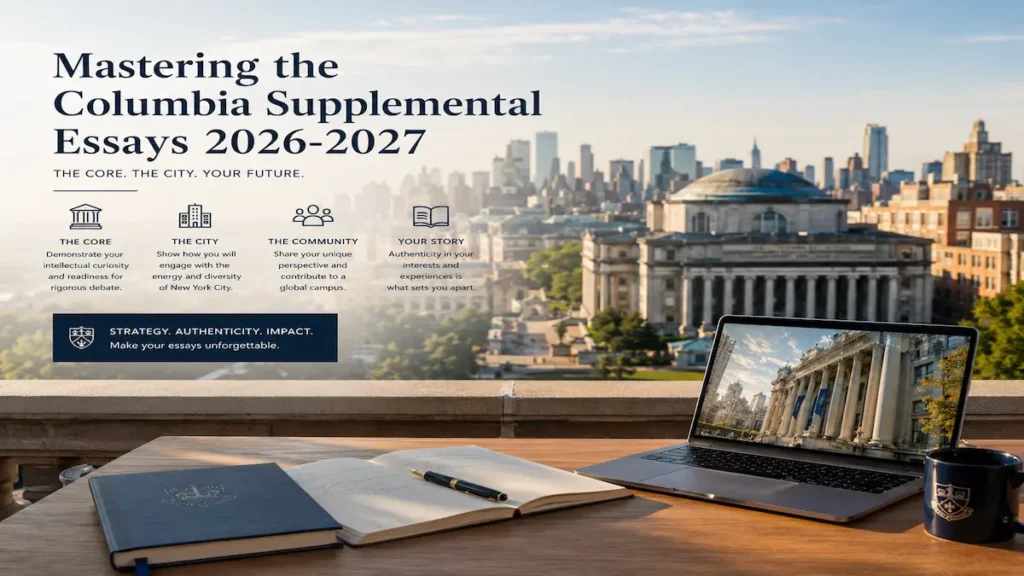
The Columbia Supplemental Essays for 2026–2027 include six required Columbia-specific responses: one Intellectual Development list of up to 100 words and five short answers of up to 150 words each.
For Fall 2027 applicants, Columbia asks about:
your intellectual influences;
an important lived experience;
engagement with disagreement;
your response to adversity;
why Columbia specifically appeals to you;
your preferred academic areas at Columbia College or Columbia Engineering.
These six responses should work as a portfolio.
A strong set of Columbia Supplemental Essays does not tell the same story six times.
Instead, the responses should collectively show:
what influences you → what shaped you → how you engage → how you adapt → why Columbia fits → what you want to study
The goal is not to manufacture six different personality traits.
The goal is to provide six different pieces of useful evidence.
Columbia Supplemental Essays 2026–2027: Quick Answer
How many Columbia-specific responses are required?
Six.
How long is the Intellectual Development list?
100 words or fewer.
How long are the other Columbia essays?
150 words or fewer each.
Is there a Why Columbia essay?
Yes.
Does Columbia ask about disagreement?
Yes.
Does Columbia ask about adversity?
Yes.
Does Columbia ask about your intended academic area?
Yes, in the context of Columbia College or Columbia Engineering.
Current structure
Columbia Response, Limits & Main Purposes
Intellectual Development List: 100 words • Intellectual influences
Lived Experience & Contribution: 150 words • Perspective + contribution
Disagreement & Engagement: 150 words • Engagement across difference
Adversity & Growth: 150 words • Response + change
Why Columbia: 150 words • Institutional fit
Preferred Areas of Study: 150 words • Academic direction
The short word limits matter.
You do not have room for lengthy setup, generic introductions, or repeated background.
Each response needs a job.
How Do You Write Strong Columbia Supplemental Essays?
Strong Columbia Supplemental Essays answer each prompt directly, use concrete evidence, and avoid making multiple answers perform the same function.
Across the six responses, Columbia should learn something about:
what influences your thinking;
what shaped your perspective;
how you respond to disagreement;
what happens when your first approach fails;
why Columbia fits interests you already have;
what academic questions you want to pursue.
After drafting each response, ask:
If I removed this response, what would Columbia no longer know about me?
If two essays have essentially the same answer, one probably needs a different angle.
Columbia Supplemental Essay Prompt 1: Intellectual Development List
Word limit: 100 words.
Columbia asks applicants to list texts, resources, and outlets that have contributed to their intellectual development outside academic courses.
The permitted range is intentionally broad and can include:
books;
journals;
websites;
podcasts;
essays;
plays;
presentations;
videos;
museums;
publications;
other resources you genuinely use.
Columbia’s instructions are unusually specific.
The response should remain a list.
Use commas or semicolons.
Items do not need to be numbered.
Author names, subtitles, and explanations are unnecessary.
How Should You Answer Columbia's Intellectual List?
Treat it as a list, not a miniature essay.
Do not write:
“The Great Gatsby taught me that...”
or:
“I enjoy The New York Times because...”
You are not being asked to explain every title.
Instead, let the collection reveal patterns.
For example:
99% Invisible; The Death and Life of Great American Cities; Our World in Data; CityLab; Radiolab; NYC Open Data; The Design of Everyday Things
Taken together, that list begins to suggest an intellectual ecosystem:
cities + systems + design + data
That is more revealing than choosing seven books simply because they sound academically impressive.
What Should You Avoid in the Columbia Intellectual List?
Avoid:
turning it into prose;
explaining every item;
filling it entirely with assigned classroom texts;
selecting titles mainly for prestige;
unnecessary author names;
subtitles;
vague categories such as “science podcasts” instead of identifiable resources.
The list should feel like an actual record of what enters your intellectual life.
Columbia Supplemental Essay Prompt 2: Lived Experience and Contribution
Word limit: 150 words.
This response asks about an aspect of your life or lived experience that matters to you and how it has shaped the way you would learn from and contribute to Columbia’s collaborative environment.
Do not reduce this to:
“Write a diversity essay.”
A more useful structure is:
experience → meaning → behavior → contribution
The lived experience provides context.
The important part is what it changed in you.
How Should You Answer Columbia's Lived Experience Essay?
Weak:
“Growing up bilingual taught me to value diversity.”
That provides a conclusion without showing much evidence.
Stronger direction:
“Helping relatives translate institutional language taught me that an explanation can be technically accurate and still useless if the listener cannot act on it. I began asking what someone actually needed to understand before deciding how to explain something.”
Now Columbia can see a behavior.
Possible topics include:
language;
translating for family;
work;
caring for siblings;
moving between communities;
family dynamics;
school environment;
cultural experience;
financial responsibility;
another experience that changed how you participate with other people.
The response becomes useful when lived experience produces a specific way of thinking or behaving.
Do Not End With a Generic Columbia Contribution
Avoid:
“I will bring my unique perspective to Columbia.”
That could mean almost anything.
Instead ask:
What would people actually notice about the way I participate?
Maybe your experience taught you to:
translate jargon;
notice who has not spoken;
question assumptions about access;
make plans around limited resources;
listen before solving;
distinguish disagreement from disrespect.
Contribution becomes more credible when it grows naturally from the experience.
How Do You Write the Columbia Disagreement Essay?
Weak:
“I explained my position until my classmate understood why my idea was better.”
That turns the response into a victory story.
Stronger:
“I assumed she opposed my proposal because she misunderstood it. When I finally asked what worried her, I realized she had identified an access problem I had never considered.”
Now we can see:
listening;
questioning;
intellectual humility;
changed understanding.
You do not need to abandon your original position.
You do not even need to reach complete agreement.
The meaningful part is the engagement.
Use the Columbia Supplemental Essay Grader
What Makes a Strong Disagreement Topic?
The disagreement does not need to involve:
politics;
philosophy;
a major social controversy;
an academic debate.
A smaller disagreement can work extremely well if the interaction reveals how you:
listened;
asked questions;
adjusted;
recognized a blind spot;
clarified assumptions;
found limited common ground.
Avoid choosing a disagreement simply because the subject sounds intellectual.
Choose one where your behavior is visible.
Columbia Supplemental Essay Prompt 4: Adversity and Growth
Word limit: 150 words.
This prompt asks you to describe a situation in which you navigated adversity and explain how you changed as a result.
You do not need the most dramatic hardship imaginable.
A meaningful challenge can involve:
academic difficulty;
employment;
family responsibilities;
relocation;
an unsuccessful project;
injury;
unfamiliar expectations;
a disruption to your normal routine.
The key is not the severity of the adversity.
It is the response and change.
How Should You Structure the Columbia Adversity Essay?
Use:
situation → response → adjustment → change
Do not spend nearly the entire 150 words describing what happened.
Columbia specifically wants to know what you did and how you changed.
Weak:
“This experience taught me never to give up.”
That is generic resilience.
Stronger:
“I stopped assuming that more effort would solve the problem and began asking whether my method itself was failing.”
Now we can identify an actual behavioral change.
Avoid Manufacturing Adversity
Do not inflate a routine setback simply because the word “adversity” appears in the prompt.
Likewise, a genuinely difficult experience does not need dramatic language to become meaningful.
Be accurate.
Give enough context to understand the situation.
Then move quickly toward:
response;
adjustment;
decision;
change.
Columbia Supplemental Essay Prompt 5: Why Columbia?
Word limit: 150 words.
This is the response that should be distinctly Columbia-specific.
The basic structure is:
existing interest → Columbia opportunity → why the connection matters
Do not begin by writing an advertisement for Columbia.
Begin with you.
How Do You Write a Strong Why Columbia Essay?
Weak:
“Columbia is prestigious, has world-class professors, and gives me access to New York City.”
That language is mostly interchangeable.
Stronger direction:
“Analyzing transit delays made me interested in how technical systems create different consequences for different neighborhoods. Columbia's Core interests me because it would keep quantitative questions in conversation with political, historical, and ethical arguments.”
Now we have:
applicant-owned evidence;
intellectual direction;
a Columbia connection;
reasoning.
A Columbia-specific reference becomes useful only when you explain why it matters to you.
What Can You Mention in Why Columbia?
Potential anchors include:
Core Curriculum;
departments;
courses;
laboratories;
research centers;
interdisciplinary programs;
publications;
campus organizations;
particular academic structures;
New York City.
But do not turn the response into:
“Columbia has X, Y, Z, A, B, and C.”
One or two deeply explained connections are usually more persuasive than six proper nouns.
Should You Mention the Core Curriculum?
Yes, when the Core genuinely connects to the way you want to learn.
Do not write:
“I love Columbia because of the Core Curriculum.”
Ask:
What would the Core make me do intellectually that matters to me?
Perhaps it would:
put technical questions beside humanistic ones;
force you outside your existing academic comfort zone;
create common intellectual material across disciplines;
connect a specialized interest with broader questions.
Explain the function.
Should You Mention New York City?
Yes, when New York actually does something in your argument.
Weak:
“I want to live in the greatest city in the world.”
That is tourism language.
Better:
existing interest → New York context → specific question or activity
Examples:
transportation → mobility systems;
architecture → built environment;
journalism → reporting;
economics → firms and markets;
climate → urban resilience;
public health → neighborhood disparities;
arts → museums and performance;
policy → institutional access.
New York should function as a learning environment, not scenery.
Columbia Supplemental Essay Prompt 6: Preferred Areas of Study
Word limit: 150 words.
The final Columbia response asks what attracts you to your preferred areas of study at Columbia College or Columbia Engineering.
This question is easy to confuse with Why Columbia.
They are not the same.
Why Columbia vs. Preferred Areas of Study
Essay • Central Question
Why Columbia: Why this university and educational environment?
Preferred Areas of Study: Why this academic direction?
Why Columbia can emphasize:
Columbia's educational structure;
Core Curriculum;
institutional features;
interdisciplinary possibilities;
distinctive resources;
New York when relevant.
Preferred Areas of Study should emphasize:
where the interest began;
questions you are asking;
what you have explored;
problems or methods that interest you;
how you want the interest to develop.
There can be some Columbia-specific material in both.
But they should not become two copies of the same essay.
How Do You Write Columbia's Academic Interest Essay?
Do more than name a major.
Weak:
“I want to study economics because economics affects everyone and can help me make a difference.”
There is almost no intellectual evidence.
Stronger:
“Tracking price changes at my family's bakery made me curious about why customers responded differently to similar increases. I began wondering how habit, substitutes, and perceived value shape those decisions.”
Now there is:
an origin;
an observation;
a question;
academic direction.
A useful structure is:
origin → question → exploration → Columbia connection → next question
Columbia Supplemental Essay Examples: Weak vs. Strong
Weak Why Columbia
I want to attend Columbia because it is prestigious, has excellent professors, and gives me access to everything New York City offers.
Why it is weak
- prestige;
- interchangeable language;
- no applicant evidence;
- no reasoning.
Stronger direction
Analyzing bus-arrival data made me interested in how technical systems produce different consequences for different neighborhoods. I want to keep those questions in conversation with Columbia's shared humanistic study rather than treating modeling as separate from questions of public responsibility.
This establishes:
- applicant evidence;
- an intellectual question;
- Columbia-related reasoning;
- coherent direction.
Weak Disagreement
My classmate disagreed with me, but after I explained my reasoning, she understood why my idea was better.
Stronger direction
I entered the discussion thinking she opposed my proposal because it was unfamiliar. When I asked what concerned her, I realized she was identifying an access problem I had never considered.
The second version demonstrates engagement rather than victory.
Common Mistakes in Columbia Supplemental Essays
1. Turning the Intellectual List Into an Essay
Columbia asks for a list.
Give it a list.
2. Writing Six Versions of the Same Story
If three responses use the same robotics project, you are losing opportunities to reveal new information.
3. Overusing the Core Curriculum
The Core can be highly relevant.
It does not need to appear everywhere.
4. Treating New York as the Main Reason for Applying
New York is a context.
It is not automatically an academic argument.
5. Name-Dropping Without Applicant Connection
A professor, course, laboratory, institute, or program matters only when you explain why it connects to something already meaningful to you.
6. Résumé Dumping
Columbia already receives your Activities section.
Use the supplemental essays to explain:
decisions;
thinking;
motivations;
responses;
changes.
7. Generic Resilience
Avoid:
“This challenge made me stronger.”
Show what actually changed.
8. Winning the Disagreement
The disagreement prompt is about engagement, not domination.
9. Generic Why Major Language
Do not stop at:
“I love biology.”
Show:
a question;
mechanism;
contradiction;
observation;
problem.
10. Writing Toward an Imaginary Columbia Archetype
You do not need every answer to sound intensely intellectual or philosophical.
Specificity is more convincing than performance.
How Should All Six Columbia Supplemental Essays Work Together?
This is where portfolio strategy becomes important.
Response • What It Can Reveal
Intellectual List: Intellectual ecosystem
Lived Experience: Perspective + contribution
Disagreement: Engagement + humility
Adversity: Adaptation + growth
Why Columbia: Institutional connection
Academic Interest: Intellectual direction
The objective is not to check six character traits.
It is to make every response contribute new evidence.
Ask:
If I removed this response, what would Columbia no longer know about me?
If two essays produce the same answer, look for unnecessary overlap.
Review Your Columbia Supplemental Essays as a Portfolio
Once all six responses are drafted, read them together.
Look for:
direct prompt fulfillment;
concrete evidence;
applicant-owned action;
specific reflection;
unnecessary repetition;
generic Columbia language;
weak New York references;
meaningful Columbia-specific reasoning;
accurate word limits;
correct Intellectual Development list formatting.
The portfolio should feel like one person viewed from six different angles, not six disconnected performances.
Review Your Columbia Supplemental Essays
The Columbia Supplemental Essay review can help you inspect each current response according to what that particular prompt asks.
For example, it can look at whether:
the Intellectual Development list is concrete and follows the requested format;
lived experience actually connects to learning and contribution;
the disagreement response contains real engagement;
the adversity essay shows navigation and change;
Why Columbia contains meaningful applicant-to-Columbia reasoning;
Preferred Areas of Study demonstrates a genuine intellectual direction.
The review uses prompt-specific criteria instead of treating all six responses like the same generic essay.
Every observation is connected to a direct quote from your own writing.
If something important is missing, the review asks a specific question rather than inventing information.
It does not rewrite the essays.
Your voice remains your own.
When a criterion is already supported, it can simply be marked Ready.
Optional Elite Second Opinion
Applicants who want another perspective can use the Elite Second Opinion.
A separate independent reader reviews the same Columbia response.
The comparison shows:
- where both readers agree;
- where their interpretations differ;
- both readings when there is a genuine difference.
The applicant can then decide what feedback is useful for revision.
This is a second reading of the writing.
It is not a Columbia admission prediction.
Applying to Princeton Too?
Columbia and Princeton both ask highly selective applicants to demonstrate intellectual direction, but their current supplements work very differently.
Columbia relies on six compact responses, including the Intellectual Development list, disagreement, adversity, Why Columbia, and academic interest.
Princeton includes separate A.B./Undecided and B.S.E. academic pathways, a much longer lived-experience response, civic engagement, and short takes.
If Princeton is also on your list, do not simply recycle your Columbia strategy.
Columbia Supplemental Essays FAQ
How many Columbia supplemental essays are required for 2026–2027?
The current structure contains six Columbia-specific responses: one 100-word Intellectual Development list and five short responses of up to 150 words each.
What is the Columbia supplemental essay word limit?
The Intellectual Development list allows 100 words. The remaining five responses allow 150 words each.
Does Columbia have a Why Columbia essay?
Yes. One current prompt asks why you are interested in attending Columbia and encourages you to identify aspects you find unique and compelling.
Is the Preferred Areas of Study essay the same as Why Columbia?
No.
Why Columbia focuses on the university and educational environment.
Preferred Areas of Study focuses primarily on your academic direction.
Should I mention the Core Curriculum?
Yes, when it genuinely supports your reason for applying.
Do not insert it merely because you think every Columbia applicant must mention the Core.
Should I mention New York City?
Yes, if New York connects meaningfully to an existing academic, professional, civic, or cultural interest.
Avoid tourism language.
Is the lived-experience prompt a diversity essay?
It is more useful to think of it as:
experience → meaning → behavior → contribution
rather than a generic diversity statement.
Does the Columbia Intellectual Development list need explanations?
No.
Keep it a list and follow Columbia's formatting instructions.
Can I reuse the same experience in multiple Columbia essays?
Yes, but usually only when each response reveals substantially different information.
With such short limits, repeated evidence can make the portfolio feel narrow.
Does the Columbia essay review predict admission?
No.
It reviews the writing and prompt fulfillment.
Columbia admission depends on the complete application.
Final Columbia Supplemental Essays Checklist
Before submitting:
I answered all six current Columbia-specific responses.
My Intellectual Development list is 100 words or fewer.
My other five responses are 150 words or fewer.
My Intellectual Development response is actually formatted as a list.
I removed unnecessary explanations from the list.
My lived-experience response connects experience to behavior and contribution.
My disagreement essay shows engagement instead of victory.
My adversity response explains how I responded and changed.
My Why Columbia essay contains real Columbia-specific reasoning.
I avoided generic New York tourism language.
My Preferred Areas of Study essay demonstrates actual intellectual direction.
I verified any Columbia resource I named.
My six responses reveal different information.
I did not simply rewrite my Activities section.
The experiences and details remain truthful and mine.
I verified the current Columbia application instructions before submitting.
Final Strategy for the Columbia Supplemental Essays
The Columbia Supplemental Essays 2026–2027 are not six opportunities to repeat that you are:
ambitious;
curious;
resilient;
collaborative;
intellectual;
excited about New York.
They are six opportunities to provide different evidence.
Think of the portfolio as:
intellectual influences → lived perspective → engagement → adaptation → Columbia connection → academic direction
Each answer should contribute something the others do not.
The Intellectual Development list should show what enters your mind.
The lived-experience response should show what shaped your perspective.
The disagreement response should show what happens when another person challenges it.
The adversity response should show how you adjust.
Why Columbia should explain why this institution makes sense for interests you already possess.
And the academic response should show where your intellectual direction may go next.
Before submitting, ask one final question:
Does Columbia know substantially more about me after these six responses than it did before reading them?
If the answer is yes, the portfolio is doing its job.
Explore More Ivy League Essay Guides
If you are applying to multiple Ivy League universities, do not force the same supplemental strategy onto every school.
Harvard, Yale, Princeton, Brown, Columbia, Cornell, UPenn, and Dartmouth ask different questions and create different opportunities to show intellectual interests, personality, lived experience, contribution, and institutional fit.
Explore each school’s current prompts before adapting material across applications.