
Supplemental Essay Strategy 2026–2027: How to Write Strong College Supplements
- What Is a Supplemental Essay Strategy?
- Supplemental Essay Strategy: Quick Answer
- Supplemental Essays at a Glance
- Why Supplemental Essays Matter
- Step 1: Build a Prompt Map Before You Draft
- Step 2: Decide What Each Essay Adds
- Step 3: Answer the Prompt Before Trying to Impress
- Step 4: Use Specificity Only Where It Matters
- Step 5: Adapt Without Inventing a New Persona
- Can You Reuse Supplemental Essay Material?
- Why the “20% School-Specific” Rule Is a Bad Rule
- How to Write a Strong Why Us Supplemental Essay
- How to Write Academic-Interest Supplements
- How to Write Community Supplements
- How to Handle Very Short Supplemental Essays
- Do All Supplemental Essays Need a Story?
- Common Supplemental Essay Mistakes
- How Should Your Supplemental Essays Work Together?
- How Can You Check Your Supplemental Essay Strategy?
- Using Essay Graders for Revision Feedback
- Supplemental Essay Strategy Final Checklist
- FAQ: Supplemental Essay Strategy
- Final Thoughts on Supplemental Essay Strategy
- Explore More College Essay Guides
Last updated: August 2026 for the 2026–2027 application cycle.
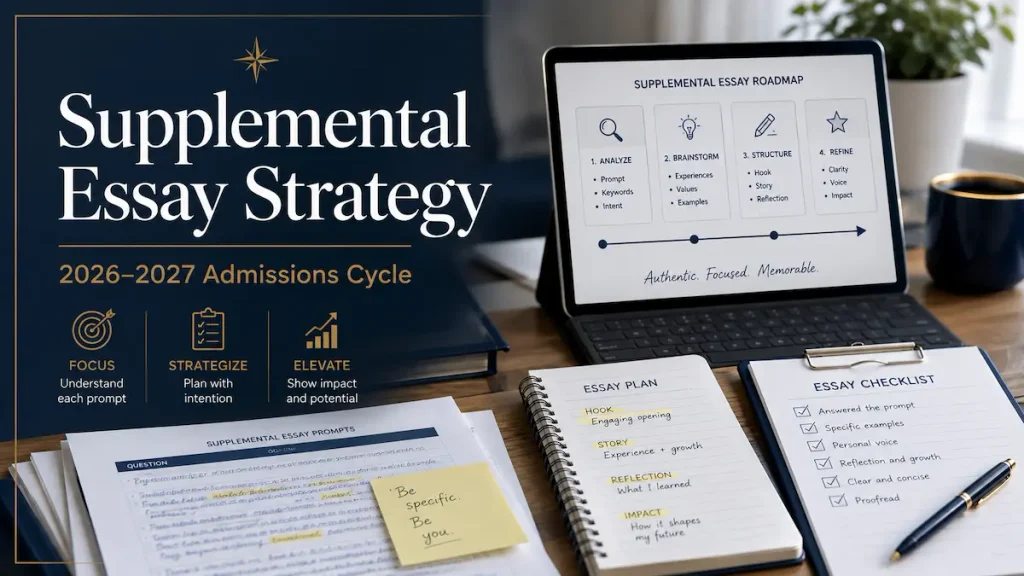
A strong Supplemental Essay Strategy starts with understanding that college-specific essays have a different job from your Common App Personal Statement.
Your personal statement can introduce an important part of your story, perspective, or development. Supplemental essays allow individual colleges to ask for information they specifically want to understand: academic interests, community experiences, personal perspective, future goals, activities, or how you might engage with their institution.
Common App itself notes that colleges can have their own college-specific questions and writing supplements, and those requirements vary by institution.
That means the best Supplemental Essay Strategy is not to write one generic “college essay” and reuse it everywhere. It is to understand what each prompt is asking, identify what new information it can add to your application, and answer it with specific evidence.
Selective College Supplemental Essays: 2026–2027 Writing Structure
| University | 2026–2027 Writing Structure | Main Prompt Types | Guide / Grader |
|---|---|---|---|
| Harvard | 5 required short answers, up to 150 words each | Experiences, disagreement, activities, future goals, roommate | Harvard Essay Grader |
| Stanford | 5 short answers + 3 essays | Personal details, intellectual curiosity, roommate, contribution | Stanford Essay Grader |
| Princeton | Multiple required essays, short responses, plus graded written paper | Academic interests, lived experience, service, personal short answers | Princeton Essay Grader |
| UPenn | Required university responses plus school/program-specific writing | Community, contribution, academic direction, school-specific interest | UPenn Essay Grader |
| Yale | Academic-interest response, short takes, and longer essay | Academic curiosity, personal interests, perspective, reflection | Yale Essay Grader |
| Cornell | College- or school-specific essays; structure varies by program | Academic direction, school fit, contribution, program-specific questions | Cornell Essay Grader |
| Brown | Required Brown-specific essays; specialized programs may add responses | Academic interests, community, personal perspective, program-specific topics | Brown Essay Grader |
| Columbia | Columbia-specific short responses and list-style questions | Academic interests, intellectual influences, community, Columbia-specific fit | Check current Columbia requirements |
Official source: Common App maintains each college’s current writing requirements and prompts within the application and its college information pages. You can review its first-year application guide for current guidance.
What Is a Supplemental Essay Strategy?
A Supplemental Essay Strategy is a plan for making your college-specific essays work together rather than treating each response as an isolated assignment.
A strong strategy should help you:
- answer each prompt directly;
- avoid repeating the same story;
- decide which experiences belong in which essay;
- use school-specific details only where relevant;
- preserve your natural voice;
- show different dimensions of your application;
- manage multiple word limits efficiently.
It is to decide which truthful parts of your experiences best answer each school’s actual questions.
Supplemental Essay Strategy: Quick Answer
To build a strong Supplemental Essay Strategy, first map every prompt by purpose—academic interest, community, contribution, activity, perspective, future goals, or school-specific connection. Then assign each prompt a different piece of evidence from your life, draft the applicant-focused content first, and add institution-specific details only when the question genuinely asks for them.
Key Takeaways
- Read the exact current-year prompt.
- Identify what the college is actually asking.
- Give each supplement a specific role.
- Avoid repeating your Common App essay.
- Reuse experiences only when the angle genuinely changes.
- Use precise school details in Why Us–type essays.
- Do not force “fit” language into prompts that do not ask for it.
- Preserve your voice across schools.
- Check the complete portfolio before submitting.
Supplemental Essays at a Glance
| Prompt Type | Main Question | Strong Strategy | Common Mistake |
|---|---|---|---|
| Why Us? | Why this institution? | Connect specific opportunities to existing interests/actions | Listing rankings and prestige |
| Academic Interest | What do you want to explore? | Show curiosity through concrete evidence | Writing a résumé of classes |
| Community | What community shaped you or how will you contribute? | Define the community and your role | Generic “diversity” language |
| Activity | What experience matters most? | Show decisions, responsibility, and meaning | Repeating the activities list |
| Perspective | What shaped how you think? | Use one specific experience or pattern | Abstract identity claims |
| Future Goals | What do you hope to do? | Connect past evidence to plausible direction | Making unrealistic promises |
| Short Takes | What small detail reveals you? | Be direct, specific, and personal | Trying to sound profound |
Why Supplemental Essays Matter
Supplemental essays matter because colleges use them to collect information that may not appear elsewhere in the application.
For example, Harvard’s current supplement contains five required short-answer questions, each with a 150-word limit, covering life experiences and contribution, disagreement, activities or responsibilities, future use of a Harvard education, and information a future roommate might want to know.
Yale’s 2026–2027 application includes an academic-interest response, several short takes, and a longer 400-word essay selected from three prompts.
Princeton’s 2026–2027 questions include an academic response tied to degree path, a substantial lived-experience essay, a service/civic engagement essay, three 50-word responses, and a required graded written paper.
Those are very different writing tasks.
That is exactly why one generic strategy does not work.
Step 1: Build a Prompt Map Before You Draft
The first step in any Supplemental Essay Strategy should be making a simple prompt inventory.
For every university, record:
- exact prompt;
- word limit;
- required or optional;
- topic category;
- what evidence you might use;
- whether that evidence already appears elsewhere.
For example:
| College | Prompt Function | Possible Evidence | Already Used? |
|---|---|---|---|
| School A | Academic interest | Independent robotics project | No |
| School A | Community | Translating for family | Common App |
| School B | Activity | Part-time job | No |
| School B | Why Us | Research interest | No |
This prevents a common problem:
writing three good essays that all reveal the same thing.
Step 2: Decide What Each Essay Adds
A strong supplement should answer:
What will the admissions reader know after this response that they did not already know?
Suppose your Common App essay already shows that you:
- love biology;
- became interested through caring for an injured animal;
- developed persistence.
Your supplements probably should not all repeat:
“Biology taught me persistence.”
Instead, another response might reveal:
- how you collaborate;
- a family responsibility;
- your sense of humor;
- a specific research question;
- community contribution;
- how you deal with disagreement.
Step 3: Answer the Prompt Before Trying to Impress
One of the easiest ways to weaken a supplement is to become so focused on sounding impressive that you stop answering the actual question.
Before drafting, rewrite the prompt in plain language.
For example:
“How do you hope to use your Harvard education in the future?”
becomes:
What direction am I moving toward, and how might Harvard help me continue that development?
A community prompt becomes:
Which community matters to me, and what role do I play in it?
A disagreement prompt becomes:
How do I behave when someone strongly disagrees with me?
Step 4: Use Specificity Only Where It Matters
Research is important for prompts that actually ask about the institution.
A weak Why Us answer says:
“I am attracted to the world-class professors, collaborative students, and amazing research opportunities.”
A stronger response connects a specific institutional opportunity to something the applicant has already demonstrated.
The structure might be:
past interest/action → specific opportunity → what you would do with it
But not every supplement is a Why Us essay.
If the prompt asks about:
- your family;
- a disagreement;
- a meaningful activity;
- your roommate;
- your community;
do not force campus programs into the response.
Step 5: Adapt Without Inventing a New Persona
A good Supplemental Essay Strategy does not mean changing your personality for each institution.
Your Stanford response should not sound like one person while your Harvard response sounds like someone completely different.
What changes is:
- the prompt;
- the evidence you emphasize;
- the length;
- the level of formality;
- the question being answered.
What should remain consistent:
- your experiences;
- your voice;
- your values;
- your actual interests.
Can You Reuse Supplemental Essay Material?
Yes—but carefully.
You can reuse:
- an experience;
- a factual description;
- a core story;
- background context.
But the final essay must answer the new prompt.
For example, the same robotics project might support:
Activity prompt:
What responsibility did you assume?
Academic-interest prompt:
What technical question did the project make you investigate?
Community prompt:
How did you make the team more accessible to newer members?
Same experience.
Different evidence.
That is much safer than using one “master essay” and swapping the university name.
Why the “20% School-Specific” Rule Is a Bad Rule
There is no meaningful universal rule that says every supplement must contain 20%, 30%, or 50% school-specific material.
Some prompts may require substantial institutional research.
Others require none.
The amount of school-specific content should depend entirely on what the prompt asks.
A Harvard roommate-style answer does not need a list of Harvard resources.
A Why Us essay often does.
Prompt first.
Formula second.
How to Write a Strong Why Us Supplemental Essay
A strong Why Us essay connects you + the institution.
Use:
1. Existing Evidence
What have you already done that demonstrates the interest?
2. Specific Resource
What program, course structure, opportunity, community, lab, curriculum feature, or institutional characteristic matters?
3. Connection
Why does that resource make sense given your existing trajectory?
Weak:
“The university’s prestigious research opportunities will help me achieve my dreams.”
Stronger:
“After using public transit data to model route delays in my city, I want to continue exploring how quantitative systems affect everyday mobility...”
How to Write Academic-Interest Supplements
Academic prompts are not invitations to list:
- AP classes;
- awards;
- intended major;
- professors you admire.
Instead, show:
question → exploration → deeper question
Yale’s own admissions advice emphasizes writing about something that matters to you, sharing your perspective, and retaining your own voice.
Academic curiosity is more convincing when you show what you actually do when a question interests you.
How to Write Community Supplements
A community essay should make three things clear:
- 1 What community are you discussing?
- 2 What role do you play in it?
- 3 What has that experience taught or changed?
How to Handle Very Short Supplemental Essays
Short responses are often harder than long essays.
At 35, 50, or 150 words, there is little room for:
- long setup;
- philosophical introduction;
- repetition;
- admissions jargon.
Yale’s current application, for example, includes short takes of no more than 200 characters—approximately 35 words.
Harvard’s current five required short answers are 150 words each.
In short responses:
answer immediately → give one concrete detail → stop
Do All Supplemental Essays Need a Story?
No.
Some prompts benefit from narrative.
Others benefit from direct explanation.
A 150-word future-goals response may work better as:
current interest → evidence → next direction
than as a dramatic scene.
Do not force every supplement into:
hook → conflict → climax → inspirational ending.
Common Supplemental Essay Mistakes
Mistake 1: Repeating the Personal Statement
Your Common App Personal Statement already has a job.
Do not use supplements merely to retell it.
Mistake 2: Writing Generic Why Us Essays
Avoid:
- prestigious;
- world-class;
- diverse;
- collaborative;
- beautiful campus.
without evidence.
Mistake 3: Name-Dropping Programs Without Connection
Mentioning five professors does not prove fit.
Explain why one opportunity matters.
Mistake 4: Reusing the Same Essay With a New College Name
This often produces answers that technically sound polished but do not answer the actual prompt.
Mistake 5: Turning Every Essay Into a Leadership Essay
Not every application needs another story about being president, captain, or founder.
Mistake 6: Trying to Guess the “Perfect Applicant”
Do not write toward an imagined archetype.
Respond truthfully to the prompt with the strongest evidence you have.
Mistake 7: Treating Every Supplemental Essay as a Why Us Essay
Many supplements are applicant-focused, not institution-focused.
Mistake 8: Using Generic AI Language
Avoid polished but empty phrases like:
“I seek to leverage interdisciplinary synergies to drive meaningful impact.”
If you would never say it naturally, reconsider it.
How Should Your Supplemental Essays Work Together?
Your full application might reveal:
- Personal Statement: important personal perspective;
- Academic Supplement: intellectual curiosity;
- Community Essay: collaboration;
- Activity Essay: responsibility;
- Short Takes: personality;
- Why Us: institution-specific direction.
That is a coherent Supplemental Essay Strategy because each piece contributes different evidence.
The goal is not to hit predetermined traits.
It is to avoid wasting precious writing space by showing the same thing repeatedly.
How Can You Check Your Supplemental Essay Strategy?
Before submitting, review the essays as a portfolio, not one at a time.
Ask:
- Does each response answer its prompt?
- Which experiences repeat?
- Which qualities repeat?
- Is any important part of my application missing?
- Are institutional details accurate?
- Could a school name be swapped without changing the essay?
- Does the voice remain consistent?
- Is every claim supported by evidence?
- Did I follow every current word limit?
If several responses could be summarized with the same sentence, diversify.
Using Essay Graders for Revision Feedback
Once the strategy is set, graders are most useful for diagnosing individual drafts, not for generating a different persona for each school.
Use College Essay Grader to explore the available essay evaluation tools.
For your main essay:
For university-specific supplements:
- Harvard Supplemental Essay Grader
- Stanford Supplemental Essay Grader
- Cornell Supplemental Essay Grader
- UPenn Supplemental Essay Grader
- Brown Supplemental Essay Grader
- Princeton Supplemental Essay Grader
- Yale Supplemental Essay Grader
- Dartmouth Supplemental Essay Grader
The purpose is to identify revision priorities such as prompt fit, specificity, evidence, reflection, and whether the response adds useful information to the rest of the application.
Supplemental Essay Strategy Final Checklist
Before submitting:
- Did I verify every 2026–2027 prompt?
- Did I verify every word limit?
- Does each essay answer the exact question?
- Did I avoid repeating my Personal Statement?
- Is my role clear in every story?
- Are school-specific details accurate?
- Did I remove generic prestige language?
- Does each supplement add something new?
- Does my voice remain consistent?
- Is every factual claim accurate?
- Did I preview the complete application?
FAQ: Supplemental Essay Strategy
What is a Supplemental Essay Strategy?
A Supplemental Essay Strategy is a plan for deciding what each college-specific response should add to your application, which experiences to use, and how to avoid unnecessary repetition.
Should supplemental essays repeat my Common App Personal Statement?
Usually not.
They should generally reveal different information or use an experience from a meaningfully different angle.
Can I reuse supplemental essays between colleges?
You can reuse factual material and experiences, but the final response should directly answer each college’s specific prompt.
How much of a Why Us essay should be school-specific?
There is no universal percentage.
Use enough specific institutional information to demonstrate a genuine connection between your existing interests and what the college offers.
Do supplemental essays need a hook?
Not always.
Very short responses often benefit from answering directly instead of spending valuable words on an elaborate opening.
Should I mention professors and programs?
Only when relevant and accurate.
One meaningful connection is stronger than a list of names.
How do I avoid repeating myself across supplements?
Assign each essay a role before drafting: academic interest, community, contribution, activity, perspective, future goals, or another distinct area.
Should I use AI to write supplemental essays?
AI can assist with feedback, clarity, and identifying repetition, but it should not invent your experiences or replace your personal voice.
Final Thoughts on Supplemental Essay Strategy
A strong Supplemental Essay Strategy is not about discovering a secret personality that each university wants.
It is about answering each prompt precisely and making every response contribute new evidence.
A useful framework is:
prompt → purpose → evidence → reflection → portfolio contribution
Your Personal Statement introduces one meaningful part of you.
Your supplements can expand the picture.
Before submitting, use the College Essay Grader and the appropriate university-specific grader to check whether each response is specific, evidence-based, and actually answering the current prompt.
Explore More College Essay Guides
- Common App Personal Statement Guide 2026–2027
- Harvard Supplemental Essays 2026–2027
- Stanford Supplemental Essays 2026–2027
- Cornell Supplemental Essays 2026–2027
- UPenn Supplemental Essays 2026–2027
- Brown Supplemental Essays 2026–2027
- Princeton Supplemental Essays 2026–2027
- Yale Supplemental Essays 2026–2027
- Dartmouth Supplemental Essays 2026–2027