
Carnegie Mellon Supplemental Essay Grader for Fall 2027: Review Your CMU Essays Before You Submit
Table
- What Is the Carnegie Mellon Supplemental Essay Grader?
- Review Your Carnegie Mellon Supplemental Essays Before Submitting
- Start My Carnegie Mellon Essay Review
- Carnegie Mellon Supplemental Essay Grader
- What You’ll Get From Your Carnegie Mellon Review
- Want a second, fully independent opinion?
- ${cmuEscapeHtml(title)}
- Evaluation Comparison
- Elite Second Opinion
- My Carnegie Mellon Reviews
- Why the Carnegie Mellon Writing Supplement Matters
- Carnegie Mellon Supplemental Essay Prompts 2026–2027
- What the Carnegie Mellon Supplemental Essay Grader Checks
- You Do Not Need a Hidden “Why Carnegie Mellon?” Essay
- Avoid the Generic Major Trap
- Prestige Does Not Explain Your Academic Direction
- Prestige Is Not the Same as Specificity
- Show a Real Definition of a Successful College Experience
- Make Prompt 3 Add Something New
- Avoid Repeating the Same Story Across All Three CMU Essays
- Common Carnegie Mellon Supplemental Essay Mistakes
- How to Improve Your Carnegie Mellon Supplemental Essays
- Improve Prompt 2: Define the Process, Not Just the Prize
- Improve Prompt 3: Compare It With the Rest of Your Application
- Carnegie Mellon Supplemental Essay Examples: What Makes an Approach Strong?
- How the AI CMU Essay Review Works
- Should You Mention Specific Carnegie Mellon Programs?
- Does the Carnegie Mellon Supplemental Essay Grader Write the Essay for You?
- Frequently Asked Questions About the CMU Supplemental Essays
- Use the Carnegie Mellon Supplemental Essay Grader Before You Submit
- Explore More Top STEM & Tech University Essay Graders
The Carnegie Mellon Supplemental Essay Grader helps students review their CMU supplemental essays with a strict, prompt-specific admissions-style lens before submitting their application.
Carnegie Mellon’s Writing Supplement is not simply a place to repeat your résumé, praise the university’s reputation, or list everything you have accomplished. Across three short responses, Carnegie Mellon asks applicants to explain what led them toward their intended area of study, how they define a successful college experience, and what they still want the admission committee to understand about them.
For the 2026–2027 application cycle, Carnegie Mellon requires three short-answer responses through its Common Application Writing Supplement. Each response should not exceed 300 words.
That gives applicants only about 900 words across the full CMU Writing Supplement to communicate academic or creative motivation, intellectual development, learning mindset, self-awareness, and an additional dimension that may not already be clear elsewhere in the application.
Before submitting, students should always verify the current requirements directly on Carnegie Mellon’s official admissions site: Carnegie Mellon Admission Consideration.
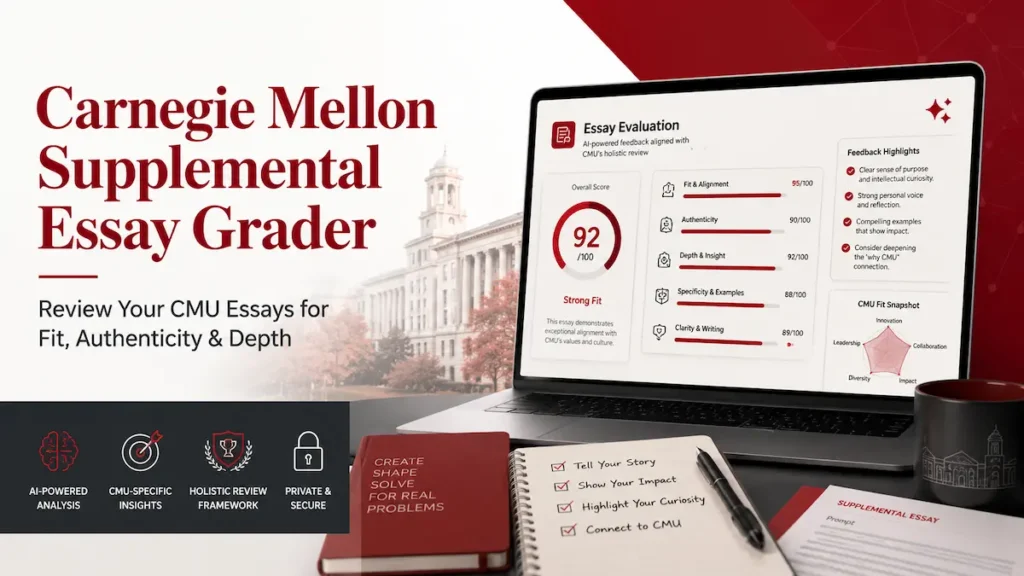
The Carnegie Mellon Supplemental Essay Grader is designed to help applicants identify whether their short answers are specific, reflective, differentiated, responsive to the actual CMU essay prompts, and effective as a complete three-response set.
What Is the Carnegie Mellon Supplemental Essay Grader?
The Carnegie Mellon Supplemental Essay Grader is an AI-powered college essay review tool built specifically for the current Carnegie Mellon supplemental essays.
Instead of applying a generic essay rubric to every school, the grader evaluates the three CMU responses according to what each individual prompt is actually asking.
This distinction matters.
Carnegie Mellon uses its three short answers to explore different parts of the applicant:
- what developed your interest in your intended academic or creative field;
- what meaningful learning and success in college look like to you;
- what important part of your application, perspective, context, values, or character deserves additional emphasis.
A student can therefore have one excellent response while still submitting a weak overall supplement.
For example, your intended-major essay might contain a compelling academic experience, but the full set can still become repetitive if your third response tells essentially the same story again.
The CMU essay grader reviews both the individual essays and the complete supplement for issues such as:
- academic or creative motivation;
- development of interest over time;
- prompt fulfillment;
- learning mindset;
- intellectual curiosity;
- reflection and self-awareness;
- personal emphasis;
- authenticity;
- specificity;
- strategic coherence across the three responses;
- generic major language;
- prestige-driven reasoning;
- résumé dumping;
- repeated narrative material;
- one-dimensional presentation.
The goal is not to predict whether Carnegie Mellon will admit you. The goal is to show you where your Carnegie Mellon application essays are working and where they still need revision.
Review Your Carnegie Mellon Supplemental Essays Before Submitting
Use the Carnegie Mellon Supplemental Essay Grader below to review all three CMU short-answer responses before submitting your application.
The tool checks whether your essays show a credible academic or creative direction, a thoughtful approach to learning, meaningful self-awareness, and enough differentiation across the complete supplement.
Start My Carnegie Mellon Essay Review
Carnegie Mellon Supplemental Essay Grader
Review your Carnegie Mellon Writing Supplement for academic direction, development of interest, learning goals, personal emphasis, specificity, and clarity.
CMU essay focus: Carnegie Mellon asks three short-answer questions, each with a maximum of 300 words. Generic major interest, prestige-only reasoning, résumé dumps, and one-dimensional tech writing will weaken your supplement.
Your account includes 2 free essay reviews for life. Paid Universal Credits are always used first.
Your account includes 2 free essay reviews for life. Paid Universal Credits are always used first.
What You’ll Get From Your Carnegie Mellon Review
Academic Motivation
Learning Mindset
Academic Direction
Personal Emphasis
Authentic Voice
Improvement Tracking
Paste your Carnegie Mellon responses below to get your score, criterion-level feedback, next revision action, and saved review.
Optional context. Paste your Common App essay if you want the grader to consider your broader personal story. Leave blank if you only want to review the CMU supplement.
Words: 0 / 650
Most students choose their intended major or area of study based on a passion or inspiration that’s developed over time — what passion or inspiration led you to choose this area of study? Maximum 300 words.
Words: 0 / 300
Many students pursue college for a specific degree, career opportunity or personal goal. Whichever it may be, learning will be critical to achieve your ultimate goal. As you think ahead to the process of learning during your college years, how will you define a successful college experience? Maximum 300 words.
Words: 0 / 300
Consider your application as a whole. What do you personally want to emphasize about your application for the admission committee’s consideration? Highlight something that’s important to you or something you haven’t had a chance to share. Tell us, don’t show us (no websites please). Maximum 300 words.
Words: 0 / 300
Complete your Primary Review first to unlock an independent second evaluation and side-by-side comparison.
Need more reviews now?
Need more credits?
View all pricing plans →
Instant activation after payment. 1 Universal Credit = 1 comprehensive Carnegie Mellon supplement review.
Why the Carnegie Mellon Writing Supplement Matters
The CMU supplemental essays give applicants opportunities to explain aspects of themselves that grades, test scores, activities, awards, recommendations, and course rigor cannot fully communicate.
But the three prompts do not all serve the same purpose.
The first asks where your academic or creative direction came from.
The second asks how you think about learning and what would make college successful for you.
The third asks you to step back, consider the rest of your application, and decide what the admission committee should understand that may not yet be visible.
That is why the Carnegie Mellon Supplemental Essay Grader looks at your essays both individually and as a complete writing set.
A strong CMU supplement should help the reader understand:
- why your intended area of study makes sense for you;
- how your interest developed through actual experiences, questions, projects, problems, ideas, or creative work;
- how you approach learning, growth, collaboration, experimentation, critique, or challenge;
- what important dimension of you adds depth beyond the academic profile already visible elsewhere.
The strongest sets use the three essays efficiently. They do not spend 900 words proving the same thing three different ways.
Carnegie Mellon Supplemental Essay Prompts 2026–2027
The official Carnegie Mellon essay prompts for 2026–2027 include three short-answer questions. Each response has a maximum length of 300 words.
CMU Prompt 1: Intended Major or Area of Study
Most students choose their intended major or area of study based on a passion or inspiration that’s developed over time — what passion or inspiration led you to choose this area of study?
This is the academic or creative origin-story prompt.
Carnegie Mellon is not simply asking you to announce your intended major.
Statements such as:
- “I have always loved computer science.”
- “Engineering lets me solve problems.”
- “Business has always interested me.”
- “I want to study biology because I love science.”
- a class;
- a project;
- a design;
- an experiment;
- a technical failure;
- an artistic process;
- a family experience;
- a problem you tried to solve;
- independent learning;
- a job;
- a competition;
- a question you could not stop thinking about.
The important part is what happened, what you did with it, and how it changed or deepened your academic direction.
CMU Prompt 2: Successful College Experience
Many students pursue college for a specific degree, career opportunity or personal goal. Whichever it may be, learning will be critical to achieve your ultimate goal. As you think ahead to the process of learning during your college years, how will you define a successful college experience?
This is one of the easiest CMU essay prompts to answer superficially.
Students often define a successful college experience as:
- earning high grades;
- graduating;
- getting internships;
- building a professional network;
- obtaining a prestigious job;
- earning a high salary.
Those may all be reasonable goals, but the prompt deliberately emphasizes the process of learning.
A stronger response explains what success will mean intellectually or personally.
For example:
- becoming more comfortable revising an idea after it fails;
- learning how to collaborate with people who approach problems differently;
- developing stronger judgment rather than simply accumulating technical knowledge;
- connecting multiple disciplines;
- learning how to turn theory into something useful;
- becoming more effective at receiving and applying critique;
- investigating questions without obvious answers;
- creating work that affects real people;
- becoming more independent as a learner.
The best responses define success through a process of development, not merely through an external outcome.
CMU Prompt 3: What Do You Want to Emphasize?
Consider your application as a whole. What do you personally want to emphasize about your application for the admission committee’s consideration? Highlight something that’s important to you or something you haven’t had a chance to share. Tell us, don’t show us (no websites please).
This is the applicant's opportunity to add depth.
Before writing it, ask a simple question:
What will the admission committee still not understand about me after reading the rest of my application?
The answer does not have to be another accomplishment.
In fact, simply repeating your biggest award, internship, research position, startup, leadership title, artistic portfolio, or competition result may waste the opportunity.
Possible subjects include:
- a family responsibility;
- an intellectual habit;
- a value that influences your decisions;
- a personal constraint;
- a community role;
- a creative practice;
- a way you support other people;
- a quiet obsession;
- a perspective shaped by your environment;
- an important part of your personality;
- a source of motivation;
- an experience that provides context for other choices in your application.
This prompt is intentionally broad. The strongest answer is the one that adds useful information rather than the one that sounds most impressive.
What the Carnegie Mellon Supplemental Essay Grader Checks
The Carnegie Mellon Supplemental Essay Grader evaluates whether each response accomplishes its specific purpose and whether the three essays work effectively together.
1. Academic or Creative Motivation
Does Prompt 1 reveal how your intended area of study developed?
A strong essay does more than state an interest. It gives the reader evidence showing why that interest became meaningful.
2. Development Over Time
Does the essay show movement?
The reader should be able to understand not only what interests you now but also something about how that interest became more serious, sophisticated, or personal.
3. Learning Mindset
Does Prompt 2 explain how you want to learn and grow during college?
The grader looks beyond grades, credentials, and career outcomes to see whether your definition of success contains a meaningful learning process.
4. Personal Emphasis
Does Prompt 3 add something useful to the application?
A strong response should deepen the reader's understanding rather than simply repeat information visible elsewhere.
5. Specificity and Reflection
Are your claims supported by concrete details?
Specificity does not mean loading the essay with technical vocabulary. It means giving the reader enough information to understand what actually happened and why it mattered.
6. Authenticity
Do the essays sound credible and personal?
Highly polished prose does not automatically make an essay stronger. A direct, clear response with meaningful substance can outperform a sophisticated-sounding essay that says very little.
7. Strategic Coherence
Do the three responses complement each other?
The AI CMU essay review checks whether your application writing set reveals multiple useful dimensions or repeatedly relies on the same story.
One important distinction separates the current CMU prompts from many other university supplements:
None of the three required prompts is explicitly a traditional “Why Carnegie Mellon?” question.
That means a strong response does not automatically need to mention:
- professors;
- laboratories;
- course numbers;
- research centers;
- campus organizations;
- Pittsburgh;
- university rankings;
- specific CMU programs.
If a Carnegie Mellon opportunity genuinely strengthens the answer, a specific reference may be useful.
But name-dropping is not a substitute for answering the prompt.
For example, mentioning the Robotics Institute does not make an intended-major response strong if the essay never explains how the applicant's interest in robotics actually developed.
Likewise, listing several CMU resources in Prompt 2 does not automatically create a thoughtful definition of a successful college experience.
The Carnegie Mellon essay review therefore does not require superficial CMU references simply to manufacture school specificity.
Prompt response comes first.
Avoid the Generic Major Trap
One of the most common problems in Carnegie Mellon supplemental essays is broad academic passion language without supporting evidence.
Generic statements include:
- “Technology has always fascinated me.”
- “Computer science is my passion.”
- “I want to change the world.”
- “Business combines everything I enjoy.”
- “Engineering allows me to solve problems.”
- “Art has always been my form of expression.”
The problem is not necessarily that these statements are false.
The problem is that thousands of applicants can make the same claim.
A stronger essay gives the reader something observable.
An HCI applicant might describe watching someone struggle with an interface and becoming interested in the assumptions designers make about users.
An engineering applicant might describe a failed prototype that made constraints more interesting than the final product.
A business applicant might explain how observing pricing, customer behavior, or inventory decisions in a family business changed the way they understood markets.
An aspiring artist might explain how critique changed their creative process from self-expression into experimentation and revision.
These examples are stronger because the reader can see the interest developing.
The CMU Supplemental Essay Grader detects when an essay asserts passion without demonstrating enough of its origin or development.
Prestige Does Not Explain Your Academic Direction
Carnegie Mellon has major strengths in areas such as computer science, engineering, robotics, business, the sciences, design, and the arts.
But prestige is not an academic motivation.
Weak reasoning includes:
- “Carnegie Mellon is one of the best universities in the world.”
- “CMU graduates get excellent jobs.”
- “CMU has a world-famous computer science program.”
- “I want to learn with brilliant students.”
- “Carnegie Mellon is my dream school.”
Those statements may explain why someone finds the university attractive. They do not explain why a field matters to the applicant or how the applicant thinks about learning.
If you mention Carnegie Mellon, connect the reference to something substantive.
Do not use reputation as a replacement for self-reflection.
Prestige Is Not the Same as Specificity
The same principle applies to your own accomplishments.
A prestigious internship, national competition, research program, selective summer experience, startup, or major award does not automatically produce an excellent CMU essay.
Consider two students.
One student describes a prestigious research internship almost entirely by listing responsibilities and accomplishments.
Another describes repairing an irrigation system with a family member, becoming curious about pressure and flow, testing possible fixes, making mistakes, and gradually developing an interest in mechanical engineering.
The second story can be much stronger.
Admissions writing is not a contest to see who had access to the most impressive opportunity.
The Carnegie Mellon Supplemental Essay Grader evaluates what you learned, noticed, questioned, changed, or understood — not the prestige of the activity itself.
Show a Real Definition of a Successful College Experience
Prompt 2 deserves special attention when figuring out how to write Carnegie Mellon supplemental essays.
Many applicants give essentially the same answer:
“I want to earn strong grades, gain internship experience, meet talented people, graduate, and prepare for a successful career.”
There is nothing inherently wrong with those goals.
But they do not tell Carnegie Mellon much about how you approach learning.
A stronger response could explain why success means:
- becoming willing to expose unfinished ideas to criticism;
- learning how to collaborate across disciplines;
- developing enough expertise to ask better questions;
- building things that survive contact with real users;
- changing your mind when evidence contradicts your assumptions;
- exploring an unfamiliar field;
- becoming more comfortable with uncertainty;
- contributing your knowledge to a community.
The question is not simply:
What do you want to achieve?
It is also:
What kind of learner do you want to become while achieving it?
Make Prompt 3 Add Something New
Prompt 3 can become one of the strongest Carnegie Mellon application essays because it gives applicants unusual control over what the reader sees next.
It can also become a wasted opportunity.
Imagine that Prompt 1 already describes your robotics team in detail.
If Prompt 3 tells another version of the exact same robotics competition, the admission committee may learn very little that is new.
Instead, the final essay might reveal:
- how you mentor younger teammates;
- a family obligation that explains how you manage your time;
- a creative interest that balances your technical identity;
- an unusual intellectual habit;
- the way you react when a project fails;
- a personal value that explains several choices elsewhere in your application.
The goal is not forced variety.
Your essays can absolutely share themes.
A future computer scientist may naturally mention computing more than once. An artist may discuss creativity throughout the application. A prospective engineer may repeatedly return to building and problem-solving.
That thematic continuity is normal.
The problem begins when multiple responses reuse substantially the same anecdote, event, accomplishment, or narrative without giving the reader meaningful new information.
Avoid Repeating the Same Story Across All Three CMU Essays
Because the grader reviews the full supplement, it can identify material narrative repetition across the three responses.
This does not mean that using the same words such as “engineering,” “research,” “community,” “design,” or “computer science” creates a repetition problem.
Nor does it mean every essay must present a completely different version of you.
The issue is scarce application space.
If Prompt 1 uses 200 words explaining a specific robotics failure and Prompt 3 spends another 200 words retelling essentially the same robotics failure, the second essay may add little value.
A stronger portfolio might use:
- Prompt 1 for the intellectual development behind robotics;
- Prompt 2 for how collaboration and iteration shape your definition of learning;
- Prompt 3 for a personal responsibility, value, creative interest, or perspective the reader has not yet seen.
Common Carnegie Mellon Supplemental Essay Mistakes
Some of the most common weaknesses the CMU essay grader identifies include:
- saying you love a field without showing how that interest developed;
- opening with an experience but never reflecting on why it mattered;
- turning Prompt 1 into a résumé summary;
- defining college success only through grades, internships, salary, or employment;
- ignoring the learning component of Prompt 2;
- using Prompt 3 to repeat information already obvious from the activities section;
- retelling the same anecdote across multiple responses;
- using prestige as a substitute for substance;
- adding CMU resources mechanically;
- writing polished but generic language that could describe almost any applicant;
- failing to answer an explicit part of the prompt;
- trying to sound more sophisticated instead of becoming more specific;
- forgetting the “no websites please” instruction in Prompt 3.
How to Improve Your Carnegie Mellon Supplemental Essays
When revising the Carnegie Mellon supplemental essays for 2026–2027, work prompt by prompt first and then evaluate the entire set.
Improve Prompt 1: Replace Claims With Evidence
Find the sentence where you claim that your intended field matters to you.
Then ask:
What proves this?
Instead of:
“I became fascinated by computer science because I enjoy solving complex problems.”
you might explain the specific problem, program, failure, question, or interaction that made you want to keep learning.
Improve Prompt 2: Define the Process, Not Just the Prize
Highlight every outcome in your response:
- grades;
- internships;
- degree;
- research position;
- job;
- startup;
- salary;
- graduate school.
Improve Prompt 3: Compare It With the Rest of Your Application
Ask:
If the admission officer deleted this response, what important thing about me would disappear?
If the answer is “nothing, because the same information is already in my activities list,” reconsider the topic.
Carnegie Mellon Supplemental Essay Examples: What Makes an Approach Strong?
Students searching for Carnegie Mellon supplemental essay examples should focus less on copying topics and more on understanding why certain approaches work.
A strong Prompt 1 example usually contains:
experience → observation/question → development → academic direction
A strong Prompt 2 often contains:
goal → definition of meaningful learning → process → growth
A strong Prompt 3 often contains:
important unseen dimension → context → why it matters → what it helps the reader understand
Those are not mandatory formulas. They are useful ways to diagnose whether the essay contains progression rather than a collection of claims.
Do not copy someone else's CMU essay topic simply because the applicant was admitted.
The useful question is not:
“What did they write about?”
It is:
“What information did their essay reveal, and how effectively did they develop it?”
How the AI CMU Essay Review Works
The Carnegie Mellon Supplemental Essay Grader evaluates your submitted responses using a CMU-specific review structure.
The AI essay grader looks at each prompt individually and then considers whether the full set works together.
The review can identify:
- where an academic motivation remains generic;
- where reflection is missing;
- where a learning philosophy is underdeveloped;
- where Prompt 3 adds little new information;
- where evidence does not support a claim;
- where multiple essays substantially repeat the same narrative;
- where polished language is masking thin content;
- where an essay genuinely gives the reader useful new information.
Should You Mention Specific Carnegie Mellon Programs?
Only when the reference genuinely improves the answer.
A student interested in human-computer interaction might naturally connect an existing interest in accessibility, interface behavior, or human-centered design to opportunities at Carnegie Mellon.
A student interested in robotics might have a real reason to discuss the university's robotics ecosystem.
An arts applicant might find a specific creative or interdisciplinary opportunity relevant to the way they want to learn.
But none of those names automatically makes an essay stronger.
The test is simple:
If you remove the CMU name or program name, does the sentence still communicate something meaningful about you?
If not, the reference may be functioning mostly as name-dropping.
Does the Carnegie Mellon Supplemental Essay Grader Write the Essay for You?
The purpose of the grader is essay review and revision feedback, not replacing your voice.
That matters especially for prompts like Carnegie Mellon's, where the value of the response comes from the applicant's own experiences, priorities, and way of thinking.
Frequently Asked Questions About the CMU Supplemental Essays
How many supplemental essays does Carnegie Mellon require for 2026–2027?
Carnegie Mellon lists three short-answer questions in its Common Application Writing Supplement.
What is the Carnegie Mellon supplemental essay word limit?
Each of the three responses should not exceed 300 words.
What are the Carnegie Mellon essay prompts about?
The three prompts focus on:
1. the passion or inspiration that led to your intended area of study;
2. how you define a successful college experience through the process of learning;
3. something important you want the admission committee to consider that may not already be clear elsewhere in your application.
Does Carnegie Mellon have a “Why CMU?” supplemental essay?
The three current required short answers do not include a traditional standalone Why Carnegie Mellon essay.
Applicants may mention relevant CMU opportunities when they naturally support an answer, but superficial university name-dropping is not a substitute for answering the actual prompt.
Should I use all 300 words?
You do not need to reach exactly 300 words simply to fill the space.
Use enough space to answer the question with specificity and reflection while staying within Carnegie Mellon's maximum.
Can I discuss the same major in multiple CMU essays?
Yes.
Thematic continuity is normal. Material repetition is the problem.
You can discuss your academic direction more than once if each response reveals something different.
What should I write about for CMU Prompt 3?
Choose something important that adds useful context or depth to your application.
It could be a value, responsibility, intellectual habit, perspective, creative interest, personal constraint, community role, or other meaningful dimension not already fully visible.
Can the Carnegie Mellon Supplemental Essay Grader predict whether I will get accepted?
No.
The grader reviews the quality and effectiveness of your essays. It does not produce an admissions probability or predict Carnegie Mellon's final decision.
Can I use the grader for all three CMU essays?
Yes. The tool is designed to review the full Carnegie Mellon Writing Supplement, allowing it to evaluate both individual prompt quality and how the responses work together.
Use the Carnegie Mellon Supplemental Essay Grader Before You Submit
The Carnegie Mellon Supplemental Essay Grader gives applicants a practical way to review their three short answers before submitting the Common Application.
A strong CMU supplement should not merely tell the reader that you are accomplished.
It should make the reader understand:
- where your academic or creative direction came from;
- how that interest developed;
- what meaningful learning looks like to you;
- what important part of your story deserves additional attention;
- how the three responses work together without wasting limited space on unnecessary repetition.
Use the grader to identify generic major language, weak reflection, résumé dumping, shallow definitions of success, repeated narrative material, and underdeveloped personal emphasis.
Then revise.
The strongest Carnegie Mellon supplemental essays are not necessarily the ones with the most impressive accomplishments or the most CMU program names.
They are the ones that answer the questions directly, use specific evidence, reveal meaningful thinking, and make each of the three short responses earn its place in the application.
Ready to review your CMU supplemental essays? Use the Carnegie Mellon Supplemental Essay Grader above before you submit your 2026–2027 application.
Explore More Top STEM & Tech University Essay Graders
Applying to several top STEM and technology universities? Explore our complete collection of AI-powered essay graders designed for highly selective engineering, computer science, and innovation-focused institutions.