
Purdue Supplemental Essay Grader for Fall 2027: Review Your Purdue Essays Before You Submit
Table
- Review Your Purdue Supplemental Essays Before Submitting
- Review Your Purdue Essays Before Submitting
- Purdue Supplemental Essay Grader
- Want a second, fully independent opinion?
- ${escapeHTML(title)}
- Evaluation Comparison
- Elite Second Opinion
- My Purdue Reviews
- What Is the Purdue Supplemental Essay Grader?
- Purdue Supplemental Essay Prompts for Fall 2027
- What the Purdue Supplemental Essay Grader Checks
- Why Specific Purdue Opportunities Matter
- Avoid the Generic Purdue Trap
- Do Not Turn Prompt 1 Into a Resource List
- How to Write the Purdue Major Essay
- Prestige Is Not a Reason for a Major
- Why the Campus Location Matters
- How to Write About West Lafayette
- How to Write About Purdue Indianapolis
- Indianapolis and West Lafayette Are Both Valid Choices
- How to Write the Purdue Alternate Major Essay
- Avoid the “Easier Admission” Trap
- Purdue Supplemental Essay Examples: What Makes an Approach Strong?
- Example: Weak Purdue Opportunities Approach
- Example: Stronger Purdue Opportunities Approach
- Example: Stronger Major + Campus Approach
- What About the Common App Essay?
- John Martinson Honors College Essays
- Avoid Repeating the Same Story Across Purdue Essays
- How the Purdue Supplemental Essay Grader Scores Your Essays
- What Purdue Essay Scores Mean
- The Purdue Essay Grader Does Not Predict Admission
- Common Purdue Supplemental Essay Mistakes
- How to Improve Your Purdue Supplemental Essays
- Improve Your Campus-Location Explanation
- Frequently Asked Questions About Purdue Supplemental Essays
- Use the Purdue Supplemental Essay Grader Before You Submit
- Explore More STEM and Tech Essay Graders
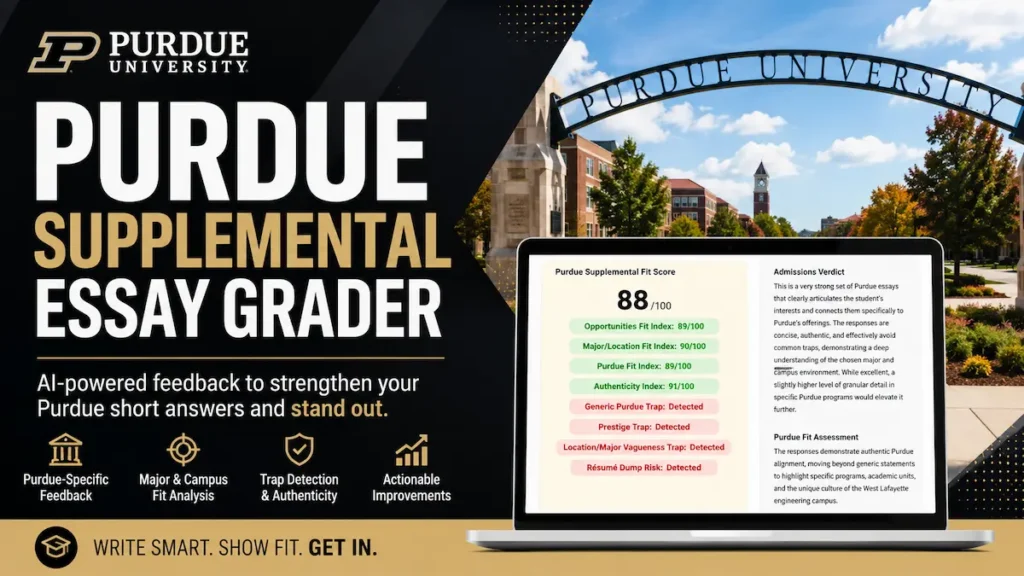
The Purdue Supplemental Essay Grader helps students review their Purdue University short answers before submitting a Fall 2027 application.
Purdue's supplemental questions require more than a generic “Why Purdue?” response. Applicants need to explain how specific Purdue opportunities support their interests both inside and outside the classroom, why their selected major makes sense, and why they want to study at their selected Purdue campus location — Indianapolis or West Lafayette.
If an applicant selects an alternate major, Purdue may also ask for an additional response explaining that alternate academic path and campus location.
Because Purdue's required short answers are limited to 250 words or fewer, broad praise wastes valuable space. Statements about rankings, reputation, famous programs, or becoming a Boilermaker do little unless they connect to something the applicant genuinely wants to study, build, investigate, contribute, or experience.
A strong Purdue application should instead show:
- specific Purdue opportunities;
- meaningful academic interests;
- credible reasons for the selected major;
- intentional campus-location reasoning;
- applicant-specific motivation;
- concise and controlled writing.
Purdue's current first-year application guidance directs students to apply through the Common Application and answer Purdue-specific questions as part of the application. Applicants should always verify current requirements directly through the official Purdue University Application Guide
Review Your Purdue Supplemental Essays Before Submitting
Use the Purdue Supplemental Essay Grader below to review your Fall 2027 Purdue short answers.
The grader checks whether your responses identify meaningful Purdue opportunities, explain your academic direction, address Indianapolis or West Lafayette appropriately, and use specific evidence instead of generic prestige language.
Review Your Purdue Essays Before Submitting
Purdue Supplemental Essay Grader
Review your Purdue essays and short answers for opportunity fit, major and campus-location fit, Purdue-specific grounding, authenticity, and common essay traps.
Purdue essay focus: Purdue asks how opportunities at Purdue support your interests in and out of the classroom, and why your selected major and campus location — Indianapolis or West Lafayette — fit your goals. Generic Purdue praise, prestige-only reasoning, vague campus-location answers, and résumé dumps will weaken your supplement.
What You’ll Get From Your Purdue Review
See whether your essays form a specific, coherent, and Purdue-ready application profile.
Main Essay Strategy
Purdue Opportunity Fit
Major Motivation
Campus Location Fit
Conditional Honors Review
Improvement Tracking
Paste your Purdue essays below to get your score, criterion-level feedback, next revision action, and saved review.
Optional context. If provided, 250–650 words.
Words: 0 / 650
How will opportunities at Purdue support your interests, both in and out of the classroom? Max 250 words.
Words: 0 / 250
Briefly discuss your reasons for choosing your major and your interest in studying at Indianapolis or West Lafayette. Max 250 words.
Words: 0 / 250
Briefly discuss your reasons for pursuing the alternate major and campus location (Indianapolis or West Lafayette) you have selected. Max 250 words.
Words: 0 / 250
Honors College Essay 1
Explain your vision, ideas or goals for how you hope to shape your honors experience while at Purdue. Please put this in the context of the four pillars which are the foundation of the John Martinson Honors College. Max 500 words.
Honors College Essay 2
Please describe the interdisciplinary nature of your chosen field of study and how it complements or supports other fields. Max 500 words.
Explain your vision, ideas or goals for how you hope to shape your honors experience while at Purdue. Please put this in the context of the four pillars which are the foundation of the John Martinson Honors College. Max 500 words.
Words: 0 / 500
Please describe the interdisciplinary nature of your chosen field of study and how it complements or supports other fields. Max 500 words.
Words: 0 / 500
Elite Second Opinion — 3 Credits
Complete your Primary Review first to unlock an independent second evaluation and side-by-side comparison.
Need more reviews now?
Need more credits?
View all pricing plans →
Instant activation after payment. 1 Universal Credit = 1 comprehensive Purdue supplement review.
What Is the Purdue Supplemental Essay Grader?
The Purdue Supplemental Essay Grader is an AI-powered essay review tool designed specifically for the current Purdue supplemental essay structure.
It does more than check grammar.
The grader evaluates whether each response actually answers its assigned Purdue prompt and whether the writing gives the admission committee useful information about the applicant.
For the required Purdue responses, it looks at areas such as:
- Purdue opportunity specificity;
- connection between Purdue opportunities and applicant interests;
- in-class and out-of-class fit;
- genuine reasons for the selected major;
- Indianapolis or West Lafayette campus fit;
- applicant-owned academic direction;
- prestige-driven reasoning;
- clarity and concision.
Purdue Supplemental Essay Prompts for Fall 2027
For the 2026–2027 application cycle / Fall 2027 admission, Purdue's supplemental structure centers on two required short answers, with an additional conditional alternate-major response where applicable.
Each Purdue response is limited to 250 words or fewer.
Purdue Prompt 1: Opportunities at Purdue
How will opportunities at Purdue support your interests, both in and out of the classroom?
This is more specific than a generic Why Purdue essay.
The prompt explicitly asks about opportunities at Purdue.
That means a strong response should normally identify actual opportunities and explain why they matter.
Those opportunities might include:
- academic programs;
- undergraduate research;
- project-based learning;
- design facilities;
- specific courses;
- laboratories;
- entrepreneurship;
- community engagement;
- student organizations;
- professional experiences;
- multidisciplinary programs.
A Purdue resource becomes useful in an essay only when the applicant explains what they would actually do with it and how it connects to an existing interest.
Purdue Prompt 2: Major + Campus Location
Purdue also asks applicants to explain their reasons for choosing their major and their interest in studying at their selected campus location:
- Indianapolis, or
- West Lafayette.
This is important because the response has two jobs.
You need to explain:
- 1 Why this major?
- 2 Why this Purdue campus location?
A strong major explanation should come from an applicant-owned reason: an experience, question, project, problem, intellectual interest, creative process, job, family experience, or other source of academic direction.
A strong campus explanation should then show why Indianapolis or West Lafayette makes sense for that direction.
Purdue Alternate Major + Campus Location Essay
Applicants who select an alternate major may receive an additional conditional response asking why they are interested in that alternate major and selected campus location.
The Purdue alternate major essay should not sound like:
“I chose this because it might be easier to get into.”
A strong alternate-major response explains why the second academic path is genuinely plausible for the applicant.
The alternate major does not need to be almost identical to the first choice.
It simply needs credible academic or career reasoning.
What the Purdue Supplemental Essay Grader Checks
The Purdue Supplemental Essay Grader evaluates each prompt differently.
Purdue Opportunities: Specific Purdue Opportunities
Does the applicant identify actual Purdue opportunities?
A vague statement such as:
“Purdue has great research and student organizations.”
provides very little information.
A stronger response identifies something real and relevant.
For example, an engineering applicant interested in iterative physical design might meaningfully connect that interest to the Bechtel Innovation Design Center or to a program such as EPICS.
The important part is not the number of Purdue names.
It is the quality of the connection.
Connection to Applicant Interests
Why does this opportunity matter to you?
A laboratory, research program, course, or club should not be included merely because it sounds impressive.
The reader should understand what existing interest, question, skill, project, or goal makes that opportunity relevant.
In- and Out-of-Classroom Fit
Prompt 1 explicitly references both contexts.
The essay does not necessarily need a perfectly equal 50/50 split, but it should meaningfully address how Purdue will support the applicant beyond a single dimension.
For example:
- coursework + engineering design team;
- research + student organization;
- classroom study + community engagement;
- entrepreneurship coursework + startup ecosystem.
Why Specific Purdue Opportunities Matter
Our Production validation showed an important distinction.
A response that said only that Purdue had a strong “project-based engineering culture,” multidisciplinary projects, and engineering organizations was still too broad.
A stronger response became meaningfully Purdue-specific by connecting the applicant's engineering interests to concrete opportunities such as the Bechtel Innovation Design Center and EPICS.
This is the difference between specificity and name-dropping.
Weak name-dropping:
“Purdue has Bechtel, EPICS, great research, great professors, and many clubs.”
Better:
explain why a prototyping environment matters because your previous engineering experiences taught you that a design that works on paper may still fail under real maintenance, material, or operating constraints.
Avoid the Generic Purdue Trap
Some of the weakest Purdue supplemental essays rely almost entirely on general praise.
Examples include:
- “Purdue has many opportunities.”
- “Purdue is one of the best universities.”
- “Purdue has excellent professors.”
- “I want to become a Boilermaker.”
- “Purdue has a strong reputation.”
- “Purdue graduates work at great companies.”
Those statements could describe thousands of applicants.
They tell the admission committee almost nothing about why Purdue fits this particular student.
Instead, ask:
What would I actually do at Purdue?
and:
Why does that activity matter given what I already care about?
Do Not Turn Prompt 1 Into a Resource List
There is another failure mode at the opposite extreme.
Some applicants research Purdue thoroughly and then cram the essay with:
- five programs;
- three labs;
- four clubs;
- course numbers;
- professors;
- special facilities.
A list proves that you searched Purdue's website.
It does not prove meaningful fit.
One well-developed opportunity may be more valuable than six superficial references.
A useful pattern is:
existing interest → Purdue opportunity → intended action → expected growth
For example:
I became interested in how physical systems fail outside controlled conditions. At Purdue, Bechtel would give me a place to prototype and test designs rather than leaving them as calculations.
How to Write the Purdue Major Essay
The second required Purdue response begins with your reasons for choosing your major.
Avoid broad statements such as:
- “Technology is the future.”
- “I have always loved engineering.”
- “Business is my passion.”
- “Psychology helps people.”
- “I enjoy solving problems.”
- “Computer science has great career opportunities.”
These ideas may be true, but they do not establish a strong personal reason for the field.
A more effective answer provides evidence.
That evidence could come from:
- a project;
- a classroom experience;
- an independent investigation;
- something you built;
- something that failed;
- a job;
- research;
- family responsibilities;
- volunteering;
- artistic work;
- a question you kept returning to.
Prestige Is Not a Reason for a Major
Career outcomes can matter.
But a response dominated by:
- salary;
- job availability;
- famous employers;
- rankings;
- prestige;
will usually be weaker than one focused on substantive academic motivation.
Consider:
“I want to study computer science because technology companies offer excellent salaries and many jobs.”
versus:
“Debugging a scheduling program made me interested in how small assumptions in an algorithm can produce unexpected behavior across a larger system.”
The second gives the reader an intellectual reason.
The first mostly describes the labor market.
The Purdue essay grader distinguishes between the two.
Why the Campus Location Matters
One of the most important updates to Purdue's current prompt structure is that applicants should not treat the major response as a simple old-style “Why Major?” essay.
The selected campus location matters too.
A student can write an excellent major explanation and still leave the prompt incomplete if the essay barely addresses Indianapolis or West Lafayette.
How to Write About West Lafayette
A weak West Lafayette explanation says:
“I chose West Lafayette because it is Purdue's main campus and has a great reputation.”
That is mostly status.
A stronger explanation connects the campus environment to something the applicant wants.
Possible themes might include:
- research;
- hands-on design;
- student technical organizations;
- campus academic ecosystem;
- laboratory work;
- project communities;
- residential campus experience;
- multidisciplinary collaboration.
How to Write About Purdue Indianapolis
Indianapolis should not be treated as a lesser or secondary version of Purdue.
Purdue's own Indianapolis materials describe specialized laboratories, the Indianapolis Makerspace, professional-practice resources, experiential education, student services, and a downtown urban environment.
A strong Purdue Indianapolis essay might therefore connect the location to:
- urban professional exposure;
- industry;
- healthcare;
- technology;
- community organizations;
- city-based applied work;
- experiential education.
Indianapolis and West Lafayette Are Both Valid Choices
Do not write as though West Lafayette is the “real Purdue” and Indianapolis is an alternate option that needs to be defended.
The purpose of the location component is fit.
A student who wants an urban professional environment may have compelling reasons for Indianapolis.
Another who wants a more traditional large-campus academic ecosystem may have compelling reasons for West Lafayette.
The Purdue Supplemental Essay Grader evaluates the reasoning, not which location you chose.
How to Write the Purdue Alternate Major Essay
If your application includes an alternate-major response, treat it seriously.
Avoid:
“My alternate major is Data Science because it is also a good career.”
For example, a first-choice Computer Science applicant could still have a credible alternate interest in Statistics because they are drawn to inference, modeling, and data-driven decisions.
Or a Mechanical Engineering applicant might genuinely consider another engineering field because a particular problem interests them from multiple technical perspectives.
The alternate choice does not need to be a weaker version of the first choice.
It needs to be plausible.
Avoid the “Easier Admission” Trap
Do not frame an alternate major primarily as:
- easier to enter;
- less competitive;
- a backup;
- a pathway to transfer into the preferred major later.
Admissions strategy may influence an applicant's choices privately, but the response itself should explain why the alternate academic path is one the student could genuinely pursue.
Purdue Supplemental Essay Examples: What Makes an Approach Strong?
Students searching for Purdue supplemental essay examples should focus on structure and reasoning rather than copying another student's programs or activities.
A strong Purdue Opportunities response often follows:
interest → specific Purdue opportunity → intended engagement → benefit
A strong Major + Campus response often follows:
experience/question → reason for major → academic direction → reason for selected location
A strong alternate-major response often follows:
alternate academic interest → reason it matters → selected campus → plausible future direction
These are not mandatory templates.
They are diagnostic frameworks.
Example: Weak Purdue Opportunities Approach
“Purdue has excellent academics, great professors, many clubs, and amazing research. I want to take advantage of everything Purdue offers.”
Example: Stronger Purdue Opportunities Approach
A stronger applicant might explain that repairing equipment revealed an interest in design reliability and then connect that interest to a specific Purdue prototyping or design opportunity.
Now the university resource is meaningful because the reader already understands why the student needs it.
Example: Weak Major + Campus Approach
“I chose computer science because technology has many jobs. I chose West Lafayette because it is Purdue's main campus and has a great reputation.”
Example: Stronger Major + Campus Approach
A stronger response might describe a specific computing problem that developed the student's interest, then explain why a particular West Lafayette or Indianapolis environment supports the next stage of that exploration.
Again:
student first, Purdue second.
What About the Common App Essay?
Purdue first-year applicants apply through the Common Application, which includes the personal essay as part of the broader application process. Purdue's official application materials describe the application essay and Purdue-specific questions as components of review.
However, this product is the Purdue Supplemental Essay Grader.
The Common App essay is therefore not required to run the Purdue supplemental review.
If the grader provides a Common App field as optional context, you may leave it blank and review only the Purdue responses.
This distinction is important.
You should not need to paste an unrelated personal essay simply to receive feedback on your Purdue short answers.
John Martinson Honors College Essays
Applicants to the John Martinson Honors College may have additional writing requirements.
The Purdue grader can support Honors responses when that pathway is selected, but those essays are conditional rather than requirements for every Purdue applicant.
If you are not applying to Honors College, you should not write or submit Honors responses merely for the grader.
For Honors applicants, strong responses should still prioritize substance over generic language such as:
- “I want to become a leader.”
- “I enjoy interdisciplinary learning.”
- “I want to challenge myself.”
- “I want to meet motivated students.”
Avoid Repeating the Same Story Across Purdue Essays
Your Purdue essays will naturally share themes.
That is fine.
An engineering applicant may mention engineering in both responses.
A CS applicant may refer to the same broad technical interests.
An Indianapolis applicant may discuss the city more than once.
That is not automatically repetition.
The problem occurs when multiple essays substantially reuse:
- the same anecdote;
- the same event description;
- the same accomplishment narrative;
- the same distinctive sentence;
- the same detailed example.
How the Purdue Supplemental Essay Grader Scores Your Essays
The Purdue Supplemental Essay Grader uses a 100-point review structure.
The exact criteria vary by prompt.
For Purdue Opportunities, the review considers factors such as:
- specific Purdue opportunities;
- connection to applicant interests;
- in- and out-of-classroom fit;
- clarity and control.
For Major + Campus Location, it considers:
- genuine reason for the major;
- campus-location fit;
- specificity over prestige;
- clarity and control.
A beautifully written but generic response can still score poorly.
Likewise, a straightforward essay can score highly if it contains strong evidence and directly answers the question.
What Purdue Essay Scores Mean
The score should be read together with the feedback rather than as an admissions prediction.
A high score generally indicates that the response:
- answers the actual prompt;
- uses specific Purdue opportunities where the prompt asks for them;
- provides strong applicant-owned reasoning;
- addresses campus location meaningfully;
- avoids excessive prestige language;
- uses its limited space effectively.
The Purdue Essay Grader Does Not Predict Admission
The Purdue Supplemental Essay Grader is a writing-review tool.
It does not calculate:
- admission probability;
- acceptance likelihood;
- applicant readiness;
- chance of admission.
Common Purdue Supplemental Essay Mistakes
Common problems include:
- saying Purdue has “many opportunities” without naming any;
- listing Purdue opportunities without explaining why they matter;
- discussing only academic opportunities and ignoring the outside-classroom part of Prompt 1;
- discussing only clubs;
- writing a generic Why Major response;
- ignoring the selected campus location;
- mentioning Indianapolis or West Lafayette without meaningful reasoning;
- relying on rankings or reputation;
- emphasizing salary and famous employers;
- using “top engineering school” as academic motivation;
- treating the alternate major as an admissions backup;
- repeating the same narrative across multiple responses;
- writing content reusable for virtually any university.
How to Improve Your Purdue Supplemental Essays
Improve Purdue Opportunities
Find every Purdue resource in your essay.
For each one, ask:
Why is this here?
If the answer is merely:
“because it proves I researched Purdue,”
remove it or develop the connection.
Then ask:
What would I actually do through this opportunity?
Improve Your Major Explanation
Find the sentence where you explain why you chose the field.
Ask:
What evidence supports this claim?
If your entire rationale is “I enjoy problem solving,” add the experience or question that proves it.
Improve Your Campus-Location Explanation
Cover the campus name and ask:
Would this sentence still work if I replaced Indianapolis with another large city or West Lafayette with another college town?
If yes, your location reasoning may still be generic.
Improve the Alternate-Major Response
Ask:
Would I genuinely be willing to study this field?
Then explain why.
Do not spend limited space defending why it is your second choice.
Frequently Asked Questions About Purdue Supplemental Essays
How many Purdue supplemental essays are required for Fall 2027?
The current Purdue supplemental structure includes two required short-answer responses, with an additional conditional alternate-major response when applicable.
What is the Purdue supplemental essay word limit?
The required Purdue short answers are 250 words or fewer.
What is the first Purdue essay about?
It asks how opportunities at Purdue will support your interests both inside and outside the classroom.
What is the second Purdue essay about?
It asks why you selected your major and why you are interested in studying at your selected Purdue campus location — Indianapolis or West Lafayette.
Does Purdue have an alternate-major essay?
Applicants selecting an alternate major may receive an additional conditional response about that alternate major and campus location.
Does Purdue require a Why Purdue essay?
The opportunities prompt functions partly as a Purdue-specific fit essay, but it is more precise than the traditional generic “Why this university?” question.
It asks how actual Purdue opportunities support your interests.
Do I need to name Purdue programs?
For Prompt 1, meaningful Purdue specificity is important because the question explicitly asks about Purdue opportunities.
You do not need a long list.
One or two well-chosen opportunities explained thoughtfully can be stronger than many superficial names.
Should I mention both in-class and out-of-class opportunities?
Yes. That distinction appears directly in the prompt.
The discussion does not need to be perfectly equal, but both sides should be meaningfully addressed.
Do I have to write about West Lafayette?
No.
Your location response should correspond to the Purdue campus selected in your application.
Indianapolis and West Lafayette are both valid paths.
Is the Common App essay required in the Purdue Supplemental Essay Grader?
No.
The Purdue supplemental grader can review the Purdue-specific responses without requiring the Common App essay.
Can the grader review Honors College essays?
If the current grader presents the Honors College pathway, those responses can be reviewed when applicable.
They are not required for applicants who are not applying to Honors.
Does the Purdue Supplemental Essay Grader predict whether I will get admitted?
No.
It evaluates your essay responses, not your admission probability.
Use the Purdue Supplemental Essay Grader Before You Submit
The Purdue Supplemental Essay Grader gives Fall 2027 applicants a practical way to test whether their Purdue short answers are specific enough before submission.
Strong Purdue essays do not simply say that the university is prestigious or full of opportunities.
They explain:
- which opportunities matter;
- why they matter to this applicant;
- why the selected major makes sense;
- why Indianapolis or West Lafayette fits;
- what the student hopes to do with those opportunities.
If you selected an alternate major, that response should reveal genuine academic logic rather than backup-only reasoning.
Use the grader to identify vague Purdue praise, shallow resource lists, weak major motivation, generic campus reasoning, prestige-driven language, and repeated narrative material before submitting your Fall 2027 application.
Then revise until every Purdue-specific reference has a reason to be there.
Explore More STEM and Tech Essay Graders
Applying to other STEM-focused or highly selective universities? Review more school-specific essay graders below to compare your supplemental essays across top engineering, technology, and research-driven programs.
You can also explore Ivy League, public university, and specialized essay graders to see how your academic direction, personal story, and school-specific evidence change across different applications.s built around that school’s current prompts, admissions priorities, and common essay traps.